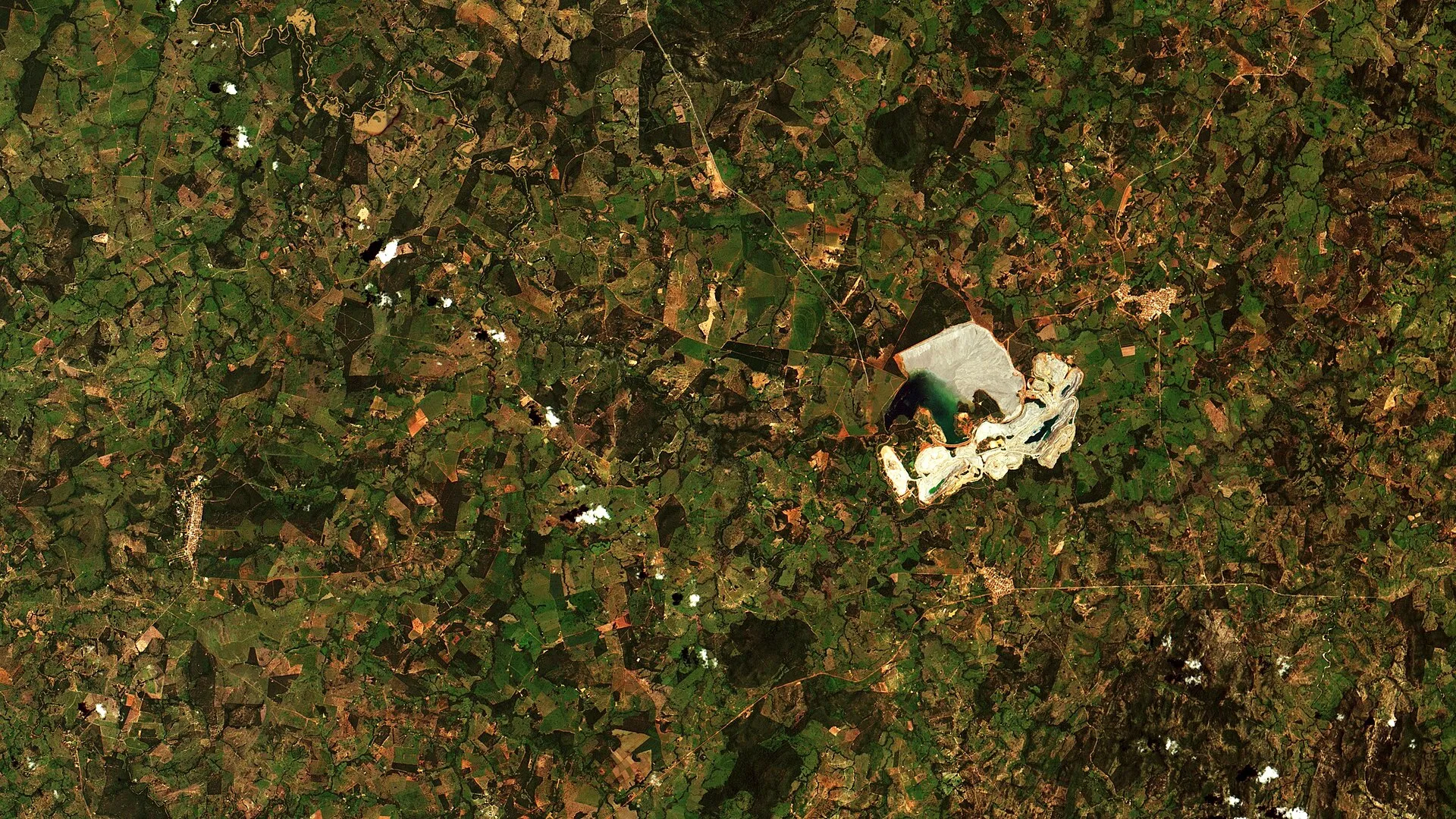
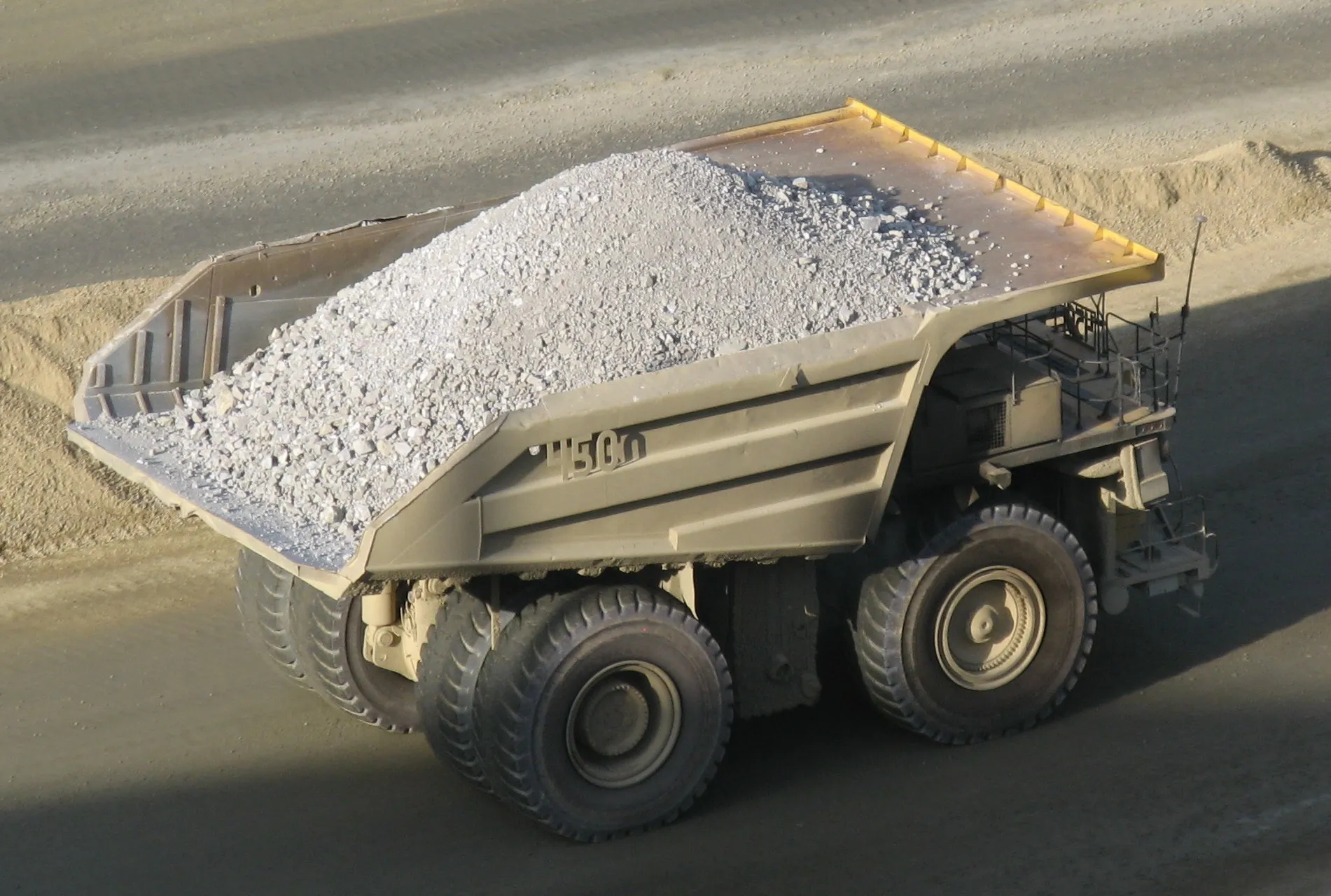
Open-pit vs. underground mining: what are the differences
How engineers choose between open-pit and underground mines, what benches and drifts are, the main mining methods and when a pit turns into a tunnel.
Translated from the original article in Portuguese. Read the original.
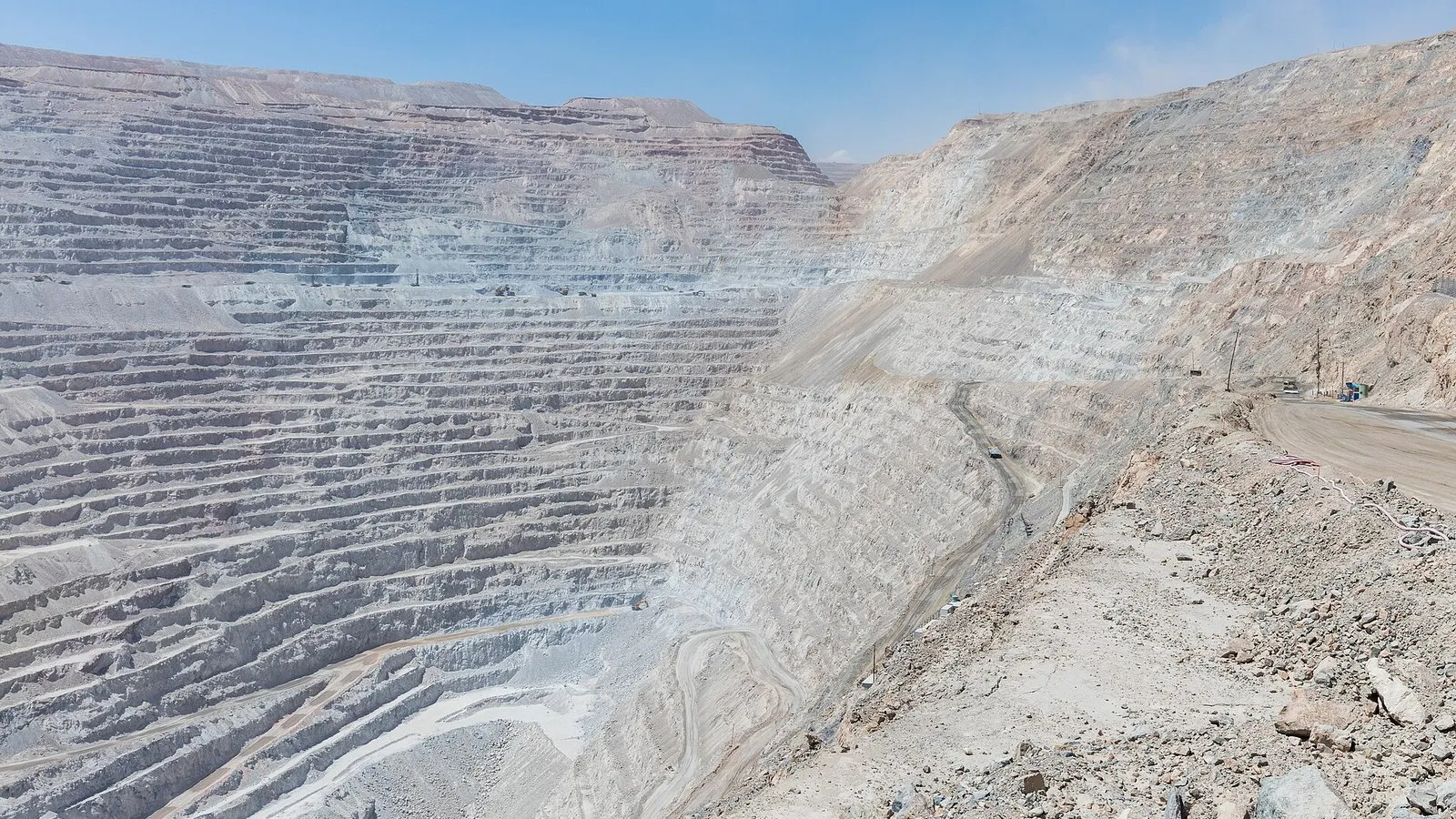
The difference between an open-pit mine and an underground mine is the path to the ore. In the first, whatever lies on top is removed and a stepped pit is opened. In the second, the ore is reached through shafts, ramps and tunnels. The choice depends on the depth and shape of the deposit and on how much each path costs.
In short
- Open-pit: the pit goes down in steps, the benches. In general, it is the cheapest method per ton.
- Underground: access is through shafts, ramps and drifts. It suits deep or narrow deposits.
- The key calculation is the stripping ratio: how much worthless rock comes out for each ton of ore.
- Underground, Brazil’s NR-22 safety standard requires mechanical ventilation and at least two exit routes to the surface.
- Many mines start as open pits and then continue underground.
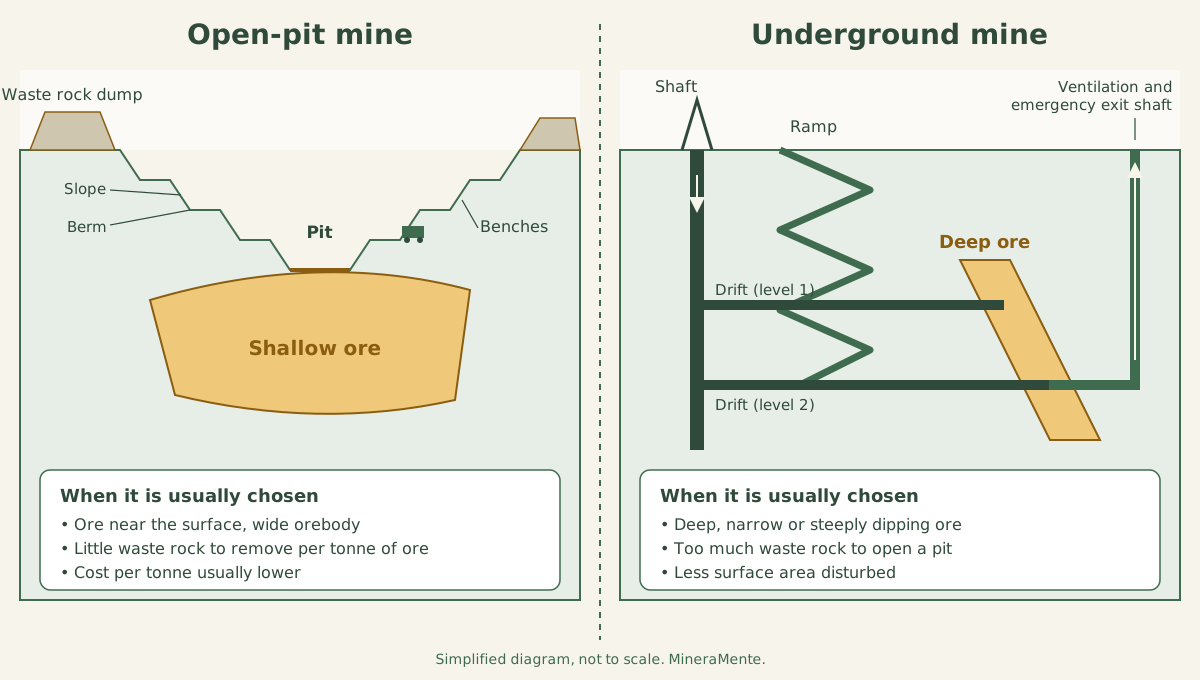
What changes between the two types of mine
The stages of a mine, from exploration to closure, are covered in How a mine works: from discovery to closure. Here, what changes is the mining itself (lavra, the Portuguese technical term for extraction):
| Open-pit | Underground | |
|---|---|---|
| Access | From the surface | Through shafts, ramps or tunnels |
| Typical deposit | Shallow and extensive | Deep, narrow or inclined |
| Cost per ton | Generally the lowest | Higher |
| Productivity (US) | About three times higher, in tons per worker per hour | Lower |
| Footprint on the surface | Pit and waste rock piles | Smaller, but the ground may sink |
The mining engineering course at Pennsylvania State University (Penn State), in the US, sums it up: if there were a choice, mining would always be open-pit, because it is cheaper. Often, however, the ore is too deep. In the US, less than 10% of mines are underground.
How engineers choose between open-pit and underground
There is no fixed depth at which a mine “turns” underground. The decision weighs four points.
1. Depth and shape of the ore body. A 2015 article by researchers from UFRGS (the Federal University of Rio Grande do Sul), in Rem: Revista Escola de Minas, points to these two factors, along with economic viability, as the main ones. A wide, shallow deposit favors a pit. A narrow, deep vein favors underground mining.
2. Stripping ratio. To mine from the surface, you have to remove the waste rock, the worthless rock lying above or beside the ore. The deeper the pit, the more waste rock comes out per ton of ore. Engineers compare this ratio with a maximum allowable ratio, calculated from the cost of mining one ton underground, the cost of mining one ton in the pit and the cost of removing one ton of waste rock. Below the limit, the pit pays off.
3. Cost and time. The deeper the pit, the more expensive it is to haul material to the processing plant. An underground mine, on the other hand, requires digging access routes before it can produce: according to Penn State, a shallow deposit can start being mined within weeks, while accessing a deep one can take months or more than a year.
4. Environmental and social constraints. Some deposits cannot be mined as open pits because of environmental or social limits, and underground becomes the only option.
The answer varies case by case. In the Jequitinhonha Valley, in the Brazilian state of Minas Gerais (MG), according to the ANM (Brazil’s National Mining Agency), CBL’s Cachoeira Mine, in Itinga and Araçuaí, is underground, and Sigma’s Grota do Cirilo Mine, in Itinga, is open-pit. Both mine lithium in pegmatites. See What is lithium, what is it used for and where Brazil produces it.
What an open-pit mine looks like: pit and benches
The pit goes down in steps, the benches. Under NR-22, each bench has a berm, the floor, and a face (slope), the inclined wall. The steps give access to people and machines and serve as a working platform. The dimensions and the angle of the walls depend on the stability of the rock: steeper walls reduce waste rock but increase the risk of slope failure.
The cycle includes drilling and blasting with explosives (when needed), loading with excavators and hauling with trucks or conveyor belts. At the S11D complex, in Canaã dos Carajás, in the state of Pará (PA), Vale replaced trucks with excavators and mobile crushers linked by about 30 km of conveyor belts. According to the company, this was only possible because the ore body is long (9.5 km by 1.5 km, 300 m deep) and relatively homogeneous.
What an underground mine looks like: shafts, ramps and drifts
The main access routes are:
- Shaft: a vertical or nearly vertical opening through which people, materials and ore pass, usually with cable-hoisted transport systems.
- Ramp: an inclined tunnel that trucks and machines drive down, usually with a gradient of 1 in 7 or 1 in 8, according to Penn State.
From them, the mine is organized into levels connected by drifts. AngloGold Ashanti’s Cuiabá gold mine, in Sabará (MG), is about 1,600 meters deep, with 330 km of drifts and a main ramp 26 km long, according to the company’s president for Latin America, in May 2026.
The main underground mining methods
Penn State divides the methods into three families, according to how the rock is supported.
Room and pillar (no artificial support). Rooms are opened and pillars of the ore itself are left to hold up the roof, like columns. Only part of the deposit is removed. The method requires a more or less flat deposit, such as layers of coal, salt, potash and limestone. In the US, about 90% of underground mines use it, counting coal mines.
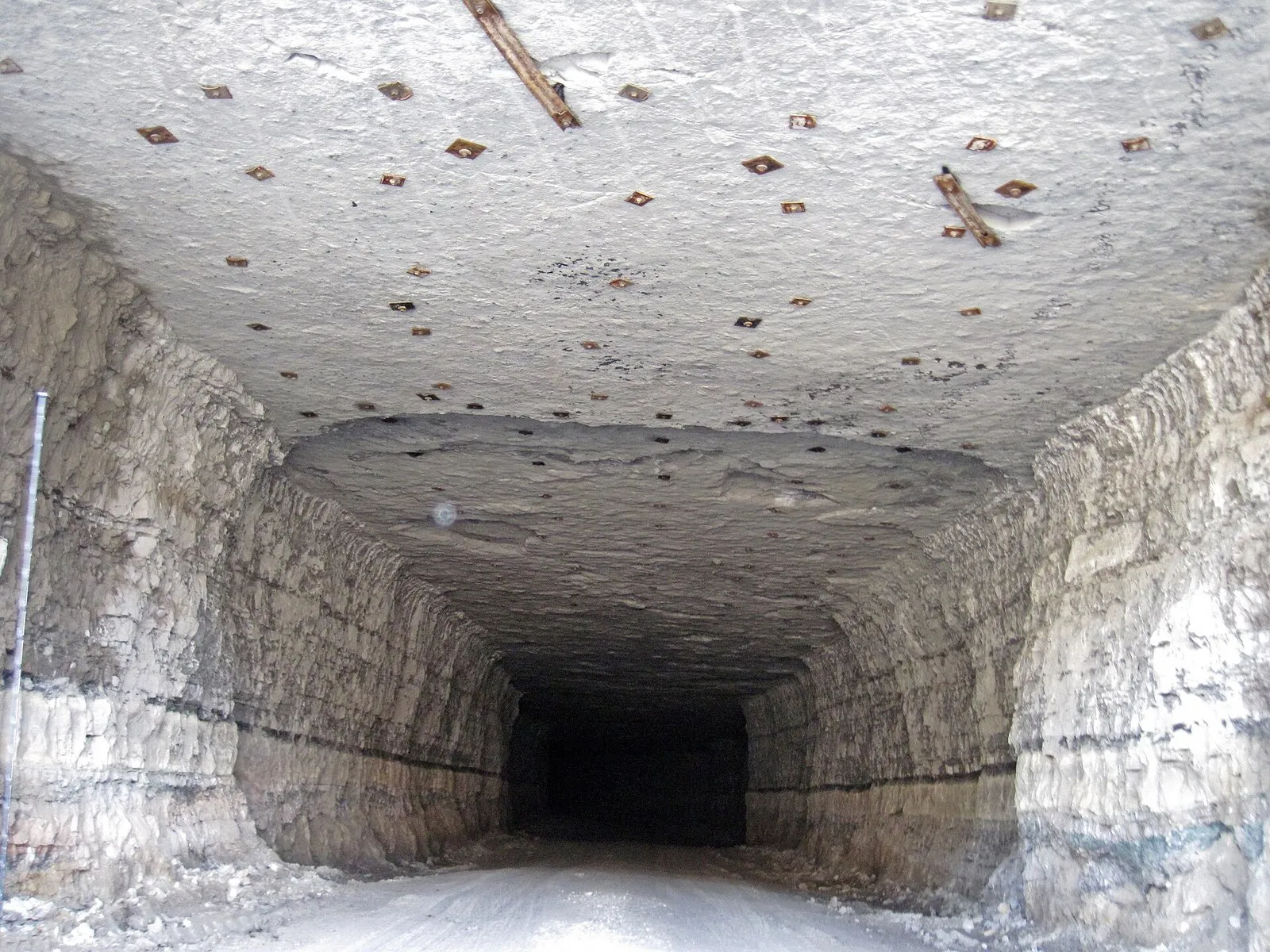
Cut and fill (supported). The ore is removed in sections, and each void is filled with broken rock or a mixture of cement and waste rock, which then carries the load. It is expensive but very selective, which is why it is common in gold and silver veins.
Caving (controlled collapse). A large block of ore is undercut so that it collapses under its own weight, and the broken material is collected at drawpoints below. It suits large, massive, low-grade deposits, such as some copper deposits. When the collapse reaches the surface, the ground sinks (subsidence).
Safety: what NR-22 requires
NR-22, Brazil’s mining safety standard issued by the Ministry of Labor and Employment, applies to both types of mine. Its text comes from MTE Ordinance No. 225/2024 and was amended by, among others, MTE Ordinance No. 105, of January 2026. Some points:
- Ventilation: every underground mine needs mechanical ventilation designed by a qualified professional, to supply oxygen, dilute gases and dust and keep temperature and humidity at suitable levels. Where there are people, oxygen cannot fall below 19% of the air volume.
- Engines: underground, combustion engines may only be diesel, with effective ventilation.
- Exits: an active underground mine must have at least two separate access routes to the surface, so that an emergency in one does not block the other.
- Rock stability: cracks at the top of benches, in the pit, and loose blocks in the roof or broken pillars, underground, are warning signs. The standard requires stopping work and moving workers away.
Planning these measures is one of the tasks described in What does a mining engineer do (and what the profession is like).
Which one has a bigger impact on the environment?
An open-pit mine takes up more area, with the pit, waste rock piles and roads. An underground mine generally disturbs the surface less, but it can cause ground subsidence and affect groundwater. When there are rivers or towns above, a supported method such as cut and fill is preferred, which can also return waste rock and tailings to the mine. More on this topic in Environmental impacts of mining: what they are and how they can be reduced.
When a pit becomes an underground mine
Many pits reach a point where going deeper no longer pays off: waste rock grows and haulage gets more expensive. If there is still ore below, mining can continue through tunnels. The hard part is knowing when to switch. According to the UFRGS study, stopping the pit too early or deepening it beyond the ideal point can make the combination unviable. In the gold deposit analyzed, the best result came from a pit smaller than the “optimal” one, followed by underground mining.
The best-known example is Chuquicamata, in Chile. According to the state-owned company Codelco, after 104 years as an open pit, the mine opened an underground block caving operation in August 2019, with three levels more than 898 meters below the bottom of the pit. The company says this extends the life of the mine by at least 40 years.
Frequently asked questions
What is the difference between an open-pit and an underground mine?
In an open-pit mine, the ore is removed from the surface, in a stepped pit. In an underground mine, access is through shafts, ramps and drifts.
What is the stripping ratio?
It is the amount of waste rock, the worthless rock, removed for each ton of ore. The higher it gets, the less open-pit mining, which is generally the cheapest, pays off.
Is underground mining more dangerous?
Underground mining has its own risks, such as gases and blocks falling from the roof. That is why Brazil’s NR-22 standard requires mechanical ventilation, a minimum of 19% oxygen and at least two exits. A pit also requires monitoring, because of the risk of slope failure.
Can a mine switch from open-pit to underground?
Yes. When the pit gets too deep to pay off, mining can continue beneath it, as at Chuquicamata, in Chile, since 2019.
Found this article useful? Share it with someone who also wants to understand mining.
Share
Sources
- Penn State University – MNG 230 Introduction to Mining Engineering, Module 9: Surface Mining
- Penn State University – MNG 230 Introduction to Mining Engineering, Module 10: Underground Mining
- De Carli and Peroni (UFRGS) – Project optimization, Rem: Revista Escola de Minas, v. 68, n. 1 (2015)
- Brazil's Ministry of Labor and Employment – NR-22, Occupational Safety and Health in Mining (text of MTE Ordinance No. 225/2024)
- Brazil's Ministry of Labor and Employment – MTE Ordinance No. 105, of January 29, 2026 (amends NR-22)
- ANM – Sumário Mineral Brasileiro 2025 (Brazilian Mineral Summary 2025, base year 2024), Lithium chapter
- Vale – S11D: largest iron ore project in Vale's history (November 23, 2015)
- Itatiaia – AngloGold uses remote technology in a mine with 330 km of drifts and 1,600 meters deep (May 20, 2026)
- Codelco – Codelco inaugura Chuquicamata Subterránea, una de las minas más modernas (Codelco opens Chuquicamata Underground, one of the most modern mines; August 14, 2019)
- Codelco – Proyecto Chuquicamata Subterránea (Chuquicamata Underground Project)
Comments
No comments yet. Be the first to comment.