How rare earths are separated: the hardest step in the chain
Understand rare earth separation: why nearly identical elements are so hard to split, how solvent extraction works and who dominates this step.
Translated from the original article in Portuguese. Read the original.
Getting rare earths out of the ground is just the beginning. They come out of the mine mixed together, and rare earth separation into individual elements, such as neodymium and dysprosium, is the hardest and most concentrated step in the chain. The reason is chemical: these elements are so similar that industry has to repeat the same operation dozens or hundreds of times to isolate each one.
In short
- From ore to magnet, separation comes after concentration and chemical cracking, and before the production of metals, alloys and magnets.
- Separation is hard because rare earths have very similar chemical behavior, with small, gradual differences in ion size.
- The main method is solvent extraction, carried out in circuits that can have hundreds of mixer-settlers.
- The process consumes a lot of acid, caustic soda and water and has to deal with thorium and uranium.
- China handles most of the separation. Brazil is still at the research stage.
The path from mine to magnet
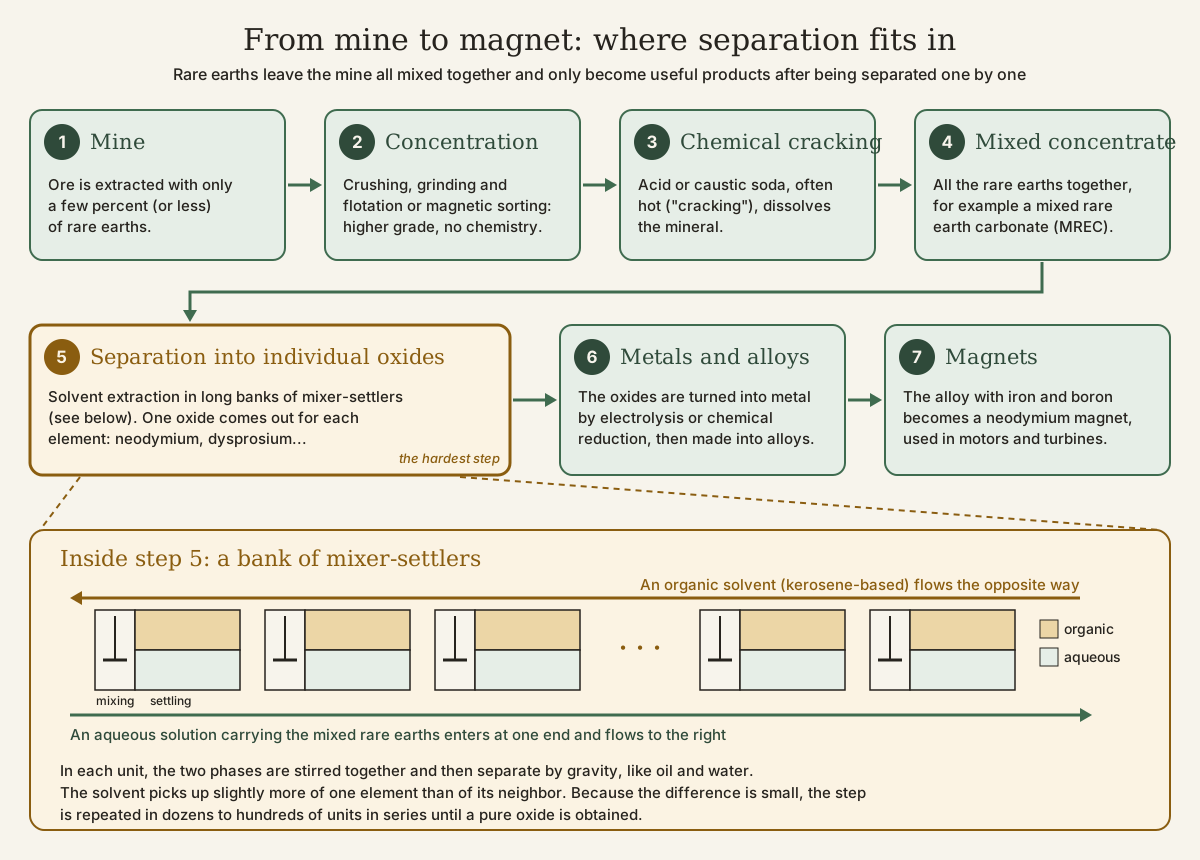
Rare earths are 17 elements used mainly in magnets (see Rare earths: what they are, what they’re used for and why they matter to Brazil). According to the US Department of Energy (DOE) and the country’s Environmental Protection Agency (EPA), the path to the magnet has these steps:
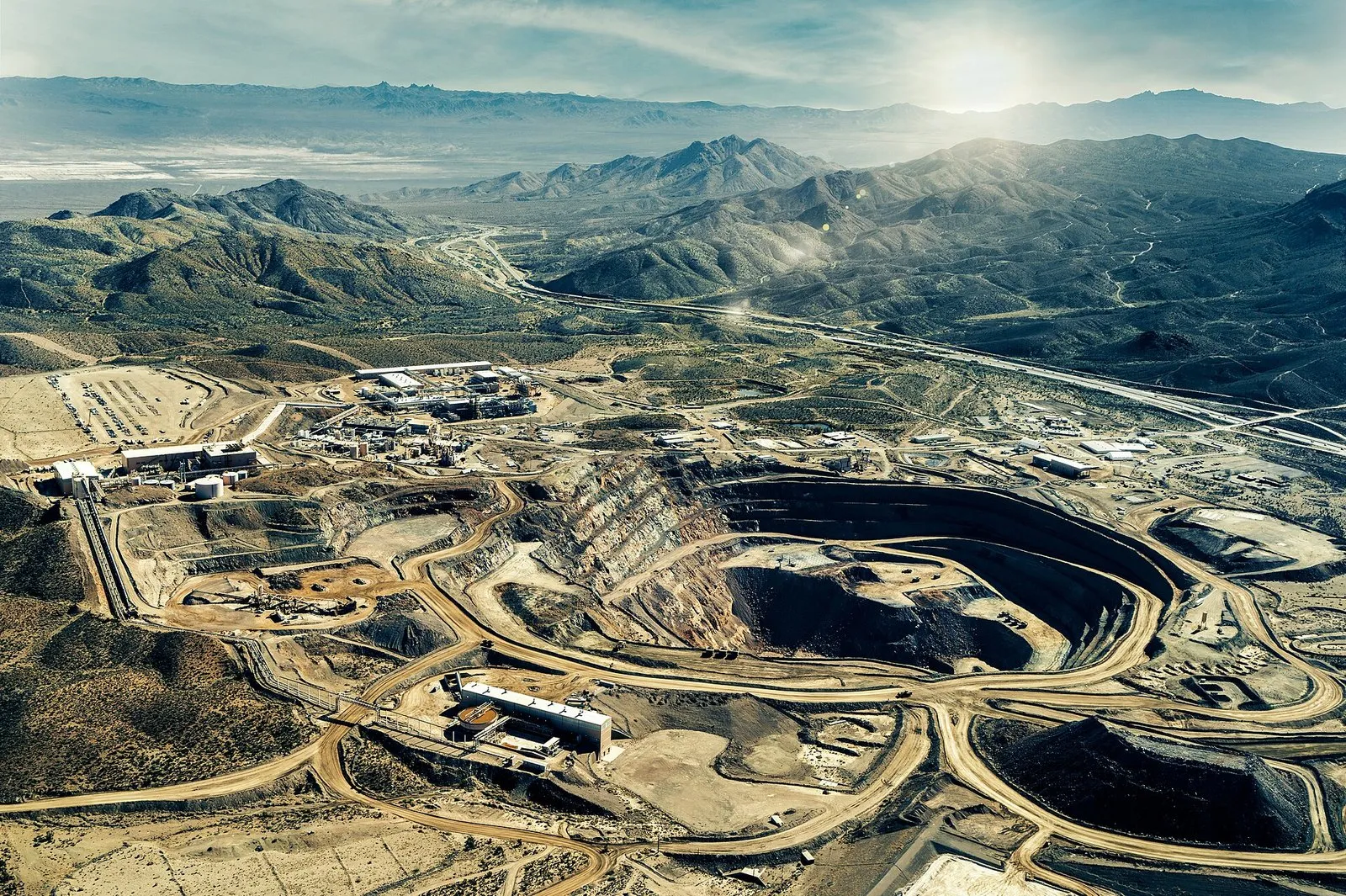
- Mine and concentration. The ore is crushed, ground and concentrated by flotation or by magnetic or gravity separation, usually without any chemical change. At Mountain Pass, in California, the EPA’s 2012 report records that the grade rose from about 7% to 60% rare earth oxides. See How a mine works: from discovery to closure.
- Chemical cracking. The concentrate is attacked so that the mineral dissolves. According to the DOE, bastnaesite requires high-temperature cracking with sulfuric acid or other reagents. For monazite, the EPA cites digestion with caustic soda.
- Mixed concentrate. A product with all the rare earths together, such as the mixed rare earth carbonate (MREC) planned for the Caldeira Project. In ionic clays, the cracking is simpler, using a salt solution.
- Separation. The mixed concentrate becomes individual oxides: one of neodymium, another of dysprosium, and so on.
- Metals and alloys. The oxides are turned into metal. According to the DOE, the most common processes are electrolysis and reduction with sodium.
- Magnets. The alloys become neodymium-iron-boron magnets.
Why separation is so hard
According to the EPA, the chemical behavior of all rare earths is very similar, with small variations linked to atomic number and ionic radius (the size of the ion), which decreases as the atomic number increases. This gradual shrinking along the series is called the lanthanide contraction.
Neighbors on the periodic table are almost indistinguishable. The DOE highlights the case of neodymium and praseodymium, which are especially hard to separate. That is why many magnets use the two together, in an alloy called didymium.
The difficulty is old. According to a biography of American chemist Frank Spedding published by the US National Academy of Sciences, chemists historically could separate rare earths only in small quantities, by fractional crystallization, and some cases required hundreds or even thousands of operations.
How solvent extraction works
Today, the main method is solvent extraction (SX), which is a bit like mixing oil and water:
- The aqueous phase is the acidic solution with the rare earths dissolved in it.
- The organic phase is a solvent that does not mix with water. According to the DOE, the most common is kerosene with an extractant, such as di-(2-ethylhexyl) phosphoric acid (D2EHPA).
- The two phases are stirred together in a mixer and then separate by gravity in a settler.
At each contact, the extractant picks up slightly more of one element than of another. According to a 2020 study in the AIChE Journal, with acidic extractants such as D2EHPA, extraction increases with atomic number, a reflection of the lanthanide contraction. That is why the units are connected in series, with the two phases flowing in opposite directions.
According to the DOE, these circuits can have hundreds of mixer-settlers, and separating neodymium from praseodymium alone may require 30 units. An article published in Nature in 2023 mentions “tens or even hundreds of stages” to obtain high-purity individual oxides.
The DOE also describes two shortcuts used in practice. Cerium, which accounts for a large part of the material, is usually removed first by oxidation, which reduces the size of the equipment. And separation starts by splitting the light rare earths (such as neodymium and praseodymium) from the heavy ones (such as dysprosium and terbium), before the subsequent separations.
Are there other routes?
Yes, but solvent extraction remains the main one at industrial scale, according to the DOE.
Ion exchange. This was the route that made pure rare earths available. According to Spedding’s biography, his team at the Ames Laboratory, in the US, used ion exchange columns and later the reagent EDTA, which led to a pilot-scale operation in 1953.
Proteins that recognize metals. In 2023, American researchers reported in Nature a bacterial protein, lanmodulin, capable of separating neodymium from dysprosium in a single step in a column, with purity above 98% for each element. It is a laboratory result.
New extractants. In February 2026, a research center linked to the DOE announced a process from Oak Ridge National Laboratory that split a mixture of light and heavy rare earths in 4 stages, tested at a scale of several liters.
Waste, acids and radioactivity
According to the DOE, the process consumes large amounts of acid, caustic soda and water, and treating the effluents is one of the main costs. The EPA lists spent solvent and solvent extraction crud, both flammable, among the hazardous wastes.
There is also the radioactivity issue. According to the EPA, ores containing monazite often have high levels of thorium, and the DOE notes that small amounts of uranium and thorium must be separated from the rare earth streams. The EPA points out that proper design, operation and controls greatly reduce the environmental risks.
Who dominates separation
Separation is the most concentrated step in the chain. By the DOE’s estimates for 2020, China had just under 60% of mining, but almost 90% of separation, and close to 100% for heavy rare earths.
The International Energy Agency (IEA) attributed over 90% of rare earth refining to China, according to an Anadolu report from April 2026. The IEA’s Global Critical Minerals Outlook 2026, according to a report on the Investment Monitor website from July 2026, shows that share falling to 85% in 2025, with new projects in the US and the expansion in Malaysia, and projects 70% in 2035 if planned projects move forward.
Who separates rare earths outside China
| Company | Where | What it reports |
|---|---|---|
| Lynas | Kuantan, Malaysia | Processes material from the Mt Weld mine (Australia). In May 2025, it produced dysprosium oxide for the first time and says it is the only commercial producer of separated heavy rare earths outside China. |
| MP Materials | Mountain Pass, US | Produced 917 metric tons of neodymium-praseodymium oxide in the first quarter of 2026, a company record. It has been making magnets in Texas since December 2025. |
| Solvay | La Rochelle, France | Opened a line for magnets in April 2025 and says it has the largest plant outside China capable of separating all the rare earths. |
| Neo Performance Materials | Sillamäe, Estonia | The Silmet plant is one of the few outside China and supplies the company’s magnet factory in Narva, opened in September 2025. |
Table sources: the companies’ own announcements and interviews (see the list of sources).
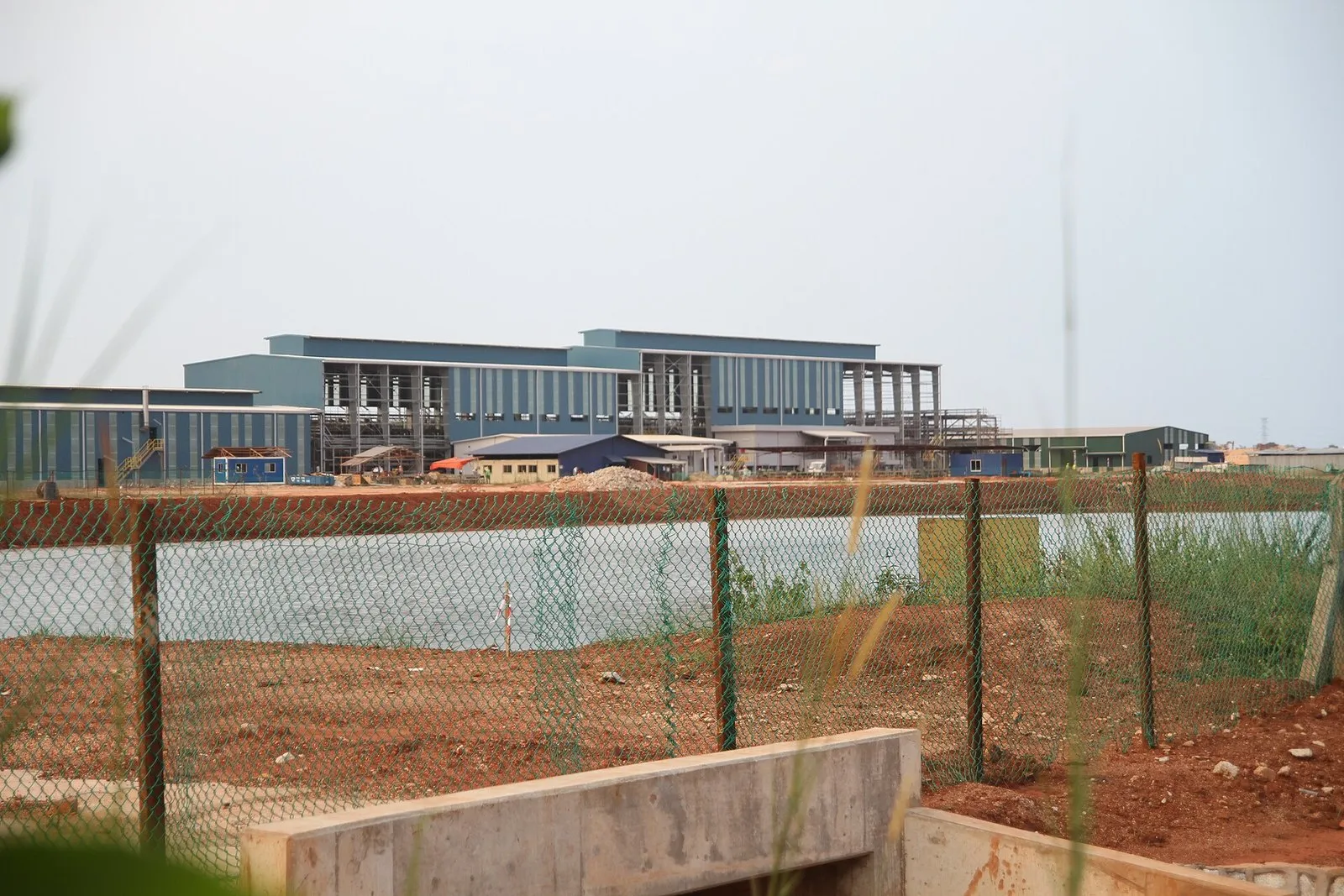
What about Brazil?
Brazil has mines and rare earth projects, but it does not yet separate these elements on a commercial scale.
According to a 2026 article by researchers at the Center for Mineral Technology (CETEM), part of Brazil’s Ministry of Science, Technology and Innovation, the center is developing solvent separation routes for praseodymium, neodymium, terbium and dysprosium and holds a patent for an oxide separation process. CETEM and the Center for Nuclear Technology Development (CDTN) work at laboratory and semi-pilot scale. The authors note that the country does not yet have semi-industrial infrastructure to validate these routes.
A report in Pesquisa FAPESP (the magazine of the São Paulo Research Foundation) from October 2025 adds that the tests used synthetic solutions, made with rare earths bought from Chinese companies, because there was no domestic concentrate.
Meteoric reported in July 2026 that it is studying separating the mixed carbonate from Caldeira in Brazil. And the MagBras project, with CETEM’s participation, aims to set up the complete cycle from ore to magnet in Brazil by 2030.
Frequently asked questions
Why is it so hard to separate rare earths?
Because they have very similar chemical behavior, with small, gradual differences in ion size. Neighbors like neodymium and praseodymium are almost indistinguishable, and the separation operation has to be repeated many times.
What is solvent extraction?
An aqueous solution containing the rare earths is stirred with an organic solvent that does not mix with it. At each contact, the solvent picks up slightly more of one element, and the process is repeated in series until pure oxides are obtained.
How many stages does separation have?
It depends on the ore and the desired purity. According to the US Department of Energy, solvent extraction lines can have hundreds of mixer-settlers, and separating neodymium from praseodymium alone may require 30.
Does Brazil separate rare earths?
Not yet on a commercial scale. CETEM and CDTN are researching separation routes at laboratory and semi-pilot scale, and companies are studying plants in the country.
Found this article useful? Share it with someone who also wants to understand mining.
Share
Sources
- US Department of Energy (DOE) – Rare Earth Permanent Magnets: Supply Chain Deep Dive Assessment (February 24, 2022)
- US Environmental Protection Agency (EPA) – Rare Earth Elements: A Review of Production, Processing, Recycling, and Associated Environmental Issues, EPA 600/R-12/572 (December 2012)
- Li and Binnemans – Hydration counteracts the separation of lanthanides by solvent extraction, AIChE Journal, vol. 66 (2020)
- Mattocks et al. – Enhanced rare-earth separation with a metal-sensitive lanmodulin dimer, Nature, vol. 618 (2023)
- Lawrence Livermore National Laboratory – Enhancing rare-earth element separation (July 17, 2023)
- Critical Materials Innovation Hub (Ames Laboratory) – NEAREST: scaling neutral-ligand REE separations with mixer settlers (February 2, 2026)
- National Academy of Sciences – Frank Harold Spedding, Biographical Memoir, by John D. Corbett (2001)
- Anadolu Agency – report on an International Energy Agency (IEA) report on rare earths (April 8, 2026)
- Investment Monitor – report on the IEA Global Critical Minerals Outlook 2026 (July 16, 2026)
- Magnetics Magazine – Lynas Separates Heavy Rare Earths in Malaysia (Lynas announcement of May 16, 2025)
- MP Materials – MP Materials Reports First Quarter 2026 Results (May 7, 2026)
- Solvay – Solvay advances European rare earths production through capacity expansion (April 8, 2025)
- Benchmark Mineral Intelligence – interview with Rahim Suleman, president of Neo Performance Materials (September 22, 2025)
- Invest in Estonia – Neo Performance Materials (November 2023)
- CETEM – Geopolítica e desenvolvimento tecnológico para a cadeia produtiva de terras raras no Brasil (Geopolitics and technological development for the rare earth production chain in Brazil), by Silvia Cristina Alves França and Ysrael Marrero Vera (2026)
- Pesquisa FAPESP, republished by Outras Palavras – Terras-raras: como o Brasil forja seu polo tecnológico (Rare earths: how Brazil is forging its technology hub) (October 13, 2025)
- Meteoric Resources – Caldeira DFS Confirms Confidence in Project Fundamentals, ASX announcement (July 31, 2026)
Comments
No comments yet. Be the first to comment.