Ionic clay: the type of deposit that put Brazil on the rare earth map
What an ionic clay rare earth deposit is, how it forms, why it draws interest and what its impacts are, with examples from China, Goiás and Minas Gerais.
Translated from the original article in Portuguese. Read the original.
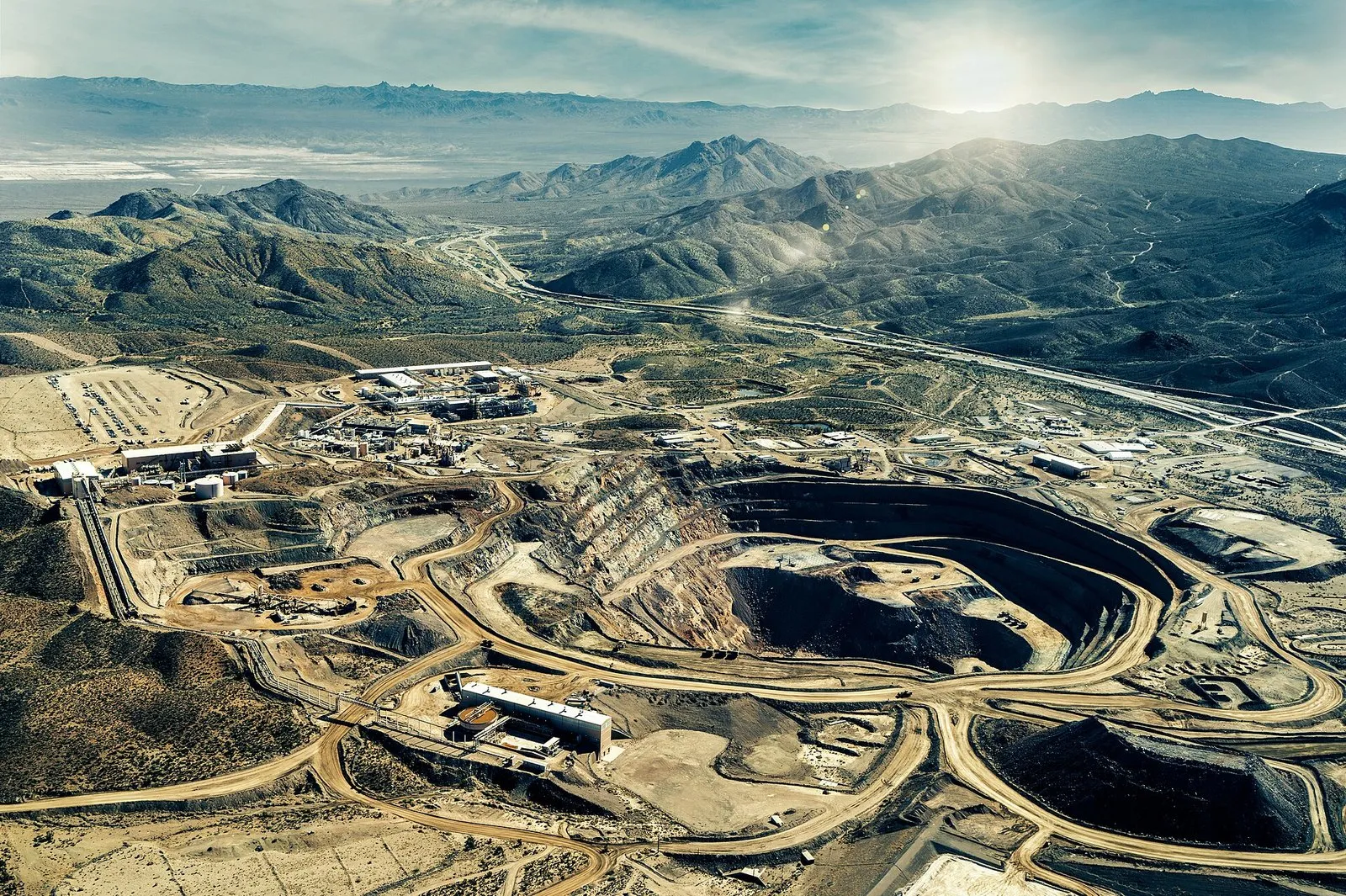
Two of the most talked-about rare earth projects in Brazil, the Serra Verde mine in Goiás (a state in central Brazil) and the Caldeira Project in Minas Gerais (a state in southeastern Brazil), have something in common: they are ionic clay deposits. In them, the rare earths are stuck to the surface of clay particles instead of locked inside hard crystals. That makes extraction simpler, but it brings challenges, such as low grades and a risk of contamination.
In short
- In an ionic clay (or ion adsorption) deposit, the rare earths are weakly held on the surface of clays such as kaolinite and halloysite.
- It forms through the slow decomposition of rocks such as granites and alkaline rocks, a process favored by humid climates.
- It is attractive because it usually has more heavy rare earths (such as dysprosium and terbium), little thorium and uranium and a simpler extraction, with a salt solution.
- The challenges are low grades, the large amount of soil moved and the history of contamination in southern China.
- In Brazil, the examples are Serra Verde (Goiás), in production, and the Caldeira Project (Minas Gerais), in development.
What an ionic clay deposit is
Rare earths are 17 chemical elements used mainly in magnets (see Rare earths: what they are, what they are used for and why Brazil matters). In many deposits, they sit inside tough minerals such as monazite and bastnäsite, and the rock has to be broken and ground before any treatment (see How a mine works: from discovery to closure).
Ionic clay is different. According to a review published in 2025 in the Journal of Geochemical Exploration, chemical weathering of the rock released the rare earths, which ended up adsorbed onto clays, mainly kaolinite and halloysite. Adsorption means the ions are held on the surface of the particle, not inside it.
A 2020 study in Nature Communications confirmed with direct measurements that this bond is weak, which is why the rare earths are easy to release. Think of a fridge magnet: it stays put, but comes off with little effort.
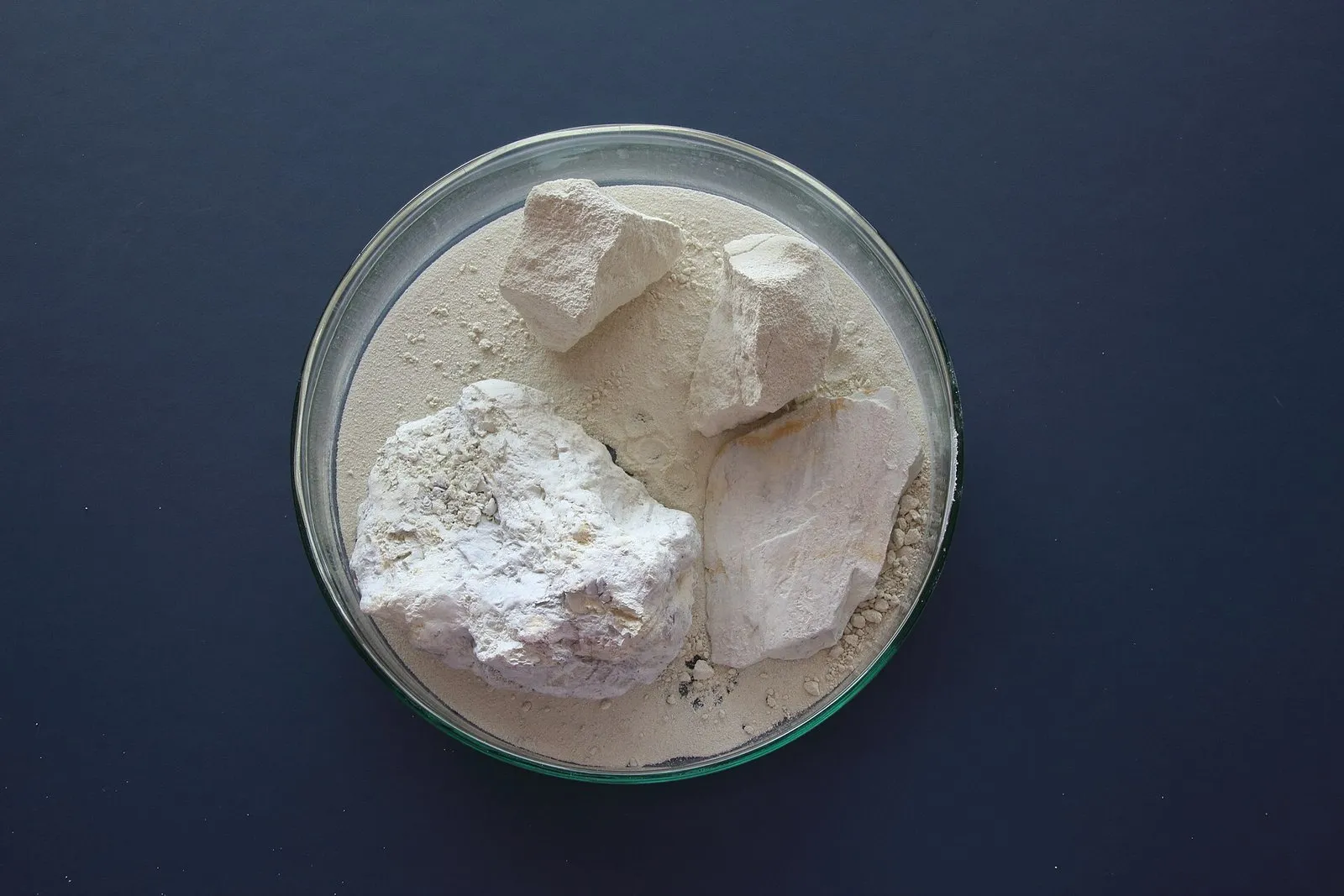
How this deposit forms
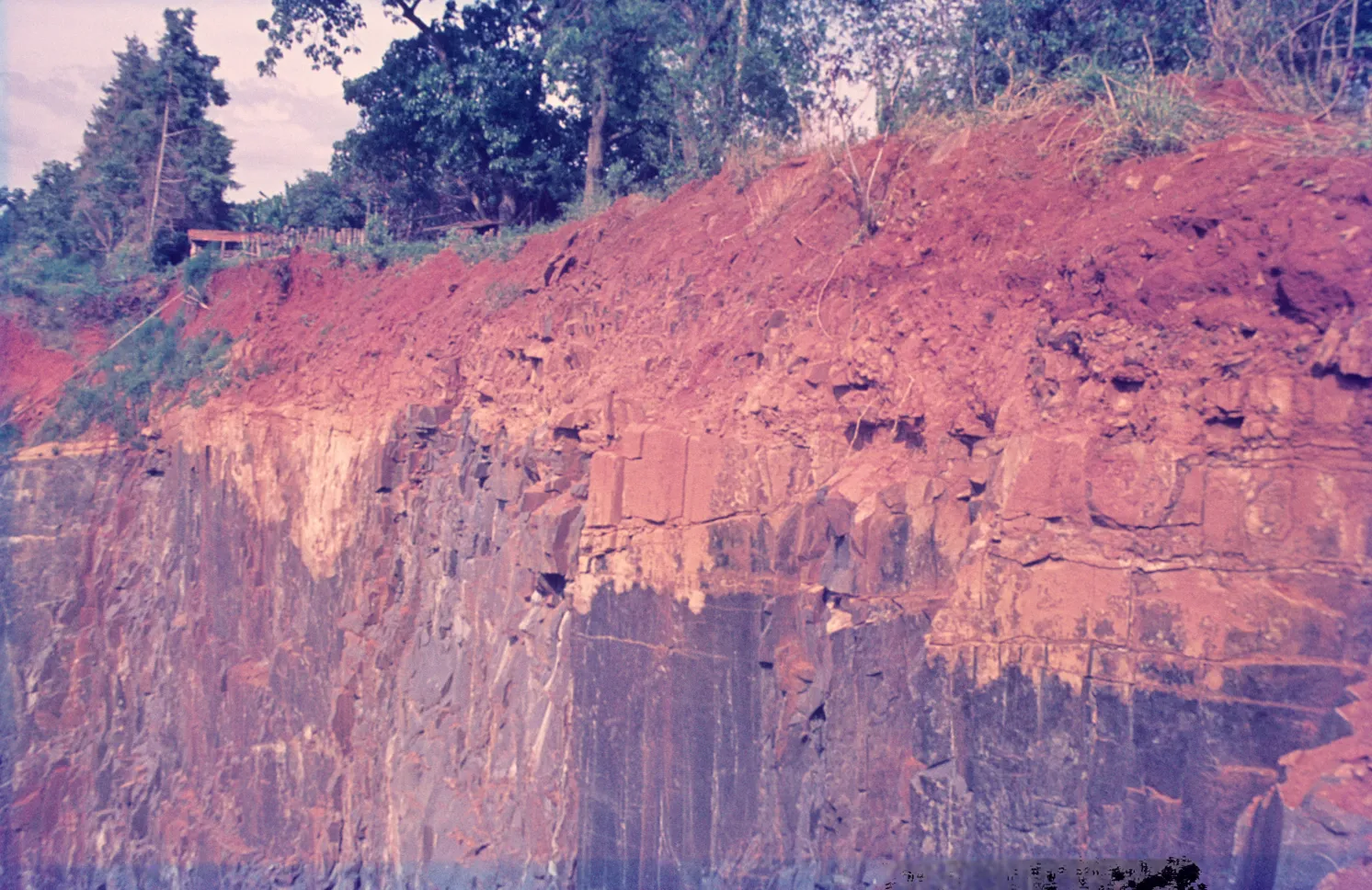
It all starts with a rock that already contains a little rare earth. Over a very long time, rainwater seeps in and breaks down its minerals, a process called weathering. The result is a weathering profile:
- Parent rock: the original rock, still intact.
- Saprolite: heavily altered rock that keeps the original structure but crumbles easily.
- Clay zone: where the rare earths, carried by water, become held on the clays. This is the ore.
- Soil: the layer most leached by rain.
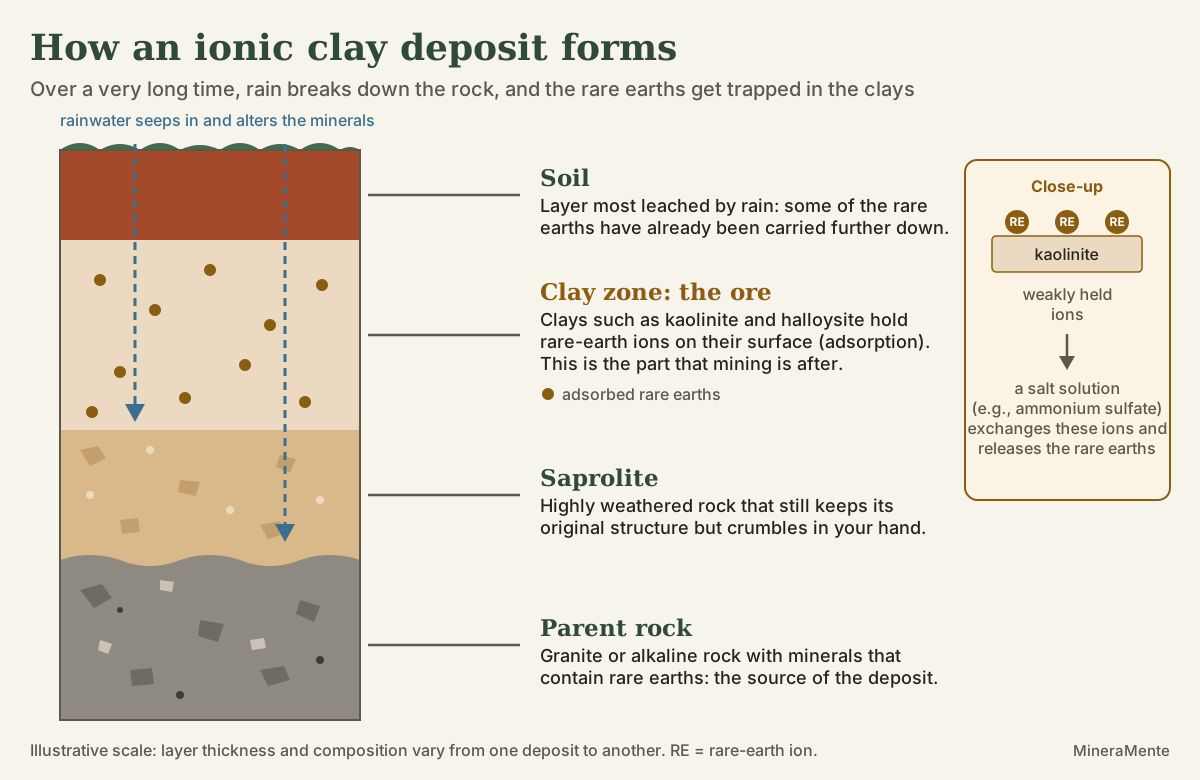
The United States Geological Survey (USGS) sums up the conditions: deep weathering of granitic rocks and a suitable source rock able to produce a weathered blanket rich in rare earths. According to the 2025 review, humid climates favor the formation of kaolinite and halloysite, but too much rain can dissolve the clays, and the deposit is only preserved where there is little erosion.
At Caldeira, according to Meteoric Resources, the source rocks are the syenites of the Poços de Caldas Alkaline Complex, about 80 million years old. At Serra Verde, the 2025 review records a granite.
Why it is so sought after
Heavy rare earths. The ionic clay deposits of southern China, in provinces such as Jiangxi, are the world’s main source of heavy rare earths, a group that includes dysprosium (Dy) and terbium (Tb). According to the 2025 review and the 2020 study, they account for about 80% of global supply of these elements. They help neodymium magnets work at high temperatures (see Neodymium magnets: what they are and why they are in electric cars and wind turbines).
Simpler extraction. A salt solution, usually ammonium sulfate, swaps the rare earths for other ions and releases them. For Caldeira, Meteoric describes open-pit mining with excavator and truck, no drilling or blasting, and processing at room temperature, with no flotation or calcination. The USGS notes that these ores can be mined and processed at a much lower cost than other deposit types.
Little radioactive material. According to the USGS and the 2025 review, ionic clays usually have little thorium and uranium, which simplifies waste disposal. It is a tendency, not a guarantee: the Poços de Caldas Complex also hosts uranium, according to Meteoric. The regulator’s decision on the Caldeira pilot plant is covered in The Caldeira Project in Poços de Caldas: what the Lynas takeover means.
What the challenges and impacts are
Low grades. According to the 2020 study, the Chinese deposits contain between 0.05% and 0.2% rare earth oxides (500 to 2,000 parts per million, or ppm). As a simple calculation, 1 tonne of oxides requires treating 500 to 2,000 tonnes of ore, not counting losses. That is why these projects move a lot of soil.
China’s track record. According to a 2023 study by researchers from Jiangxi, mining of these clays went through tank leaching, heap leaching and later in situ leaching, in which the solution is injected into the ground itself, without digging up the ore. (Leaching means dissolving the metal of interest with a solution.) The authors point out that the in situ method is simple, cheap and disturbs the surface less. Other studies show the environmental cost:
- A 2020 paper in the journal Environmental Pollution reports that in situ leaching with ammonium sulfate causes nitrogen pollution in soil and in surface water and groundwater. In a mining area in Ganzhou (Jiangxi), twelve years after mining ended, the tailings were still acidic (average pH of 3.90) and ammonia nitrogen was 12 to 40 times higher than in the soil before mining.
- A 2024 study concluded that in situ leaching with ammonium sulfate weakens the soil, raising concern about landslides on slopes.
- The 2020 Nature Communications study sums it up: this low-cost leaching has had a significant environmental impact in China.
Alternatives under study. Researchers are testing other reagents, such as magnesium sulfate, which in 2018 tests required more solution and released the rare earths more slowly. Another line is bioleaching, using microorganisms, which a 2025 Chinese review presents as a promising answer to pollution.
At Caldeira, according to Meteoric, the clay will be dug up and treated in a plant, not leached in the ground. But the reagent is still ammonium sulfate, which makes controlling water and waste essential.
Where ionic clay deposits exist
Most of the confirmed and mined deposits are in southern China. The 2025 review cites a few exceptions: Brazil, Madagascar, Uganda and Australia.
| Deposit | Location | Status | Reported figures |
|---|---|---|---|
| Zudong and others | Jiangxi and neighboring provinces, China | Main producing region | Zudong: grade of about 0.1% |
| Pela Ema (Serra Verde) | Minaçu, Goiás, Brazil | Commercial production since January 2024 | 458 million tonnes at 0.098% |
| Caldeira (Meteoric) | Poços de Caldas, Minas Gerais, Brazil | In development | Resource of 1.6 billion tonnes at 2,317 ppm (July 2026) |
Table sources: 2025 review (Zudong and Pela Ema) and Meteoric (Caldeira).
At Serra Verde, according to USA Rare Earth, which has owned the mine since September 2026, the goal is to reach a rate of about 4,000 tonnes of oxides per year by the end of 2026 and, in a second stage, an average of 6,400. The company says it is the only one outside Asia producing neodymium, praseodymium, terbium and dysprosium at scale.
At Caldeira, the resource reported by Meteoric contains about 594,000 tonnes of neodymium oxide, 209,000 of praseodymium, 34,000 of dysprosium and 6,000 of terbium. In other words, even in an ionic clay deposit, neodymium and praseodymium, which are light rare earths, dominate the content. The difference between a resource and a reserve is explained in How much rare earth does Brazil have? Why the numbers change.
There are other projects in the region, such as Viridis’s Colossus, which had R$ 77.5 million (Brazilian reais) approved by BNDES, Brazil’s national development bank, in September 2026 for a research center with a pilot plant, according to Poder360.
Why this puts Brazil on the map
Brazil is one of the few places outside China with confirmed ionic clay deposits and a mine in production. According to a report on a study by the Geological Survey of Brazil (SGB) and the University of Campinas (Unicamp), the country is positioning itself as the main Western hub for rare earths from these clays. The bottleneck is still separating the elements and making magnets, stages concentrated in China.
Frequently asked questions
What is ionic clay?
It is a deposit in which the rare earths are weakly held on the surface of clays such as kaolinite and halloysite. It forms through the slow decomposition of rocks such as granites and alkaline rocks.
Why are ionic clays important?
They are the world’s main source of heavy rare earths, such as dysprosium and terbium: about 80% of global supply comes from deposits of this type in southern China.
How are rare earths extracted from ionic clay?
With a salt solution, usually ammonium sulfate, which swaps out the rare earth ions held on the clay and carries them into the solution.
Does ionic clay mining pollute?
It can, if poorly controlled. In China, in situ leaching with ammonium sulfate left acidic tailings and nitrogen contamination that persisted 12 years after mining ended, according to a 2020 study.
Where is there ionic clay in Brazil?
The best-known examples are Serra Verde’s Pela Ema mine in Minaçu, Goiás, in production since 2024, and the Caldeira Project in Poços de Caldas, Minas Gerais, in development.
Found this article useful? Share it with someone who also wants to understand mining.
Share
Sources
- USGS – Rare Earth Element Accumulation Processes Resulting in High-Value Metal Enrichments in Regolith (project page)
- Russo et al. – The fundamentals of rare earth element ion adsorption clay deposits: a mineral systems approach for exploration, Journal of Geochemical Exploration, v. 278 (2025)
- Borst et al. – Adsorption of rare earth elements in regolith-hosted clay deposits, Nature Communications, v. 11 (2020)
- Zhang et al. – Ammonia nitrogen sources and pollution along soil profiles in an in-situ leaching rare earth ore, Environmental Pollution, v. 267 (2020)
- Guo et al. – Research on the saturated/unsaturated seepage laws of ionic rare earth ore under different leaching conditions, Frontiers in Earth Science (2023)
- Hamka et al. – Impacts of Ammonium Sulfate Leaching on Ion Adsorption Rare Earths and Soil Mechanical Properties, Rudarsko-geološko-naftni zbornik (2024)
- Wang et al. – Readsorption of rare earth elements during leaching process of ion-adsorption-type rare earth ore, Rare Metals (2018)
- Zhao et al. – Research Progress on Bioleaching Technology for Ion-Adsorption Type Rare Earth Ores, Acta Chimica Sinica (2025)
- Meteoric Resources – announcement to the Australian Securities Exchange (ASX) on the Caldeira Project mineral resource (July 9, 2026)
- Mining Technology – Serra Verde begins rare earth production (January 12, 2024)
- USA Rare Earth – USA Rare Earth Completes Combination with Serra Verde Group, press release attached to Form 8-K filed with the SEC (September 4, 2026)
- Poder360 – BNDES aprova R$ 77,5 milhões para projeto de terras-raras em MG (BNDES approves R$ 77.5 million for a rare earth project in Minas Gerais) (September 8, 2026)
- Cenário Energia – report on an SGB and Unicamp study of ion adsorption clays (April 2, 2026)
Comments
No comments yet. Be the first to comment.