Rare earths in Brazil: where they are and what projects exist
Rare earths in Brazil in 2026, mapped and explained: the Goiás mine, the Minas Gerais and Bahia projects, the deposit types and the stage of each one.
Translated from the original article in Portuguese. Read the original.
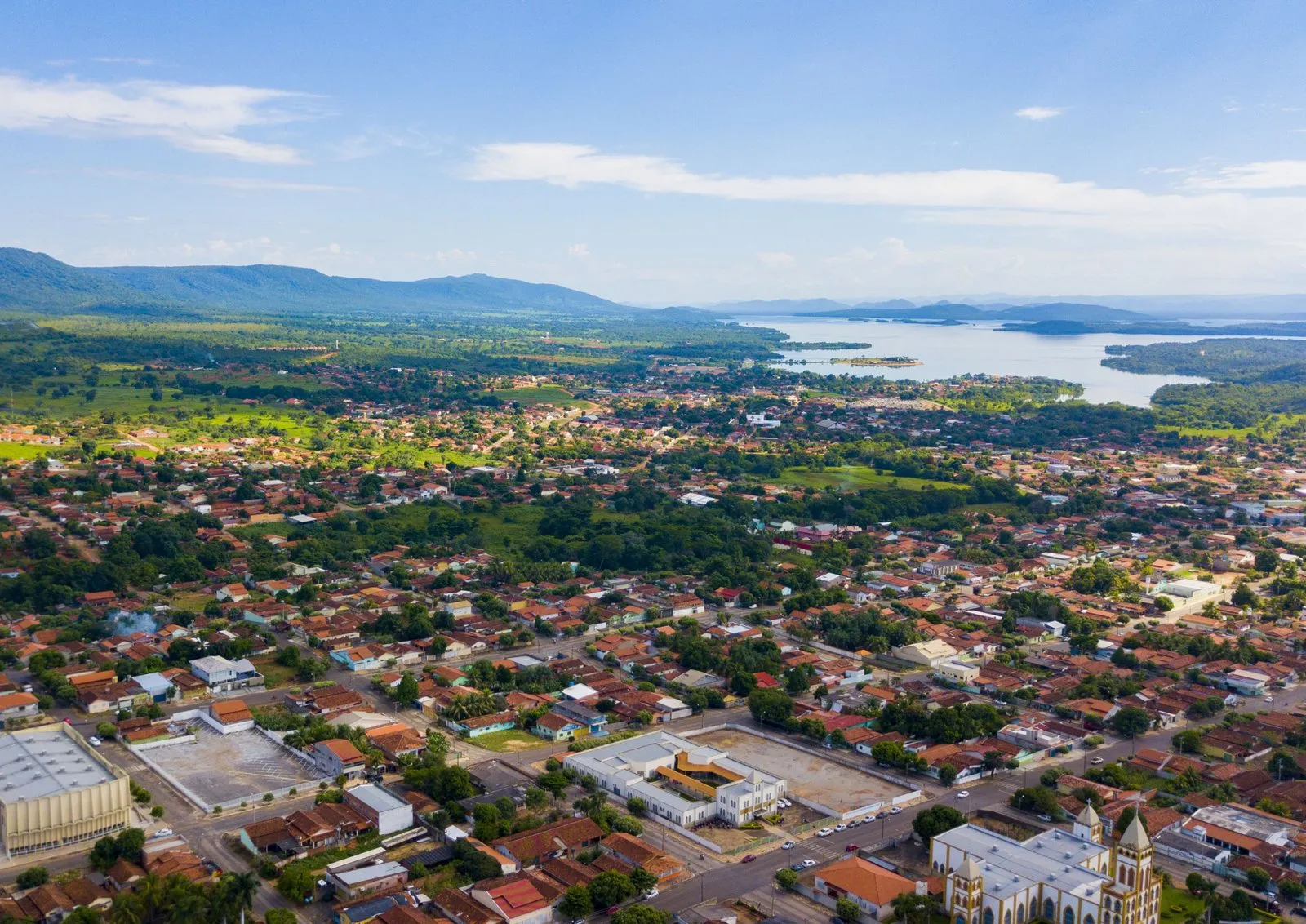
Rare earths in Brazil are, for now, concentrated in three states: Goiás, in central Brazil, home to the country’s only mine with commercial production; Minas Gerais, in the southeast, which has the most advanced projects; and Bahia, in the northeast, where one project is at the study stage. This guide shows where each project is, what kind of deposit it mines, which company runs it and what stage it had reached as of October 2026.
In short
- The Pela Ema mine, owned by Serra Verde, in Minaçu, Goiás (GO), is the only one with commercial rare earth production in Brazil. Since September 2026, the company has belonged to the American firm USA Rare Earth.
- The most advanced projects are in southern Minas Gerais, on the Poços de Caldas plateau: Caldeira (Meteoric) and Colossus (Viridis). Both have a preliminary license and are awaiting their installation license, the stages of Brazil’s environmental licensing process.
- There are also projects in Nova Roma (GO), Araxá (MG) and in Bahia, and the Geological Survey of Brazil (SGB) is mapping new areas.
- Almost all deposits under development are ionic clay deposits. Araxá is a carbonatite, and the Bahia project targets a very high-grade rock.
- According to Observatório da Mineração, a Brazilian news outlet that covers mining, even under optimistic schedules the new projects are only expected to reach commercial production between 2028 and 2030.
Three types of deposit, explained simply
Rare earths are locked inside minerals or stuck to clay particles, and the type of deposit changes the way they are extracted. The main ones in Brazil are:
- Ionic clay. This is a deep soil formed by the weathering of rocks in a tropical climate. The rare earths are weakly attached to the clay particles and can be released with a salt solution, without crushing or grinding rock. We explain the process in Ionic clay: the type of deposit that put Brazil on the rare earth map.
- Carbonatites and alkaline rocks. These are rocks formed from magma, rich in carbonate minerals. In western Minas Gerais, the SGB cites the Araxá, Tapira, Salitre and Serra Negra complexes. In Araxá, according to St George Mining, the rare earths are mainly in monazite, concentrated in the weathered rock near the surface.
- Monazite sands. These are beach sands with heavy minerals. According to the Center for Mineral Technology (CETEM), a Brazilian federal research center, they were mined for decades in northern Rio de Janeiro, southern Espírito Santo and southern Bahia, most notably in Buena (RJ).
The Bahia project does not fit these groups: according to Brazilian Rare Earths, it is a very high-grade rock in which the main mineral is chevkinite.
The map of the projects
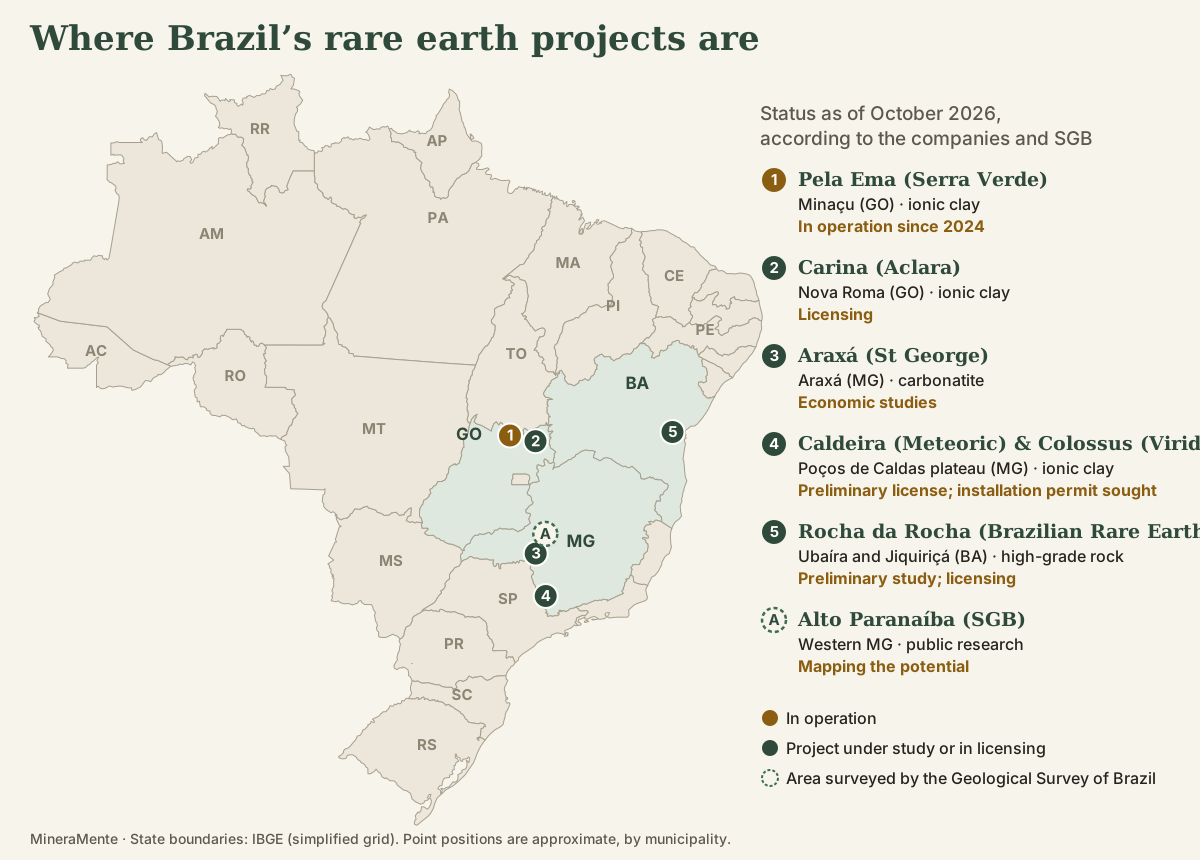
| Project | Company | Location | Deposit | Stage (Oct 2026) |
|---|---|---|---|---|
| Pela Ema | Serra Verde (USA Rare Earth) | Minaçu (GO) | Ionic clay | In operation |
| Carina | Aclara Resources | Nova Roma (GO) | Ionic clay | Licensing |
| Caldeira | Meteoric Resources | Caldas and Poços de Caldas (MG) | Ionic clay | Preliminary license; awaiting installation license |
| Colossus | Viridis Mining and Minerals | Poços de Caldas (MG) | Ionic clay | Preliminary license; awaiting installation license |
| Araxá | St George Mining | Araxá (MG) | Carbonatite | Economic studies |
| Rocha da Rocha | Brazilian Rare Earths | Ubaíra and Jiquiriçá (BA) | High-grade rock | Preliminary study and licensing |
Goiás: the only mine in operation
Pela Ema (Serra Verde), in Minaçu. It is an ionic clay deposit. According to USA Rare Earth, which completed its purchase of Serra Verde on September 3, 2026, production began in January 2024 and is going through an optimization program. The goal is to reach about 4,000 metric tons per year of rare earth oxides by the end of 2026 and, in a second phase already under construction, 6,400 metric tons per year. How the mine works is covered in Serra Verde: how the Goiás rare earth mine works, and the political context of the sale in Why is everyone talking about rare earths?.
Carina (Aclara Resources), in Nova Roma. This is also ionic clay, notable for heavy rare earths such as dysprosium and terbium. Aclara is Canadian. According to the April 2026 feasibility study, the mine would run for 18 years and produce an average of 4,378 metric tons per year of rare earth oxides. The application for the preliminary license was submitted to the Goiás state government in May 2025. In April 2026, Aclara expected to receive that license within the first half of the year and to start operating in the second half of 2028. We found no public confirmation that the preliminary license has been granted.
Minas Gerais: Poços de Caldas and Araxá
The Poços de Caldas plateau, in southern Minas Gerais, sits on a complex of alkaline rocks about 80 million years old and 800 km² in area, according to Meteoric. The weathering of these rocks formed an extensive layer of clay, where two neighboring projects are located.
Caldeira (Meteoric Resources). The Australian company Meteoric reports a resource of 1.6 billion metric tons at 2,317 ppm (parts per million) of rare earth oxides (July 2026) and completed its feasibility study on July 31. The preliminary license was issued in December 2025, and a decision on the installation license, applied for in 2026, was expected in the last quarter of the year. On October 1, 2026, Lynas Rare Earths, which produces rare earths in Australia and Malaysia, announced an agreement to buy Meteoric for about A$968 million in shares, a deal still subject to approvals. Details in The Caldeira Project in Poços de Caldas: what the Lynas purchase means.
Colossus (Viridis Mining and Minerals). Also Australian, Viridis reports a resource of 473 million metric tons at 2,505 ppm of rare earth oxides (July 2026). The preliminary license was approved in December 2025, and the application for the installation license was submitted in May 2026. The goal is to start production in the first half of 2028.
Araxá (St George Mining). It is located in the Barreiro Carbonatite Complex, in western Minas Gerais, the region that supplies more than 80% of the world’s niobium, according to the company. In August 2026, St George reported a resource of 111.2 million metric tons at 3.57% rare earth oxides and 0.57% niobium oxide, a much higher grade than that of the clays. The project is in the economic studies and mine planning stage.
Bahia: a very high-grade project
Rocha da Rocha (Brazilian Rare Earths). The main deposit, Monte Alto, is in Ubaíra and Jiquiriçá, about 270 km from Salvador, the capital of Bahia. According to the company, the ore has an average grade of 11.3% rare earth oxides. The preliminary study, dated August 13, 2026, has an accuracy of plus or minus 40%. The plan is to concentrate the ore at the mine and refine it in Camaçari, near Salvador. Licensing began in December 2024, and the goal is to start production in 2031.
Where the government is exploring
The Geological Survey of Brazil (SGB) is studying the potential of new areas:
- Alto Paranaíba (MG). Fieldwork in 2026 in Patos de Minas, São Gotardo, Tiros and Carmo do Paranaíba. A work plan from the agency calls for investigating ionic clays in the Serra Negra and Salitre complexes.
- Ribeira Belt (São Paulo and Paraná states). The third field stage took place in April 2026, and the SGB selected priority areas for detailed studies.
- Parnaíba Basin (Piauí and Bahia states). According to a September 2026 news report, the eastern edge of the basin is being studied by the SGB, and the Canadian company Origen Resources is negotiating exploration projects there, with no resource estimated yet.
There are also deposits that cannot be mined: according to Observatório da Mineração, Seis Lagos, in the state of Amazonas (AM), lies within an Indigenous reserve.
From the map to production: what is still missing
The projects still need an installation license, financing and, later, an operating license. Observatório da Mineração points to social and environmental concerns, such as a warning from Brazil’s Federal Public Prosecutor’s Office about water springs in the Caldeira area and a fine imposed on Serra Verde for deforestation. Meteoric says it complies with all environmental requirements and cites official letters from federal agencies stating that the project poses no radiological risk. Another challenge is refining: Aclara plans to separate the elements in the United States, and Brazilian Rare Earths proposes a refinery in Bahia. To understand the reserve figures, read How much rare earth does Brazil have? Why the numbers change.
Frequently asked questions
Where are the rare earths in Brazil?
The main projects are in Goiás (Minaçu and Nova Roma), Minas Gerais (Poços de Caldas and Araxá) and Bahia (Ubaíra and Jiquiriçá). The SGB is exploring other areas in Minas Gerais, São Paulo, Paraná and Piauí.
How many rare earth mines are operating in Brazil?
One: the Pela Ema mine, owned by Serra Verde, in Minaçu (GO), in production since January 2024. The other projects are at the study or licensing stage.
Who are the companies behind the projects?
Serra Verde belongs to the American company USA Rare Earth. Meteoric, Viridis, St George and Brazilian Rare Earths are Australian, and Aclara is Canadian. Meteoric has agreed to be sold to Lynas, a deal still subject to approvals.
When are the new projects expected to start producing?
According to the companies’ schedules, Colossus and Carina are aiming for 2028, and Rocha da Rocha for 2031. Caldeira depends on its installation license and on the investment decision. Timelines can change: Caldeira’s installation license was expected in June 2026 and has slipped to the end of the year.
Found this article useful? Share it with someone who also wants to understand mining.
Share
Sources
- USA Rare Earth – USA Rare Earth Completes Combination with Serra Verde Group, press release attached to Form 8-K filed with the SEC (September 4, 2026)
- Observatório da Mineração – Factsheet Terras Raras no Brasil (Rare Earths in Brazil factsheet) (September 2026)
- Aclara Resources – Aclara Announces Filing and Results of Feasibility Study for Its Flagship Carina Project (April 13, 2026)
- Aclara Resources – Aclara Submits EIA and Provides Update for Its Carina Project in Brazil (May 29, 2025)
- Aclara Resources – Aclara Announces Filing and Results of Pre-Feasibility Study for Its Flagship Carina Project (November 6, 2025), via Stockwatch
- Meteoric Resources – Measured Resources Grow 246% to 128Mt, ASX announcement (July 9, 2026)
- Meteoric Resources – Quarterly Activities Report, June 2026, ASX announcement (July 24, 2026)
- The Motley Fool Australia – Meteoric Resources releases Caldeira DFS (July 31, 2026)
- Small Caps – Meteoric's Caldeira Project Secures Key Environmental Green Light (December 2025)
- Lynas Rare Earths and Meteoric Resources – Lynas Rare Earths to acquire Meteoric Resources, ASX announcement (October 1, 2026)
- Viridis Mining and Minerals – Quarterly Activity Report, June 30, 2026, ASX announcement (July 24, 2026)
- Mining Weekly – Colossus rare earths project, Brazil: update (September 11, 2026)
- St George Mining – 155% increase to Measured & Indicated Resources confirms Araxá as world-class rare earths, niobium project, ASX announcement (August 11, 2026)
- Brazilian Rare Earths – BRE Scoping Study Supports First Quartile, Integrated Heavy Rare Earth Dominant Project, ASX announcement (August 13, 2026)
- SGB – Plano de trabalho 094/2025: potencial dos corpos alcalino-carbonatíticos de Serra Negra e Salitre (Work plan 094/2025: potential of the Serra Negra and Salitre alkaline-carbonatite bodies) (2025)
- Cenário Energia – SGB intensifica mapeamento de terras raras em Minas Gerais (SGB steps up rare earth mapping in Minas Gerais) (March 27, 2026)
- Brasil 61 – SGB avança com estudo no Cinturão Ribeira em SP e PR (SGB advances study in the Ribeira Belt in São Paulo and Paraná) (May 12, 2026)
- Movimento Econômico – Mineradora canadense confirma ocorrência de terras raras em áreas no PI e na BA (Canadian miner confirms rare earth occurrences in areas of Piauí and Bahia) (September 29, 2026)
- CETEM – Rochas e Minerais Industriais (Industrial Rocks and Minerals), chapter 36: Terras Raras (Rare Earths)
- IBGE – Malha territorial das unidades da federação (state boundaries, mesh API used for the map)
Comments
No comments yet. Be the first to comment.