Mine closure and land rehabilitation: what happens after mining
How land degraded by mining is rehabilitated: closure plan, stability, revegetation, monitoring, future land use and abandoned mines in Brazil.
Translated from the original article in Portuguese. Read the original.
When a mine is exhausted, the work does not end: the company has to dismantle its facilities, leave pits, stockpiles and dams stable, restore the soil and vegetation, and monitor the area until it can be put to another use. In Brazil, the rehabilitation of land degraded by mining is a constitutional obligation, and every mine needs an approved closure plan. In practice, however, there are still many idle or abandoned mines.
In short
- Anyone who exploits mineral resources is required to restore the degraded environment, says Brazil’s Constitution.
- Every operation needs a Mine Closure Plan, required by the ANM, Brazil’s National Mining Agency, from the mining permit application onward and updated during operation.
- Closure aims for physical and chemical stability, restored vegetation, monitoring and a future use for the area.
- The mining company pays the bill. When the company disappears or goes bankrupt, the liability may end up with the government, as happened with coal in Santa Catarina, a state in southern Brazil.
- In Minas Gerais, a state in southeastern Brazil, the State Environmental Foundation (Feam) registered 520 idle or abandoned mines in its survey with 2022 as the base year.
What the law requires
Brazil’s Constitution (art. 225, § 2) requires anyone who exploits mineral resources to restore the degraded environment, according to the technical solution required by the relevant public agency. Decree No. 97,632/1989 created the Degraded Area Rehabilitation Plan (PRAD), submitted together with the Environmental Impact Study (EIA/Rima), to return the land to a use defined in advance.
ANM Resolution No. 68/2021 regulates the Mine Closure Plan (PFM): dismantling temporary structures, physically and chemically stabilizing the ones that remain, monitoring them and preparing the area for new mining or another use. Since 2020, Brazil’s Mining Code has stated that rehabilitation includes the decommissioning (deactivation) of all facilities, including tailings dams, and that closure must be validated by the ANM and the environmental agency. Failing to rehabilitate the area is an environmental crime (Law No. 9,605/1998, art. 55).
Closure starts before mining
Closing a mine well depends on planning early, as shown in How a mine works: from discovery to closure. Under Resolution 68/2021, even an operation that is still applying for a mining permit must submit a conceptual closure design, with a physical and financial schedule for the pre-closure, closure and post-closure phases.
During operation, the plan is updated every five years or whenever the economic development plan changes, whichever comes first. Each update must describe the areas already closed and rehabilitated: this is progressive closure, which avoids leaving all the rehabilitation until the end. The last update must reach the ANM at least two years before the planned closure date.
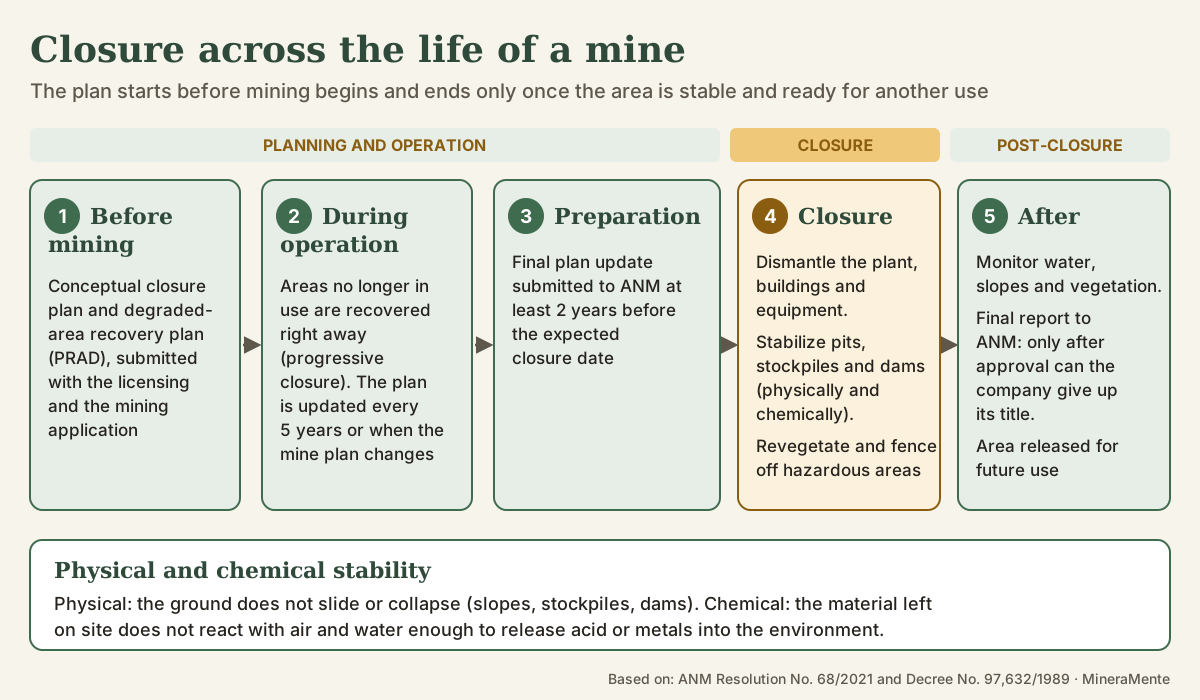
Physical and chemical stability
The processing plant, buildings and equipment can be dismantled. The remaining structures, however, stay: pits, underground tunnels, dams, and tailings and waste rock piles. For these, the regulation requires two types of stability:
| Type | How the ANM defines it | In practice |
|---|---|---|
| Physical | Stability in morphological and geomechanical terms | Slopes, piles and dams that do not slide or collapse |
| Chemical | Chemical balance between the area and the environment | Material that does not release acid or metals into water and soil |
The best-known chemical risk is acid mine drainage, explained in Environmental impacts of mining. Material from Brazil’s National Council of the Public Prosecution Service (CNMP) points to another effect of shutting down operations: when water pumping stops, the water table rises again and contaminated springs may appear.
For mines with dams, the plan must include the decharacterization of these structures (ending their function of holding tailings) or another solution that reduces the potential damage. If that is not possible, the dam remains under monitoring. See Tailings dams: what they are and why some are dangerous.
Revegetation: soil comes first
Once the land is stabilized, revegetation begins. Two techniques in use are planting native seedlings and transferring topsoil, the surface layer of soil, to cover the degraded area. In an experiment in ironstone campo rupestre (a type of rocky mountain grassland) published in 2021, a 40 cm layer of topsoil produced more cover than a 20 cm layer, but much of it came from exotic species with invasive potential, which requires management.
Nature also helps, slowly. A study published in REM: Revista Escola de Minas in 2009 assessed a former open-pit coal mining area in Urussanga, Santa Catarina, 28 years after mining ended. There were 32 species of shrubs and trees regenerating on their own, on a very acidic substrate (pH between 3.5 and 4.3), and three native species were recommended for rehabilitation programs.
Monitoring: how to know if it worked
The Mining Code regulation calls for monitoring tailings piles and deposits, slope stability, the aquifer and drainage. For vegetation, a 2005 study from the Polytechnic School of the University of São Paulo (USP) noted that follow-up is “often nonexistent” and tested five simple indicators in sand mines, such as plant density and seedling mortality. The areas assessed had not yet reached the expected result.
Monitoring can last many years. In Siderópolis, Santa Catarina, in a 42-hectare area whose rehabilitation was completed in 2015, the Geological Survey of Brazil was still measuring water from wells, drainage channels and ponds in 2025.
At the end, the company submits a final report on the execution of the plan to the ANM. Only after approving it can the agency accept the relinquishment of the mining title, and this does not release the company from obligations set out in other laws.
Future use: what comes next
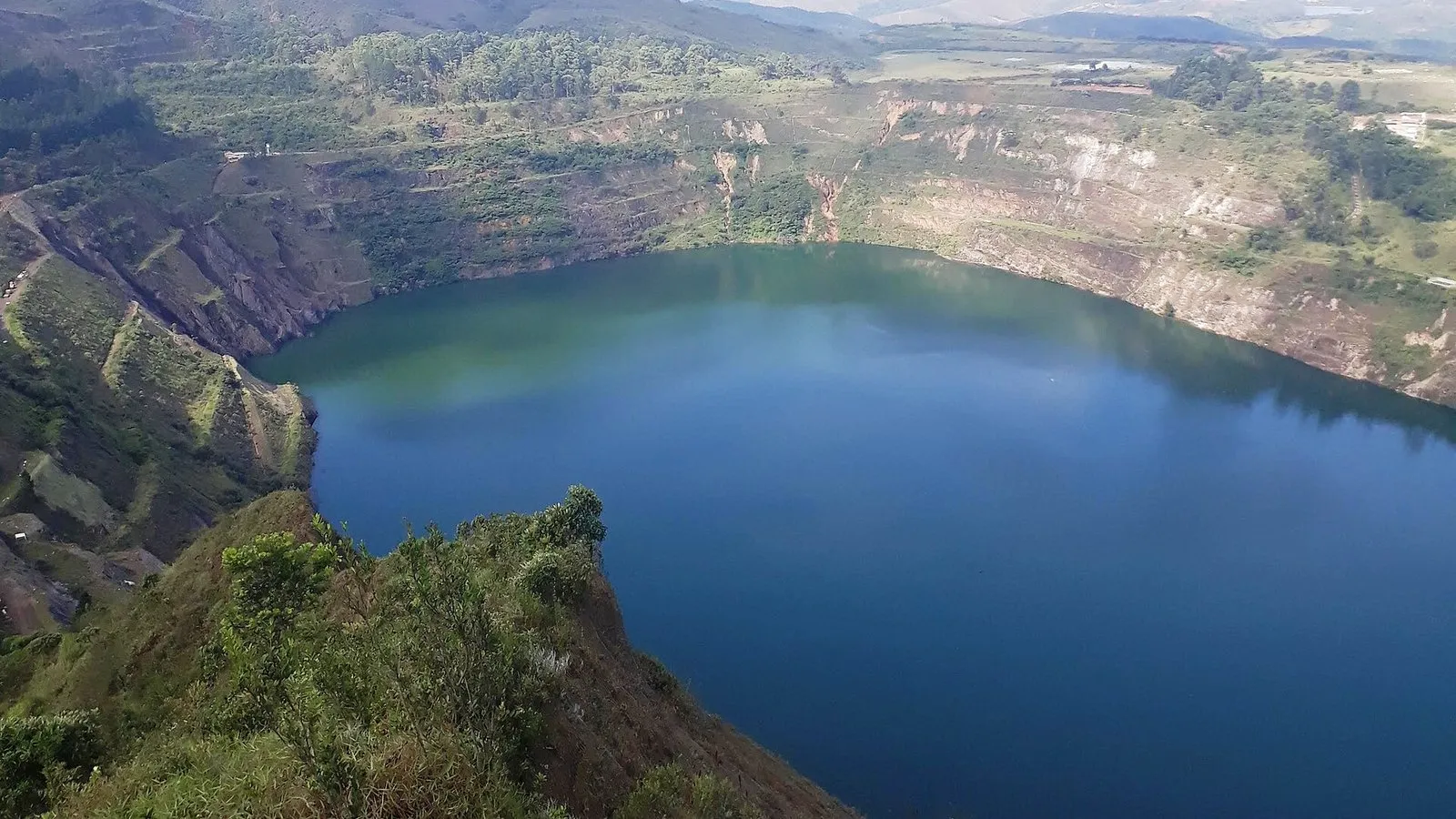
The future use can be forest, lake, park, neighborhood or new mining. In March 2026, the government of Minas Gerais cited the Inhotim Institute, in Brumadinho, and Mangabeiras Park, in Belo Horizonte, as areas once affected by mining that gained new uses. It also cited projects under way: the Nova Vila neighborhood, by AngloGold Ashanti, in Nova Lima, and Vale’s plan for the Águas Claras Mine, shown in the cover photo.
According to Feam, in 2025 the state was overseeing 130 areas undergoing closure and rehabilitation, and more than 20 had already received the Environmental Rehabilitation Declaration, which certifies that they are fit for new uses.
Who pays the bill?
As a rule, the mining company. Under the Mining Code regulation, the title holder’s obligations remain in force until closure, and the title is only extinguished after the plan approved by the ANM has been completed.
The problem arises when the company goes bankrupt first. For mining dams with medium or high risk or potential damage, the law allows the government to require a deposit, insurance or guarantee (Law No. 12,334/2010, art. 17). For closure in general, the ANM put to public consultation, between November 2024 and February 2025, a draft rule with guarantees such as a provisioning fund, surety insurance and a bank letter of guarantee, according to the law firm Cescon Barrieu.
Southern Santa Catarina shows the cost of having no guarantee. The Coal Public Civil Action, filed by Brazil’s Federal Prosecution Service (MPF) in 1993, seeks to rehabilitate six thousand hectares degraded by more than 100 years of uncontrolled mining and to close one thousand abandoned mine entrances. The courts ruled against the mining companies and also against the federal government, and it is the Geological Survey of Brazil that rehabilitates areas belonging to some defunct companies. In 2022, the Federal Court ordered the federal government to also take on the liability of the defunct Carbonífera Criciúma, about 1,500 hectares.
Abandoned mines: the liability left behind
In Feam’s second registry (base year 2022), of the 520 mines listed in Minas Gerais, 401 were idle and 119 were abandoned, and 57 had no record of an environmental license. Feam itself warns that the list is a sample, not the state’s total.
In the field, Feam found soil loss, silting, disorderly waste rock piles and water accumulated in pits. Often it was hard even to identify who was responsible.
There is progress: after a 2018 state regulation, 95 operations opened closure proceedings with Feam, compared with two in 2016.
Nationwide, an ANM presentation from February 2025 counted 3,007 mines in suspension (authorized or pending) and 1,024 pending relinquishment requests, and listed reducing the risk of abandonment among the goals for revising Resolution 68/2021. In November 2025, Brazil’s Federal Court of Accounts (TCU) gave the agency 180 days to present an action plan, including a diagnosis of how many mines are operating, suspended or abandoned.
As Mining myths and facts sums up, not every mine becomes an abandoned hole, but the ones that did still weigh on the environment and on the public purse.
Frequently asked questions
What is mine closure?
It is the set of actions to shut down a mine safely: dismantling facilities, stabilizing structures, rehabilitating and monitoring the area and preparing it for another use, according to a plan required by the ANM, Brazil’s National Mining Agency.
What is the difference between a PRAD and a mine closure plan?
The PRAD, from 1989, deals with environmental rehabilitation and goes to the environmental agency. The ANM’s closure plan is broader: according to the agency, the PRAD is only one part of it.
Who pays to rehabilitate an abandoned mine?
The party responsible is whoever mined the area. When the company no longer exists, the bill may fall to the government, as happened to the federal government in the Santa Catarina coal case.
Can a mine pit become a lake or a park?
Yes, as long as the area is stable and the water and terrain allow it. In Minas Gerais, mined areas gave way to Inhotim and Mangabeiras Park, according to the state government.
Found this article useful? Share it with someone who also wants to understand mining.
Share
Sources
- Federal Constitution of 1988, art. 225, § 2 (Planalto)
- Decree No. 97,632/1989 (plan for the rehabilitation of land degraded by mining)
- ANM Resolution No. 68/2021 (Mine Closure Plan) – Official Gazette of the Union, May 4, 2021
- ANM Resolution No. 68/2021, text with the 2022 amendments (copy published by Poder360)
- Decree-Law No. 227/1967 (Mining Code), arts. 6-A and 43-A, added by Law No. 14,066/2020
- Decree No. 9,406/2018 (regulation of the Mining Code), arts. 5 and 51
- Law No. 9,605/1998 (environmental crimes), art. 55
- Law No. 12,334/2010 (dam safety), art. 17, § 2, added by Law No. 14,066/2020
- ANM – Presentation "Discussões e tratativas para atualização das regulamentações ligadas ao fechamento de minas" (Discussions on updating mine closure regulations) (February 6, 2025), MPF workshop
- Cescon Barrieu – ANM holds public consultation on financial guarantees for carrying out the Mine Closure Plan (December 23, 2024)
- Agência iNFRA – TCU orders ANM to present an action plan on mine closure (November 19, 2025)
- CNMP – Mine closure (appendix IV, material from the Environment Commission)
- Feam – II Cadastro de Minas Paralisadas e Abandonadas do Estado de Minas Gerais (2nd Registry of Idle and Abandoned Mines in Minas Gerais, base year 2022)
- Agência Minas – State government assists with post-mining, seeking environmental rehabilitation and reuse of areas (March 21, 2026)
- Klein et al. – Natural regeneration in an area degraded by coal mining in Santa Catarina, REM: Revista Escola de Minas 62(3) (2009)
- Rezende et al. – Topsoil depth influences the recovery of rupestrian grasslands degraded by mining, Revista Brasileira de Ciência do Solo 45 (2021)
- Almeida and Sánchez – Revegetation of mining areas: monitoring criteria and performance assessment, Revista Árvore 29(1) (2005)
- MPF – The Coal Public Civil Action (major cases)
- MPF – MPF inspects works by the city of Criciúma (SC) in an area degraded by coal mining (July 28, 2025)
- Geological Survey of Brazil – Environmental rehabilitation program for the Santa Catarina Coal Basin: monitoring of Area IV – Belluno (first half of 2025)
Comments
No comments yet. Be the first to comment.