Tailings dams: what they are and why some are dangerous
What a tailings dam is, how it is built, why the upstream method is the riskiest, and what changed in Brazil's rules after Mariana and Brumadinho.
Translated from the original article in Portuguese. Read the original.
A tailings dam is a reservoir built to store the material left over when ore is processed, a mixture of fine particles and water. How risky it is depends largely on how it was built and maintained. Dams raised “upstream,” resting on the tailings themselves, are the most vulnerable, and that was the type of structure that failed in Mariana in 2015 and in Brumadinho in 2019, both in Minas Gerais, a state in southeastern Brazil.
In short
- Tailings are what is left after ore processing: a fine material, usually mixed with a lot of water.
- A tailings dam grows little by little, through raisings, which can be done upstream, downstream or by the centerline method.
- The upstream method is cheaper but more prone to liquefaction, when waterlogged tailings start to flow like a liquid.
- Brazil’s Law No. 14,066/2020 banned the upstream method and required these dams to be decharacterized. In October 2026, 38 were still left, according to the ANM.
- Anyone can check the status of Brazilian mining dams on SIGBM Público, run by the ANM, Brazil’s National Mining Agency.
What tailings are and why they must be stored
In mineral processing, ore is crushed, ground and concentrated (the steps are covered in How a mine works). Whatever has no economic value becomes tailings. According to CETEM, Brazil’s Center for Mineral Technology, with lower-grade ores the amount of tailings can far exceed the amount of product.
Because the process uses water, tailings come out as slurry, a kind of mud. Equipment called thickeners removes part of the water, but according to CETEM the slurry still contains only 40% to 50% solids. This mud needs a safe place for the entire life of the mine, and beyond.
How a tailings dam grows: the three methods
Two terms help here. Upstream is the reservoir side; downstream is the valley side. The dam starts with a starter dike and, as the reservoir fills, it is built up in stages called raisings. What changes between methods is the direction in which the dam’s axis moves:
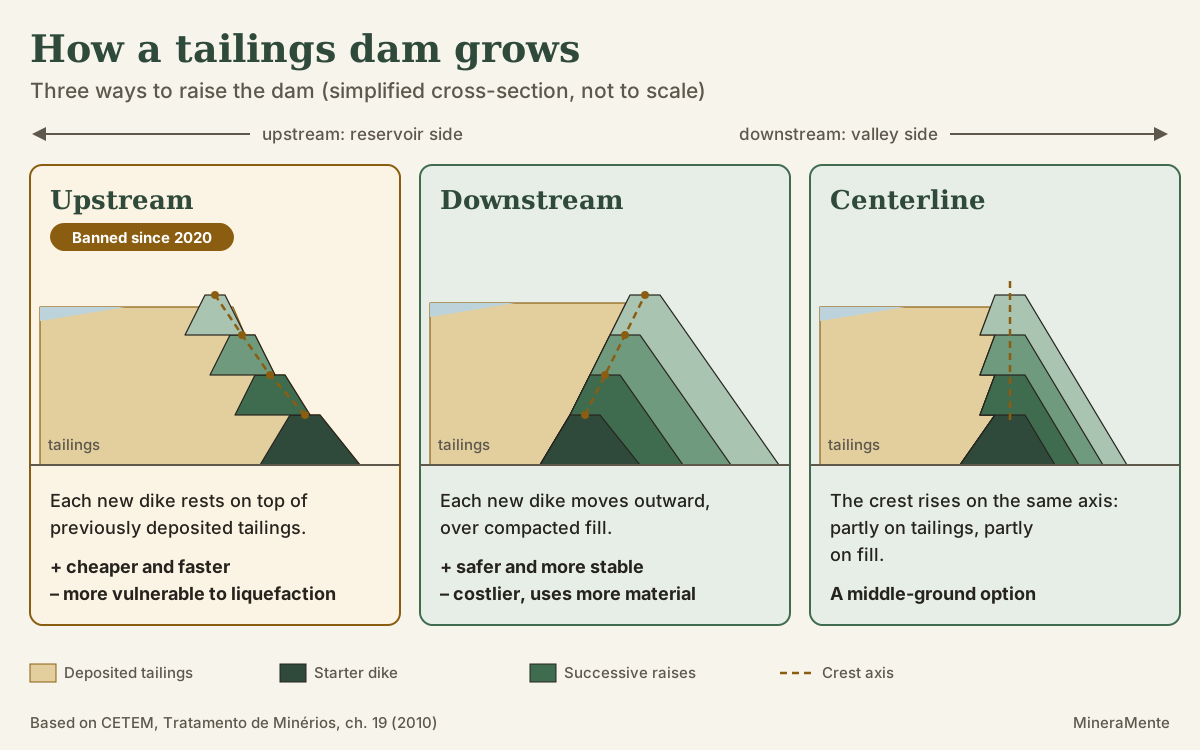
| Method | How it works | Advantages | Disadvantages |
|---|---|---|---|
| Upstream | Each new dike sits on the “beach” of tailings already deposited. | Lower cost, faster raising. | Lower safety, risk of liquefaction. |
| Downstream | Each new dike advances toward the valley, with compacted material and internal drainage. | Greater safety and resistance to vibrations. | Higher cost, more material. |
| Centerline | The crest rises along the same axis, partly on the tailings, partly on the dike. | Behavior close to the downstream method, intermediate cost. | The upstream part may slide. |
Source: CETEM (2010) and ANA/SNISB.
In a February 2019 note, the ANM stated that the upstream method was “widely adopted between the 1970s and 1990s” and was “obsolete.”
Why the upstream method is riskier: liquefaction
Inside the dam, the fine grains of tailings can form loose, waterlogged layers. According to CETEM, if this material undergoes a sudden load, static or dynamic (such as vibrations), the water pressure between the grains rises, they stop supporting one another, and the tailings can flow like a viscous liquid. This is liquefaction.
In the upstream method, the new dikes rest precisely on this material: if it liquefies, the foundation gives way. CETEM lists earthquakes, blasting at the mine and equipment traffic as possible triggers. In a survey of tailings dam accidents cited by the center, liquefaction is the most frequent cause, accounting for 46.7% of cases.
Mariana and Brumadinho: what happened
According to the ANA, Brazil’s National Water and Sanitation Agency, both dams had been raised using the upstream method. Behind the numbers are lives lost and communities still living with the consequences.
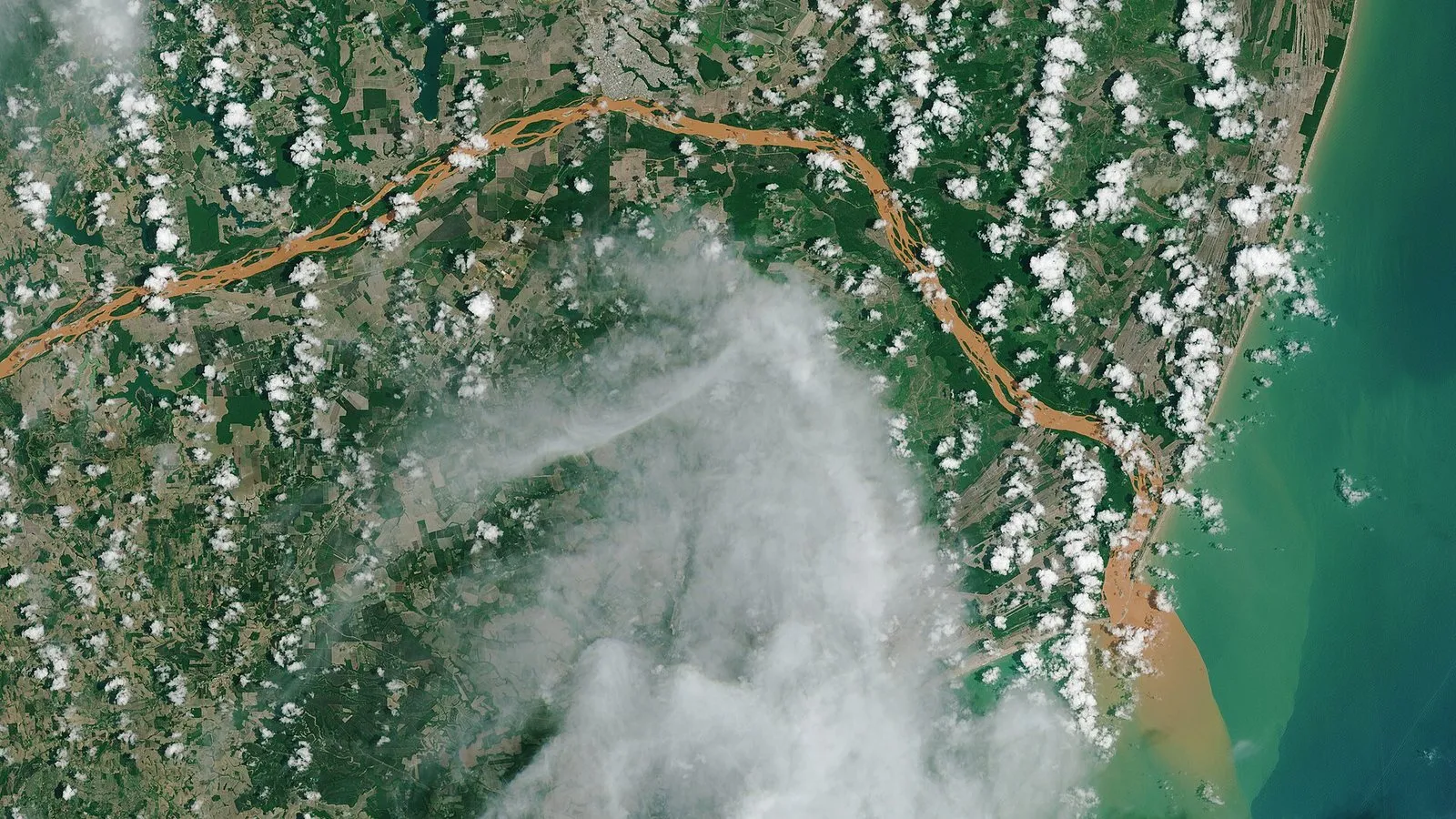
Fundão, in Mariana (November 5, 2015). According to Brazil’s Federal Prosecution Service (MPF), the Samarco dam failed at around 3:30 p.m., and about 40 million cubic meters of tailings spilled out immediately. The wave buried part of the village of Bento Rodrigues and killed 19 people. The mud flowed down the Gualaxo do Norte and Carmo rivers, reached the Doce River and arrived at the Atlantic Ocean on November 21, in Linhares, in the state of Espírito Santo. A study commissioned by Samarco, from August 2016, pointed to drainage problems since 2009 and a section of the dam built on unstable ground.
B1, at the Córrego do Feijão Mine, in Brumadinho (January 25, 2019). The Vale dam failed at around 12:30 p.m., according to Agência Brasil, and released about 12 million cubic meters of tailings, according to the MPF. The MPF counts 270 deaths; Avabrum, the victims’ families association, counts 272, including the babies of two pregnant women, a figure also used by the Legislative Assembly of Minas Gerais (ALMG). In January 2026, according to the ALMG, two people were still missing. The tailings reached the Paraopeba River basin and more than 20 municipalities. A panel of experts hired on behalf of Vale concluded, in December 2019, that static liquefaction of the tailings had occurred. In July 2026, the criminal case was in the testimony phase, according to the MPF.
What changed in the rules
The foundation is Brazil’s National Dam Safety Policy (PNSB), created by Law No. 12,334/2010, which applies to dams 15 meters tall or more, holding 3 million cubic meters or more, containing hazardous waste, or with medium or high potential damage, among other cases. Each dam receives two ratings (high, medium or low): the risk category, linked to the condition and construction method of the structure, and the associated potential damage, the harm a failure would cause, regardless of the probability of it happening. After Brumadinho, the rules got tougher:
- ANM Resolution No. 13/2019: banned the upstream method, according to the agency’s own record.
- Law No. 14,066, of September 30, 2020: banned building or raising mining dams by the upstream method and ordered existing ones to be decharacterized by February 25, 2022, a deadline the ANM can extend. A decharacterized dam is one that no longer holds tailings and is given another purpose. The law also prohibited new dams with a community in the Self-Rescue Zone (ZAS), the stretch of valley where there would be no time for emergency services to arrive, and set fines of up to R$ 1 billion (Brazilian reais).
- ANM Resolution No. 95, of February 7, 2022: consolidated the safety rules for mining dams and detailed decharacterization and the alert and emergency levels.
- ANM Resolution No. 220/2025: published in October 2025, it will replace Resolution 95/2022 starting in August 2027 and redefines the attention, alert and emergency stages.
SIGBM: how to follow the status of dams
The Integrated Mining Dam Safety Management System (SIGBM) is the ANM’s registry. Its public version shows each dam’s risk category and alert or emergency level. Under Resolution 95/2022, the levels are:
| Level | What it means |
|---|---|
| Alert | An anomaly that poses no immediate risk but must be controlled and monitored. |
| Emergency 1 (NE1) | Potential compromise of safety, such as a safety factor below the minimum. |
| Emergency 2 (NE2) | An uncontrolled anomaly. |
| Emergency 3 (NE3) | Failure is inevitable or already under way. |
According to the ANM bulletin, on October 1, 2026 there were 908 registered mining dams, 465 of them under the PNSB, and 82 on alert or emergency: one at level 3 and six at level 2. Ensuring the stability of these structures is one of the duties described in What does a mining engineer do.
Where decharacterization stands in 2026
The ANM’s October 2026 report (data as of October 3) shows progress and delays at the same time:
- In 2019, there were 74 upstream dams covered by the PNSB. Today there are 38.
- 28 were removed from the registry after completing decharacterization, and 15 had their construction method changed.
- 19 have works in progress, and 11 have finished works and are being monitored.
- Minas Gerais holds 61% of the remaining dams, and 37% of them are at some alert or emergency level.
- In some cases, works are expected to run until December 2035.
The law’s original deadline, February 2022, has passed. The ANM says it has ruled on extensions for all remaining dams, taking into account the complexity of each case. See also Mining myths and facts.
Are there alternatives to dams?
Yes, and they are gaining ground:
- Dry processing: some iron ores can be processed without water, so no tailings slurry is produced. According to Vale, about 80% of its iron ore production in Brazil did not use dams between January and September 2023.
- Filtering and stacking: filters remove water from the tailings, which are stacked instead of sent to a reservoir, and the water goes back to the plant. Vale says it has four filtration plants in Minas Gerais, with capacity for 60 million tonnes per year.
Stacks also require engineering design and oversight: in July 2026, the ANM recorded a former upstream dam in Cajati, in the state of São Paulo, converted into a drained stack not susceptible to liquefaction. And minerals are still needed in cement, steel and electronics, as shown in Mining in everyday life. The question is how to produce them safely.
Frequently asked questions
What is a tailings dam?
It is a reservoir that stores the tailings from ore processing, a mixture of fine particles and water. It grows in stages, called raisings, as the reservoir fills.
Why are upstream dams more dangerous?
Because the new dikes rest on the tailings themselves, which may be loose and waterlogged. A sudden load can trigger liquefaction: the tailings lose strength and flow like a liquid.
Do upstream dams still exist in Brazil?
Yes. Law No. 14,066/2020 banned the method and required decharacterization, but in October 2026 there were still 38 of them under the PNSB, according to the ANM, some with works scheduled to run until 2035.
What does emergency level 3 mean?
It is the most serious level on the ANM scale: failure is inevitable or already happening. On October 1, 2026, one dam was at this level.
How can I find out if there is a dam near me?
Check the ANM’s SIGBM Público (app.anm.gov.br/SIGBM/Publico), which shows Brazil’s mining dams, their risk category and their alert or emergency level, in real time.
Found this article useful? Share it with someone who also wants to understand mining.
Share
Sources
- CETEM – Barragem de Rejeitos (Tailings Dams), by Lindolfo Soares, chapter 19 of the book Tratamento de Minérios, 5th edition (August 2010)
- ANA/SNISB – Important definitions on dam safety
- Law No. 12,334/2010 (National Dam Safety Policy)
- Law No. 14,066/2020 (amends the National Dam Safety Policy)
- ANM – Explanatory note on dams built or raised by the upstream method (February 15, 2019)
- ANM Resolution No. 175/2024, amending ANM Resolution No. 95/2022 (text reproduced by Lex)
- ANM – Presentation of ANM Resolution No. 95/2022 (March 2022, file published by IBRAM)
- ANM – Monthly mining dam safety bulletin, September 2026
- ANM – Quarterly report: decharacterization of upstream dams (October 2026)
- Demarest – ANM Resolution No. 220/2025 sets the rules applicable to mining dams
- MPF – The Samarco case: the disaster
- Agência Brasil – Study commissioned by Samarco shows the failure that caused the Mariana tragedy (August 30, 2016)
- MPF – MPF concludes first semester of hearings in the Brumadinho criminal case (July 3, 2026)
- Agência Brasil – After 7 years, the Brumadinho tragedy will be examined in court (January 25, 2026)
- Agência Brasil – Criminal case over the Brumadinho tragedy may go back to square one (January 25, 2022)
- ALMG – ALMG honors the victims of Brumadinho (January 23, 2026)
- Agência Brasil – Brumadinho: a combination of deformations caused the dam failure (December 12, 2019)
- Vale – About 80% of Vale's iron ore production in Brazil does not use tailings dams (January 18, 2024)
Comments
No comments yet. Be the first to comment.