Environmental licensing of mining in Brazil: how it works, step by step
Environmental licensing of mining in Brazil: LP, LI and LO, EIA/Rima, public hearings, who issues licenses, deadlines and what changed with Law 15,190/2025.
Translated from the original article in Portuguese. Read the original.
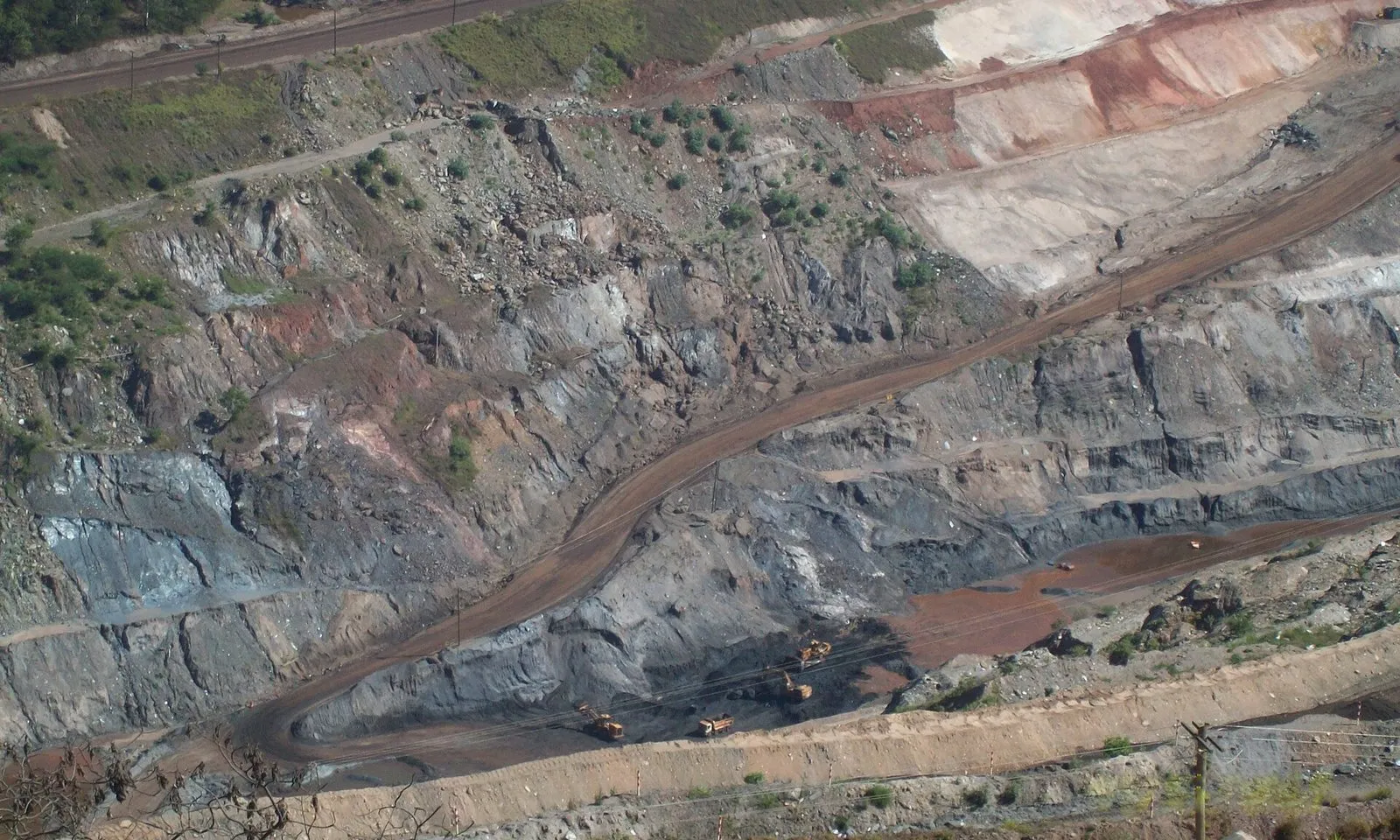
Environmental licensing of mining is the process through which a government agency assesses whether a mine can exist in a given place and under what conditions. In Brazil, it usually has three stages: the Preliminary License (LP, Licença Prévia), the Installation License (LI, Licença de Instalação) and the Operating License (LO, Licença de Operação). It is a separate authorization from the mining title issued by the National Mining Agency (ANM), and a mine needs both. Since February 2026, the general rules have been set out in Law 15,190/2025, the General Environmental Licensing Law.
In short
- Every mine needs an environmental license and a mining title, registered with the ANM. One does not replace the other.
- The classic path has three licenses: LP (site and design), LI (construction) and LO (operation).
- High-impact projects submit an EIA/Rima (environmental impact study and report) and go through at least one public hearing before the LP.
- Licenses are usually issued by the state agency. Ibama, Brazil’s federal environmental agency, steps in for cases such as Indigenous lands, projects spanning two states or radioactive material.
- Law 15,190/2025 set deadlines for review and validity periods, but part of it is being challenged at Brazil’s Supreme Federal Court (STF).
What environmental licensing is
Law 6,938/1981 says that activities that use environmental resources or may pollute “will depend on prior environmental licensing.” And the Brazilian Constitution requires, for works capable of causing significant degradation, a prior environmental impact study, made public.
In practice, the company submits studies, the environmental agency reviews them, the public can comment and the license is issued with conditions (condicionantes): obligations the company must meet to keep it. Mining almost always qualifies: Conama Resolution 1/1986 (Conama is Brazil’s National Environment Council) lists “ore extraction” among the activities that require an EIA/Rima.
Mining title and environmental license: two different authorizations
Under the Constitution, mineral resources, including those underground, are property of the federal government. That is why anyone who wants to explore for or mine (extract) an ore needs a mining title, such as the exploration permit, granted by the ANM, and the mining concession, usually granted by the Minister of Mines and Energy. For sand, crushed stone, clay and other materials used directly in construction, there is a simpler regime, the licensing regime of Law 6,567/1978, with a license from the city government and registration with the ANM, explained in Minerals in construction. The stages appear in How a mine works: from discovery to closure.
The title deals with the right to exploit the deposit. The license deals with the impact of the activity in that place. The two processes run side by side:
- Under Decree 9,406/2018, which regulates the Mining Code, anyone applying for a mining concession has 60 days to prove they have filed for licensing and must then show the ANM, every six months, that the process is moving forward, “under penalty of rejection of the mining application.”
- Conama Resolutions 9/1990 and 10/1990, specific to mining, list the documents for each license. For the LI, Resolution 9 requires, for example, the opinion of the ANM (then DNPM) on the plan for the economic use of the deposit.
- Law 15,190/2025 says that licensing takes place “without prejudice to the other applicable licenses, grants and authorizations.”
Who issues the license: federal government, state or municipality?
Complementary Law 140/2011 establishes that each project is licensed by a single level of government. The others may give their opinion, without veto power.
| Who issues the license | In which cases (summary) |
|---|---|
| Federal government (Ibama) | Indigenous lands, federal protected areas (except Environmental Protection Areas, APAs), the sea, projects carried out together with a neighboring country or in two or more states, and those that mine or process radioactive material, with an opinion from the National Nuclear Energy Commission |
| States | General rule: everything that is not the responsibility of the federal government or the municipalities |
| Municipalities | Local-scale impact, according to a list set by the state environmental council |
Most mines, therefore, are licensed by the state. The Pela Ema rare earth mine, in the state of Goiás, is an example: according to a USA Rare Earth filing with the SEC, the U.S. securities market regulator, it is licensed by the Goiás State Department of the Environment (Semad-GO), under a cooperation agreement with Ibama. The debate about this case is covered in Serra Verde: how the Goiás rare earth mine works, and the rule for Indigenous lands in Mining on Indigenous lands.
Step by step: LP, LI and LO
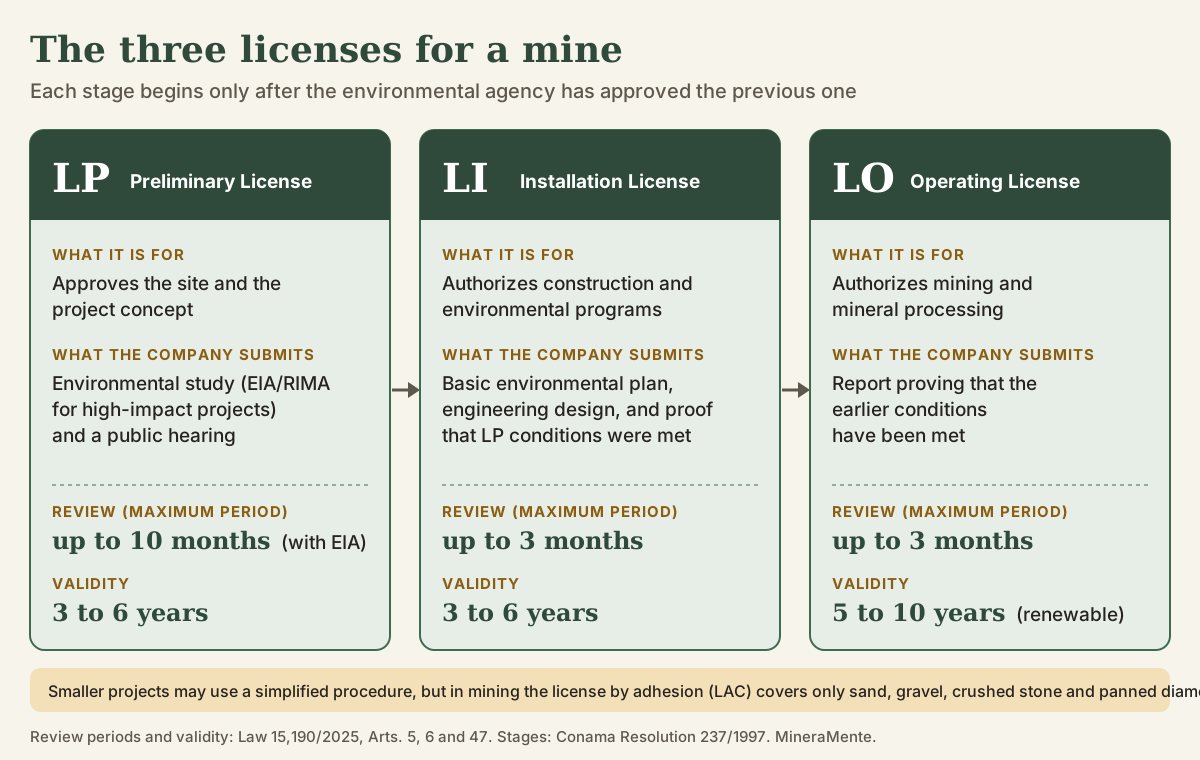
1. Terms of reference. The environmental agency, with input from the company, defines which studies it must submit (Conama Resolution 237/1997).
2. Preliminary License (LP). Planning phase. The LP certifies the environmental feasibility of the site and of the project design and sets the conditions for the following phases. For high-impact projects, it is based on the EIA/Rima.
3. Installation License (LI). Authorizes construction: access roads, processing plant, waste piles and tailings structures. Under Law 15,190/2025, the company submits the Basic Environmental Plan (PBA), the engineering design and a report showing that it has met the LP conditions.
4. Operating License (LO). Authorizes the mine to operate, after the agency verifies that the earlier measures have been put in place. It has an expiration date and must be renewed.
EIA/Rima and public hearings
The Environmental Impact Study (EIA) describes the area before the project, forecasts the impacts and proposes measures to reduce them. The Environmental Impact Report (Rima) summarizes the study in “accessible language,” with maps and charts, according to Conama Resolution 1/1986. What those impacts are is covered in Environmental impacts of mining.
Law 15,190/2025 requires at least one public hearing before the decision on the LP for projects with an EIA, with the EIA and the Rima made available to the public 45 days in advance. It also provides for online public consultation and participatory meetings.
A recent example, according to the mining company: for the Caldeira rare earth project in Caldas (Minas Gerais), Meteoric submitted an EIA of about 3,000 pages to the State Environmental Foundation (Feam) in May 2024. This was followed by a public hearing in the municipality, a site inspection, additional information and a technical opinion from Feam. The State Environmental Policy Council (Copam) approved the LP on December 19, 2025, about 19 months after the study was submitted.
How long it takes and how long each license lasts
| Conama Resolution 237/1997 | Law 15,190/2025 | |
|---|---|---|
| Review of the LP with an EIA | up to 12 months | up to 10 months |
| Review of the LP with other studies | up to 6 months | up to 6 months |
| Review of the LI and LO | up to 6 months | up to 3 months |
| Validity of the LP | up to 5 years | 3 to 6 years |
| Validity of the LI | up to 6 years | 3 to 6 years |
| Validity of the LO | 4 to 10 years | 5 to 10 years |
The deadlines in the law count from the submission of the complete studies, and the company has up to 4 months to respond to requests for additional information. A missed deadline does not produce an automatic license: the law says this “does not imply tacit issuance,” but allows another agency to take over the case at the company’s request. Renewal must be requested 120 days before expiration, and licenses with no expiration date are prohibited.
Conditions: the license comes with obligations
At the Pela Ema mine, for example, the operating license issued in December 2023 is valid until October 18, 2028, and, according to the company, requires monitoring water, controlling erosion, restoring vegetation, treating effluents, conserving wildlife and plants, planning mine closure and submitting periodic reports.
If the company fails to meet conditions, withholds information or serious risks arise, the agency may change the requirements or suspend or cancel the license (Resolution 237). Dams also have their own safety rules, explained in Tailings dams: what they are and why some are dangerous.
What changed with the General Licensing Law
Law 15,190, of August 8, 2025, was signed with vetoes. Congress overturned some of them on November 27, 2025, according to Poder360, and the restored passages were enacted on December 5. The law has been in force since February 4, 2026. Ongoing processes finish their current stage under the old rules and follow the new law in the next ones.
For mining, the main points are:
- New types of license: the single license (LAU), the corrective operating license (LOC), for those already operating without a license, and the license by adhesion and commitment (LAC), issued based on a declaration by the company.
- LAC almost entirely excluded from mining: Law 15,300/2025 excluded mining projects from the LAC, except for sand, gravel, crushed stone and small-scale diamond mining (faiscação).
- Special Environmental License (LAE): for projects defined as strategic by decree, with priority review within 12 months, an EIA/Rima and a mandatory public hearing.
The debate. According to Poder360, three Direct Actions of Unconstitutionality reached the STF in December 2025, with Justice Alexandre de Moraes as rapporteur. The actions filed by the PSOL, PV and Rede parties mainly challenge the LAC and point to impacts on environmental protection and on the division of powers between agencies, according to Rádio Senado. The Articulation of Indigenous Peoples of Brazil (Apib) sees a risk to the rights of Indigenous and quilombola peoples (quilombolas are communities descended from people who escaped slavery). Senator Tereza Cristina (PP-MS), the bill’s rapporteur in the Senate, argues that the rules strengthen licensing. The ruling, scheduled for August 2026, was taken off the agenda with no new date. Meanwhile, the law remains in force, notes the Brazilian Chamber of the Construction Industry (CBIC), which defends the law at the STF.
The useful question is not only whether licensing has become faster, but whether it is still able to predict, control and hold companies accountable for impacts, a topic also covered in Mining myths and facts.
Frequently asked questions
What is the difference between a mining title and an environmental license?
The mining title, such as the mining concession, gives the right to exploit the deposit, which belongs to the federal government. The environmental license assesses and controls the impacts of the activity. A mine needs both.
What environmental licenses does a mine need?
In the classic model, the Preliminary License (site and design), the Installation License (construction) and the Operating License (mining). Law 15,190/2025 created other types, but the license by adhesion hardly applies to mining.
Does every mine need an EIA/Rima?
Conama Resolution 1/1986 includes ore extraction among the activities that require an EIA/Rima. For the minerals of the former “class II” of the Mining Code, Conama Resolution 10/1990 allows the agency to replace the EIA with a simpler study, the Environmental Control Report.
How long does it take to license a mine?
Under Law 15,190/2025, the agency has up to 10 months to review an LP with an EIA and up to 3 months for the LI and the LO, not counting the time to prepare the studies. For the Caldeira Project (Minas Gerais), the LP was issued about 19 months after the EIA was submitted, according to the company.
Who oversees the conditions?
The agency that issued the license, which can change requirements, suspend or cancel the license. The ANM oversees the mineral side, such as mining operations and the safety of mining dams.
Found this article useful? Share it with someone who also wants to understand mining.
Share
Sources
- Federal Constitution of 1988, arts. 20 and 225 (Planalto)
- Law No. 6,938/1981 (National Environmental Policy), art. 10
- Complementary Law No. 140/2011 (powers of the federal government, states and municipalities)
- Law No. 15,190/2025 (General Environmental Licensing Law), with the parts enacted after vetoes were overturned
- Law No. 15,300/2025 (Special Environmental License, conversion of Provisional Measure 1,308/2025)
- Decree No. 9,406/2018 (regulation of the Mining Code), art. 31
- Law No. 6,567/1978 (mineral licensing regime)
- Conama Resolution No. 1/1986 (environmental impact study) – copy from IEMA, the environmental agency of Espírito Santo state
- Conama Resolution No. 237/1997 (environmental licensing) – copy from IEMA, the environmental agency of Espírito Santo state
- Conama Resolution No. 9/1990 (licensing of mineral extraction, classes I and III to IX) – compilation of Conama resolutions, copy from the Federal District Government
- Conama Resolution No. 10/1990 (licensing of mineral extraction, class II) – compilation of Conama resolutions, copy from the Federal District Government
- Poder360 – Challenged at the STF, the Environmental Licensing Law takes effect (February 4, 2026)
- Rádio Senado – STF postpones ruling on environmental licensing law (August 26, 2026)
- CBIC – Ruling on the constitutionality of the General Environmental Licensing Law is postponed at the STF (August 2026)
- Meteoric Resources – Preliminary Environmental License Approved Without Restriction, ASX announcement (December 22, 2025)
- USA Rare Earth – Supplemental Disclosures on Serra Verde, Exhibit 99.2 to Form 8-K filed with the SEC (May 13, 2026)
Comments
No comments yet. Be the first to comment.