Urban mining: can recycling e-waste replace mines?
Urban mining recovers metals from discarded electronics and batteries. See how much it supplies, where it works and why it can't replace mines yet.
Translated from the original article in Portuguese. Read the original.
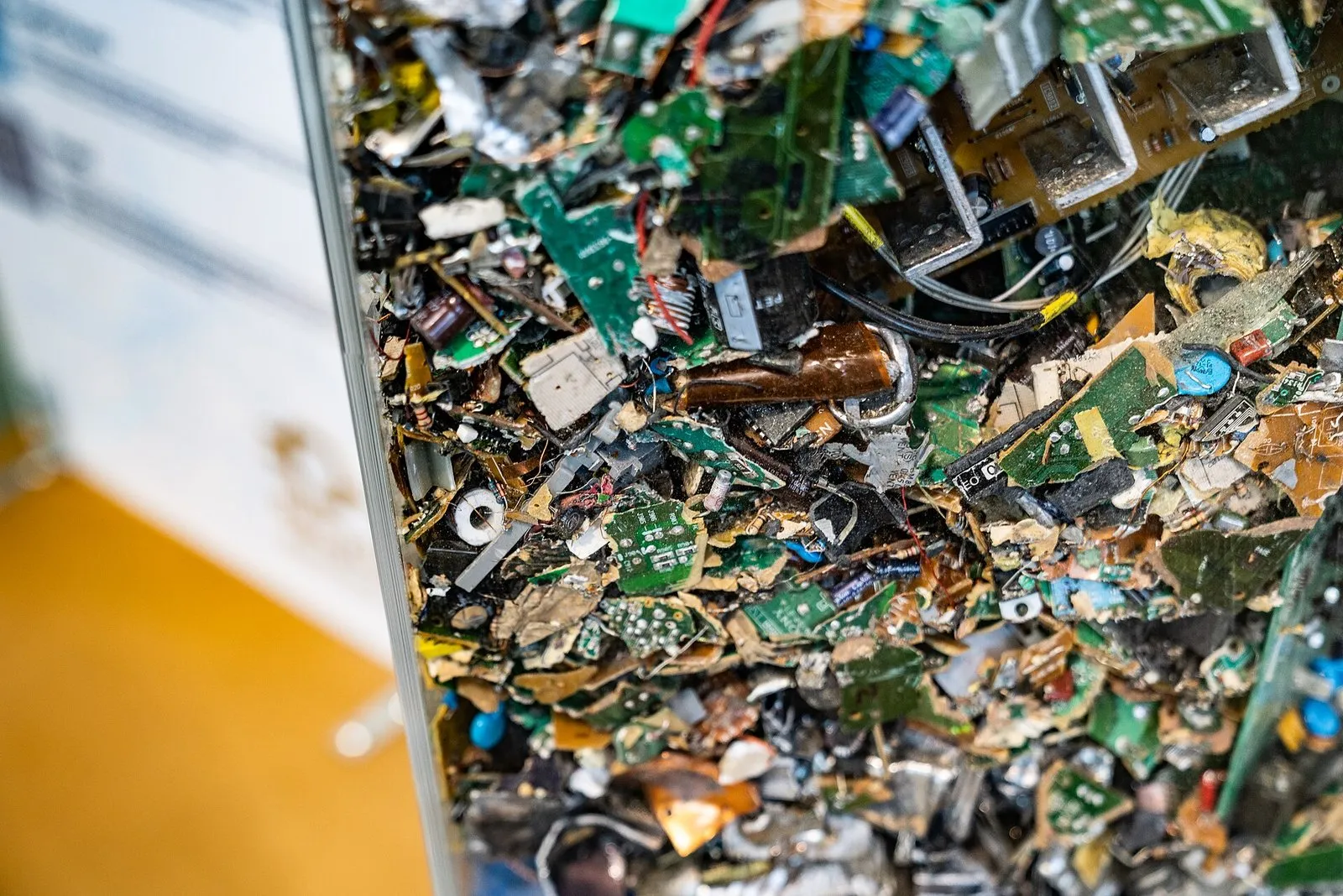
Urban mining is the name given to recovering metals from discarded products, such as cell phones, computers, batteries and old cars. The short answer to the question in the title is no: today, recycling does not replace mines and, according to projections by the International Energy Agency (IEA), it will not replace them in the coming decades either. But it already supplies a significant share of some metals, such as lead, copper and gold, and it can greatly reduce the need for new mines.
In short
- The world generated 62 million tonnes of e-waste in 2022, containing 31 million tonnes of metals, but only 22.3% of that waste was collected and recycled through documented channels.
- Recycling already works well for lead from batteries, copper, aluminum and precious metals, when the material reaches the right plants.
- For rare earths, it meets at most 1% of demand, and lithium and germanium are barely recovered from e-waste.
- The IEA estimates that recycling can reduce the need for new mines by 25% to 40% by 2050, but not eliminate it.
- In Brazil, documented collection is still low, and Law 15,506/2026 now encourages urban mining.
What urban mining is
The idea is to treat waste as a deposit. Law 15,506/2026, which created Brazil’s critical minerals policy, defines urban mining as a process of “collection, disassembly, separation, processing and refining” to recover minerals from electrical and electronic waste, batteries, end-of-life vehicles, construction debris and landfills. Learn more in Law 15,506/2026: what changes with Brazil’s new critical minerals policy.
How much metal there is in e-waste
Quite a lot. According to the Global E-waste Monitor 2024, a report by the International Telecommunication Union (ITU) and the United Nations Institute for Training and Research (UNITAR), the e-waste generated worldwide in 2022 contained about 31 million tonnes of metals, mainly iron, aluminum and copper, plus 1.6 thousand tonnes of precious metals, such as silver, gold and palladium. All of it was worth US$91 billion, including US$19 billion in copper and US$15 billion in gold.
Only US$28 billion worth of materials was recovered, most of it iron. Even so, the report estimates that documented recycling avoided the extraction of 900 million tonnes of ore in 2022. To see where each metal sits inside a device, read What minerals are in your phone.
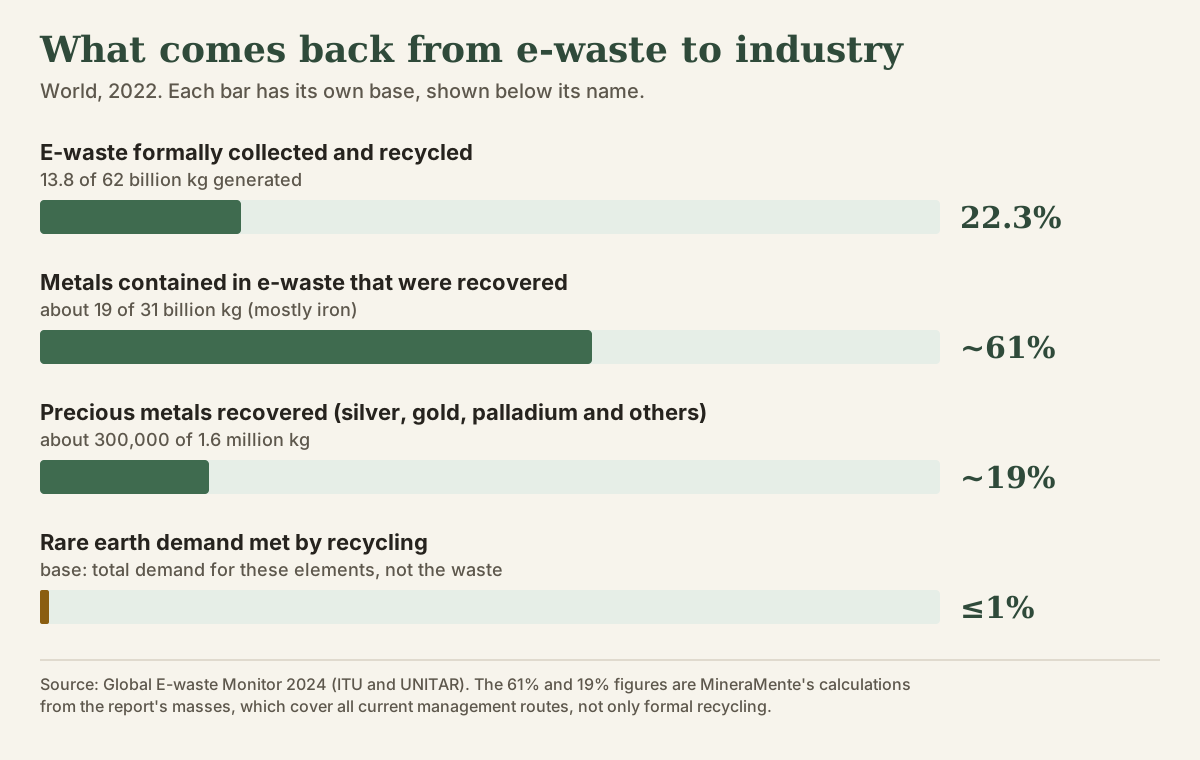
Of the 31 million tonnes of metals, about 19 million were recovered, and 12 million were lost, either in the recycling process itself or in dumps and uncontrolled recycling. For precious metals, recovery was about 300 tonnes, less than one-fifth of the total.
Where recycling already works well
Some metals have long-established, efficient recycling. The table mixes global and U.S. data, because not all figures exist on a global scale.
| Metal | What the data say | Source |
|---|---|---|
| Lead | In the U.S., secondary lead was equivalent to 70% of consumption in 2025, almost all of it from lead-acid batteries. The recycling rate for these batteries in the country reaches 99%. | USGS and IEA |
| Gold | In the U.S., about 90 tonnes of scrap were recycled in 2025, equivalent to about 60% of reported consumption. The figure combines new scrap (manufacturing leftovers) and old scrap (used products) and does not separate what came from electronics. | USGS |
| Copper | Worldwide, secondary supply (from scrap) accounted for 33% of demand in 2023. In the U.S., scrap copper made up about 30% of supply in 2025. | IEA and USGS |
| Aluminum | Worldwide, the recycled share rose from 24% to 26% between 2015 and 2023. | IEA |
| Palladium | When circuit boards are processed in copper-route smelters, palladium recovery can reach 95% or more. | Global E-waste Monitor |
Lead shows what makes the difference: according to the IEA, used lead-acid batteries are worth little, but well-designed rules pushed recycling almost to 100%. For precious metals, the Global E-waste Monitor points out that high rates depend on sorting and treating the waste before it reaches the plants, which still does not happen in most of the world.
Why recycling does not replace mines
There are four main limits.
1. Demand grows faster. You can only recycle metal that has already been extracted and used, so scrap always lags behind consumption. According to the IEA, the share of secondary supply in copper demand fell from 37% in 2015 to 33% in 2023, and for nickel, from 35% to 31%. E-waste, in turn, is growing almost five times faster than documented recycling, according to the ITU.
2. Products take a long time to become waste. According to the IEA, most of what battery recyclers receive today is factory scrap, which should still make up two-thirds of the total in 2030. Used batteries from electric cars and energy storage are only expected to become the main source from 2035 onward. The topic also comes up in Minerals in electric cars: from the battery to the motor.
3. A lot never even reaches recycling. Only 22.3% of the world’s e-waste was collected and recycled through documented channels in 2022. The ITU projects this rate will fall to 20% in 2030. The IEA notes that collection is below 5% in developing countries in Asia and Latin America, compared with 40% to 50% in Europe and North America.
4. Some metals are hard to recover. Rare earths appear in small quantities and are scattered across devices. The e-waste of 2022 contained about 7.2 thousand tonnes of neodymium, used in magnets, according to the Global E-waste Monitor, but separating these magnets is expensive, and rare earth prices still do not pay for large-scale recycling. The report also says that germanium is not recycled from e-waste and that lithium, although recoverable, is not yet economically worthwhile in this stream. To understand the magnet case, read Neodymium magnets: what they are and why they are in electric cars and wind turbines.
How much recycling could cover in the future
The IEA projections, published in November 2024, consider a scenario in which countries meet their announced climate pledges. In that scenario, by 2050:
- recycling reduces the need for new mines by 40% for copper and cobalt and by 25% for lithium and nickel;
- recycled batteries can meet 20% to 30% of demand for lithium, nickel and cobalt, depending on how much is collected;
- the supply of recycled rare earths triples.
The IEA itself stresses that recycling does not remove the need to invest in mining: mid-century demand still exceeds current production, and existing mines lose output over time. Without more recycling, however, the investment needed in mining would be 30% higher. And recycled metals such as nickel, cobalt and lithium emit, on average, 80% less greenhouse gas than mined ones.
What about Brazil?
Brazil’s National Solid Waste Policy (Law 12,305/2010) requires manufacturers, importers, distributors and retailers to set up reverse logistics systems (returning products after use) for batteries and electrical and electronic equipment, among other items. Decree 10,240/2020 detailed the rules for household electrical and electronic equipment, with targets that started at 1% in 2021 and reached 17% in 2025, calculated on the weight of products sold in 2018.
The results are still modest. According to the Global E-waste Monitor, Brazil generated about 2.4 million tonnes of e-waste in 2022 (11.4 kg per person), the largest volume in South America. Documented collection and recycling totaled 79 thousand tonnes, about 3% of the total, by MineraMente’s calculation. The report also mentions circuit boards exported from Brazil to South Korea for metal recovery.
Green Eletron, a nonprofit reverse logistics management organization, collected a record 12.5 thousand tonnes in 2025, according to a CartaCapital report with data from the organization.
What is new is Law 15,506/2026, which treats urban mining as a complementary source of critical minerals. Urban mining companies can receive tax credits of up to 20% of what they spend on these activities, within a cap of R$ 1 billion (Brazilian reais) per year, from 2030 to 2034, for the program as a whole. To find out which minerals count, read Critical and strategic minerals: what they are and why they became a priority.
So, is it worth it?
Yes, with the right expectations. Urban mining eases the pressure for new mines and cuts emissions, but, at least until 2050, it does not make mining unnecessary. For other common ideas about the sector, see Mining myths and facts: what is exaggerated and what is real.
Frequently asked questions
What is urban mining?
It is the recovery of metals and minerals from discarded products, such as electronics, batteries and end-of-life vehicles. Brazil’s Law 15,506/2026 defines it as a process of collecting, disassembling, separating, processing and refining this waste.
Can recycling e-waste replace mining?
No. According to the IEA, recycling can reduce the need for new mines by 25% to 40% by 2050, in a scenario where countries meet their climate pledges, but mining remains necessary because demand keeps growing.
Which metals are recycled the most?
Iron, aluminum, copper, lead and precious metals such as gold, silver and palladium. In the U.S., almost all lead-acid batteries are recycled, and recycled gold was equivalent to about 60% of consumption in 2025.
Why is it hard to recycle rare earths?
They appear in small quantities and are scattered across devices, and separating the magnets is expensive. Today, recycling meets at most 1% of global rare earth demand.
Where can I dispose of electronics in Brazil?
At drop-off points of the reverse logistics systems set up under Decree 10,240/2020, such as those run by management organizations. The device should be turned off and wiped of personal data before you hand it in.
Found this article useful? Share it with someone who also wants to understand mining.
Share
Sources
- ITU and UNITAR – The Global E-waste Monitor 2024 (full report, March 2024)
- ITU (UN) – Global E-waste Monitor 2024: press release (March 20, 2024)
- IEA – Recycling of Critical Minerals: Executive summary (November 2024)
- USGS – Mineral Commodity Summaries 2026: Lead (February 2026)
- USGS – Mineral Commodity Summaries 2026: Gold (February 2026)
- USGS – Mineral Commodity Summaries 2026: Copper (February 2026)
- Planalto – Law No. 12,305/2010 (National Solid Waste Policy)
- Planalto – Decree No. 10,240/2020 (reverse logistics for electrical and electronic equipment)
- Federal Senate – Law No. 15,506, of September 16, 2026 (full text)
- Green Eletron – institutional page
- CartaCapital – E-waste is still forgotten in Brazilian homes (August 5, 2026)
Comments
No comments yet. Be the first to comment.