Mining on Indigenous lands in Brazil: what Congress is debating
Brazil's Supreme Court gave Congress 24 months to regulate mining on Indigenous lands. See the bills under review, each side's arguments and what to watch.
Translated from the original article in Portuguese. Read the original.
Mining on Indigenous lands is permitted by Brazil’s 1988 Constitution, but only under the conditions of a law that, 38 years later, still does not exist. In August 2026, Brazil’s Supreme Federal Court (STF) gave Congress 24 months to pass that law. In Congress, there are bills that have been stalled for years in the Chamber of Deputies and a working group in the Senate.
What happened
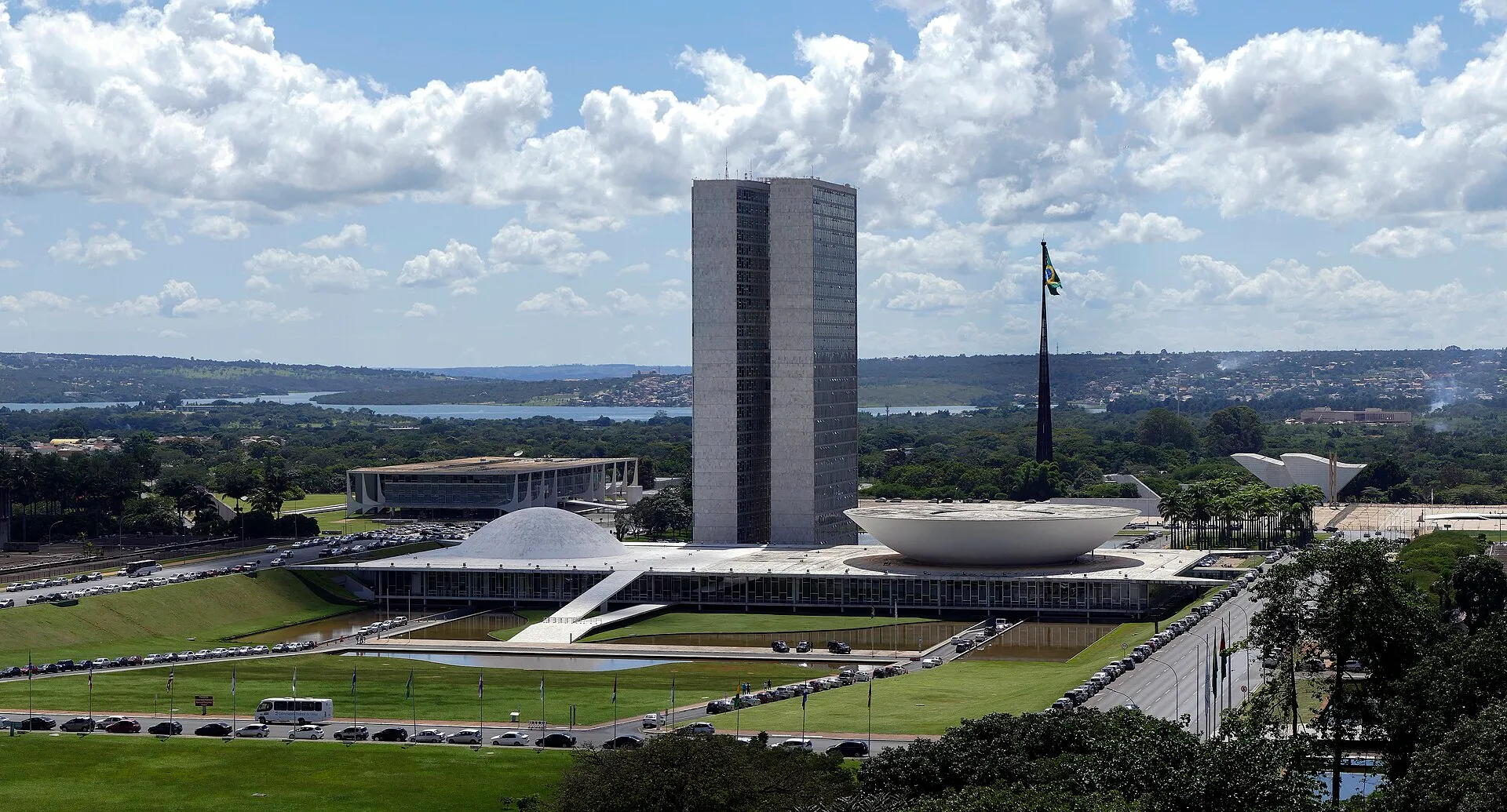
The starting point is the Constitution. Article 231 guarantees Indigenous peoples the exclusive use of the riches of the soil, rivers and lakes on their lands. Paragraph 3 of the same article says that mineral exploration and mining (extraction) in these areas “can only be carried out with the authorization of the National Congress, after hearing the affected communities,” which have the right to share in the results. Article 176, paragraph 1, adds that a law must set the “specific conditions” for mining on Indigenous lands. Without that law, there are no rules for authorizing any project in these territories.
The Coordination of Indigenous Organizations of the Cinta Larga People (PATJAMAAJ), a people living in the states of Rondônia and Mato Grosso, took the case to the STF through a writ of injunction (mandado de injunção, MI 7516), a type of lawsuit used when the lack of a law prevents a right from being exercised. According to the STF, the organization argued that the lack of regulation prevents the Cinta Larga from exploiting the mineral reserves on their lands and from receiving a share of the results.
In February 2026, the justice in charge of the case, Flávio Dino, recognized the omission and gave Congress the 24-month deadline. In his view, mining on Indigenous lands already happens, but “in an illegal, clandestine, violent way and without respect for environmental rules.” On August 13, 2026, the full STF upheld the decision. Until there is a law, the Court set provisional conditions, which the court’s news release describes as applying to the Cinta Larga land:
| Provisional condition | What it requires |
|---|---|
| Consultation | Free, prior and informed, under ILO Convention 169 |
| Area | At most 1% of the demarcated Indigenous territory |
| Who mines | Preference for the Indigenous people themselves, through a cooperative with government support |
| If someone else mines | With the Indigenous people’s authorization, they receive 50% of the amount owed to states, municipalities and the federal government |
| Use of the money | Territorial security, health, education, sustainable production and environmental recovery |
| Environment | Environmental impact study, rehabilitation of degraded areas and compensation |
The STF stresses that the decision does not authorize mining on Indigenous lands. The court also ordered the federal government to remove illegal wildcat mining from the Cinta Larga territory, by force if necessary. On this point, Justice Edson Fachin was outvoted: he would only have recognized the omission and ordered the law to be passed.
What Congress is debating
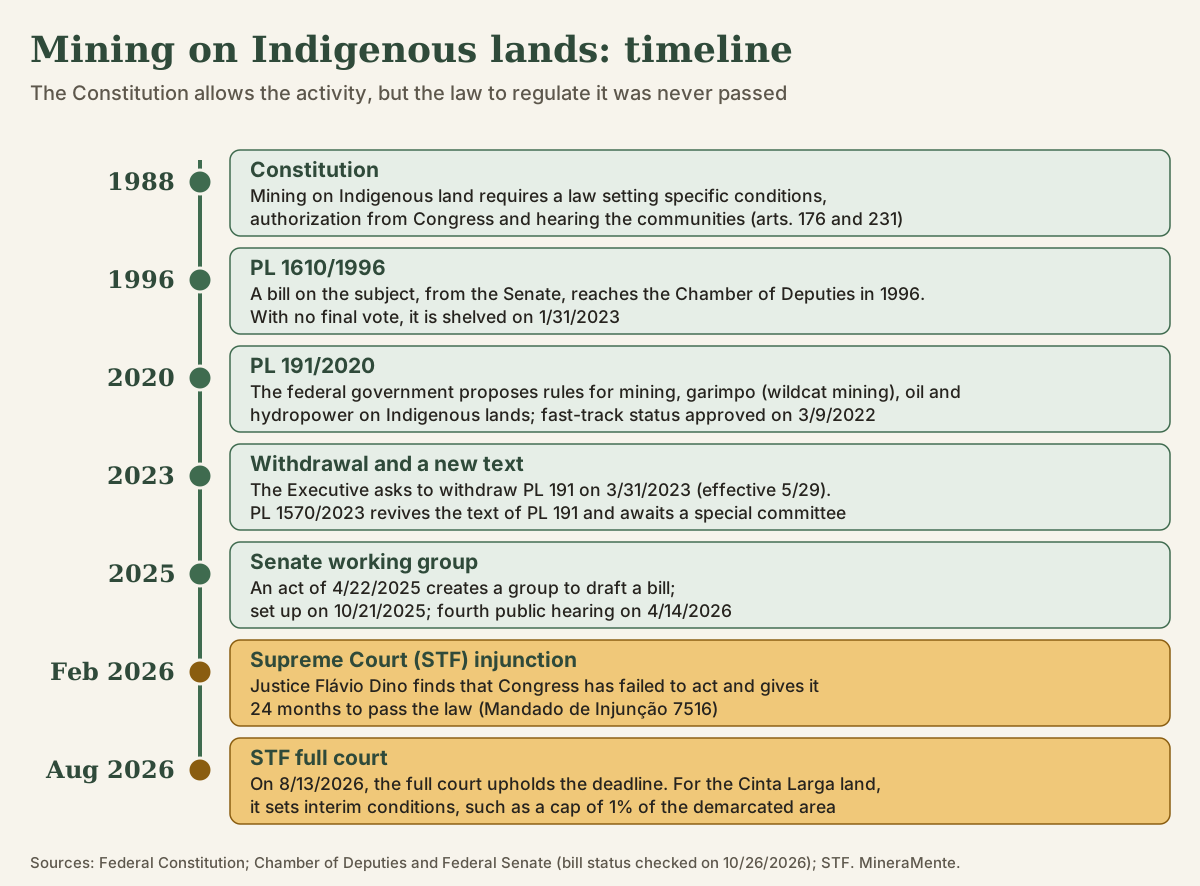
The status below was checked on the Chamber of Deputies and Senate websites on October 26, 2026.
PL 191/2020 (withdrawn). Sent by the federal government in February 2020, this bill (projeto de lei, PL) set rules for mining, wildcat mining, oil and hydroelectric dams on Indigenous lands. On March 9, 2022, the Chamber approved fast-track status, but the text was never voted on. On March 31, 2023, the executive branch asked for it to be withdrawn, which became official on May 29, 2023.
PL 1570/2023 (awaiting a special committee). Introduced by Deputy José Medeiros (PL-MT), it has the same summary as PL 191, and its justification says the bill “comes from the Presidency of the Republic.” Under the text, the President may ask Congress for authorization even if the communities object, as long as the request is justified, and the communities receive 50% of the CFEM, the financial compensation paid by mining. It also allows wildcat mining in zones defined by the ANM (Brazil’s National Mining Agency), with the consent of the Indigenous people. Five other bills, from 2023 to 2025, are attached to it. The Chamber decided to create a special committee to examine the issue, but it has not yet been formed.
Proposals in the opposite direction. PL 3240/2021, by then-Deputy Joenia Wapichana (Rede-RR), bans exploration and mining permits on Indigenous lands and increases penalties for illegal extraction. It is being processed together with older bills, which are also awaiting a special committee. PL 4730/2025, in turn, makes prior consultation of Indigenous and quilombola communities (communities descended from people who escaped slavery) affected by mining mandatory, and is awaiting an opinion from the Mines and Energy Committee.
Senate. An act by the President of the Senate on April 22, 2025, created a working group to draft a bill on the issue. Set up on October 21, 2025, with Senator Rogério Carvalho (PT-SE) as rapporteur, it held public hearings on the geological potential of Indigenous lands, the peoples’ share in the results and the experience of other countries. The last one on record was on April 14, 2026. On May 26, 2026, Senator Dr. Hiran (PP-RR) introduced PL 2608/2026, which also regulates the two articles of the Constitution and is awaiting referral.
Why it matters
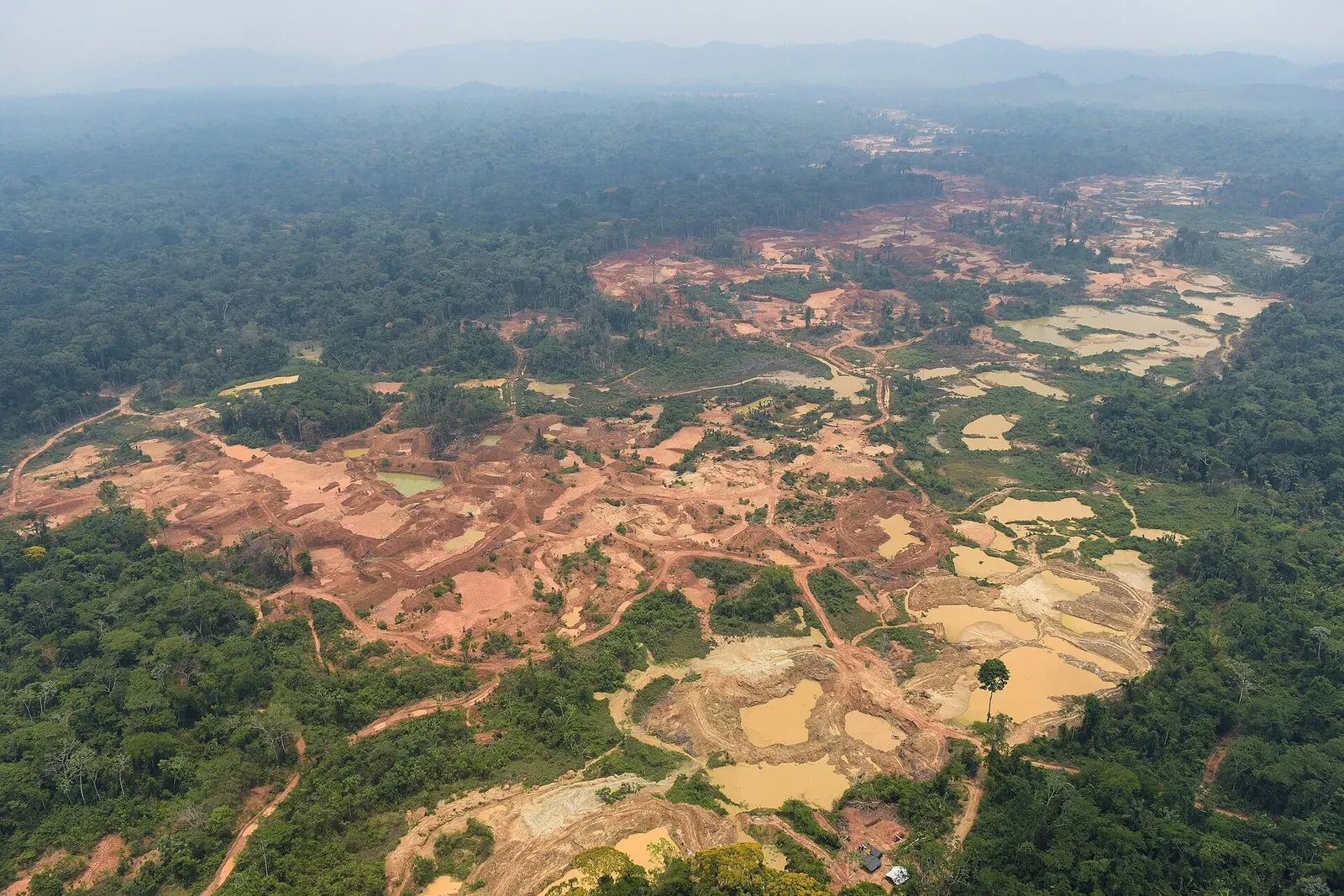
Because, in practice, mining already exists in these areas, but in the form of illegal wildcat mining (garimpo). According to MapBiomas, in 2022 there were 25,100 hectares of wildcat mining inside Indigenous lands in the Amazon, 10% of the entire wildcat-mined area in the biome. The hardest hit were the Kayapó (13,800 hectares), Munduruku (5,500) and Yanomami (3,300) lands.
It is important to keep the two things separate. Illegal wildcat mining operates without a license, without studies and without oversight, and in gold mining it uses mercury, as we explain in Environmental impacts of mining. Regulated mining, which is what the debate in Congress is about, would depend on authorization, environmental licensing and consultation. The difference between mining and garimpo is also covered in Mining myths and facts.
The debate is also taking place at a time when mineral policy is in the spotlight in Brazil, as shown by Law 15,506/2026, which created the critical minerals policy.
The sides of the debate
In favor of regulating. The government that sent PL 191 in 2020 argued that the lack of a law creates legal uncertainty, illegal mining, lack of oversight, failure to pay compensation and conflicts between companies and Indigenous peoples. PATJAMAAJ, the association that took the case to the STF, defends the right of the Cinta Larga to exploit their resources and receive a share of the gains. Justice Flávio Dino summed up this reasoning by saying that, without rules, Indigenous peoples are left with only the burdens: poverty, disease and environmental damage.
Against, or with strong reservations. The Articulation of Indigenous Peoples of Brazil (Apib) listed ten risks in the STF decision. Among them: regulation arising from the request of an association of a single people, “without adequate consultation of the country’s 391 Indigenous peoples,” the two-year deadline and uncertainty about how to apply the 1% limit. The Indigenist Missionary Council (Cimi) says that using the state’s inability to curb crime to justify exploitation is a reversal: the answer should be to enforce the law and remove the invaders. The Federal Public Prosecutor’s Office (MPF), through its 6th Chamber, analyzed PL 191 in a 2020 technical note and, in public notes in 2021 and 2022, stated that the bill was unconstitutional.
Positions that don’t fit on just one side. In 2022, the Brazilian Mining Institute (IBRAM), which brings together large mining companies, said that PL 191 “is not suitable for its intended purposes,” argued that the free, prior and informed consent of Indigenous peoples is “essential” and said it condemns illegal wildcat mining. Funai (Brazil’s National Indigenous Peoples Foundation), in 2025, asked for the debate to go through the National Council for Indigenous Policy and for any rule to respect the rights of Indigenous peoples.
| Point in dispute | Those in favor of regulating argue | Critics argue |
|---|---|---|
| Illegal wildcat mining | Rules and oversight would bring the activity out of hiding | The answer to crime is removing invaders, not opening up the territories |
| Consultation | The law can define how to hear the communities | Hearing them is not enough: the peoples must be able to say no |
| Income | A share of the results funds health, education and protection | Basic services should not depend on mining |
| Scale | The 1% limit restricts the affected area | Rivers, roads and wildlife are affected beyond the mined area |
What now?
- The clock is ticking. Congress has 24 months to pass the law. Until then, the provisional conditions set by the STF apply to the Cinta Larga land, not to all Indigenous lands.
- Chamber of Deputies. The next step is the creation of the special committee for PL 1570/2023 and the bills attached to it.
- Senate. It is worth following the working group’s report and the progress of PL 2608/2026.
- Cinta Larga territory. In June 2026, the STF gave the federal government 30 days to present a plan to remove illegal wildcat mining, to be carried out within 60 days of approval. In August, the court also ordered the completion of the hearings with the communities on the possibility of mining in the territory.
Whatever law comes will need to answer hard questions: who decides, how much of the land can be affected, how the money reaches the communities and who oversees it.
Frequently asked questions
Is mining on Indigenous lands banned in Brazil?
The Constitution does not ban the activity: it requires a specific law, authorization from Congress and that the affected communities be heard. That law has never been passed, and the STF gave Congress 24 months to enact it.
Did the STF allow mining on Indigenous lands?
No. The STF recognized Congress’s omission and gave it 24 months to pass the law. According to the court, the decision does not authorize mineral extraction on Indigenous lands.
Found this article useful? Share it with someone who also wants to understand mining.
Share
Sources
- Federal Constitution of 1988, arts. 49, 176 and 231 (Planalto, consolidated text)
- Chamber of Deputies – PL 191/2020: text, explanatory statement and legislative history (accessed October 26, 2026)
- Chamber of Deputies – PL 1570/2023 and attached bills (legislative history accessed October 26, 2026)
- Chamber of Deputies – PL 3240/2021 (legislative history accessed October 26, 2026)
- Chamber of Deputies – PL 1610/1996 (legislative history accessed October 26, 2026)
- Chamber of Deputies – PL 4730/2025, prior consultation in mining activities (legislative history accessed October 26, 2026)
- Federal Senate – ATS 1/2025, working group on mining on Indigenous lands (accessed October 26, 2026)
- Federal Senate – PL 2608/2026 (accessed October 26, 2026)
- STF – Supreme Court gives Congress 24 months to pass a law on mining on Indigenous lands (February 6, 2026)
- STF – STF orders the federal government to draw up a plan to remove illegal wildcat mining from Cinta Larga territory (June 2, 2026)
- STF – Congress has 24 months to pass a law on mining on Indigenous lands, STF rules (August 13, 2026)
- Federal Public Prosecutor's Office (MPF), 6th Chamber – Technical and public notes on PL 191/2020 (2020 to 2022)
- Funai – Mining on Indigenous lands: Funai puts the issue in context at the CNPI plenary (May 10, 2025)
- Apib – 10 risks of the STF decision on regulating mining on Indigenous Lands (February 24, 2026)
- Cimi – Mining on Indigenous lands: when constitutional protection is turned into a promise of exploitation (August 18, 2026)
- Poder360 – Mining companies oppose bill that allows wildcat mining on Indigenous land (IBRAM statement, March 15, 2022)
- MapBiomas – Proximity of wildcat mining, rivers and lakes in the Amazon (April 2024, 2022 data)
Comments
No comments yet. Be the first to comment.