Foreign capital in Brazilian rare earths: risks and opportunities
Foreign firms hold 42% of rare earth exploration applications in Brazil and most of the advanced projects. See who they are and what the new law says.
Translated from the original article in Portuguese. Read the original.
Foreign companies are already at the center of rare earths in Brazil. According to a survey by the Brazilian news outlet Repórter Brasil with the Associated Press, based on data from Brazil’s National Mining Agency (ANM), they account for 42% of the exploration applications for these minerals and for 31 of the country’s 45 most advanced cases. That brings money and experience, but it also raises questions about who keeps the value and the control of this resource. Below, we explain what the numbers show, who the companies are, the arguments on each side and what the new law changes.
What happened
In August 2026, Repórter Brasil published its analysis of every application filed with the ANM in which rare earths appear as the main substance. An application is the request a company makes to explore or mine an area. The owners of each company were identified using records from the Receita Federal (Brazil’s federal tax authority), state business registries and the U.S. capital markets regulator.
The main findings, with data through June 2026:
- there were 2,727 applications, and 86% of them were filed from 2023 onward;
- companies linked to foreign capital are only 12% of the holders, but have 42% of the applications;
- among the 45 most advanced cases (in operation or in commercial pre-operation), 31 belong to foreign capital;
- 11 of the 20 companies with the most applications have links to foreign investors;
- Australian companies lead, with 695 applications, followed by American companies, with 347.
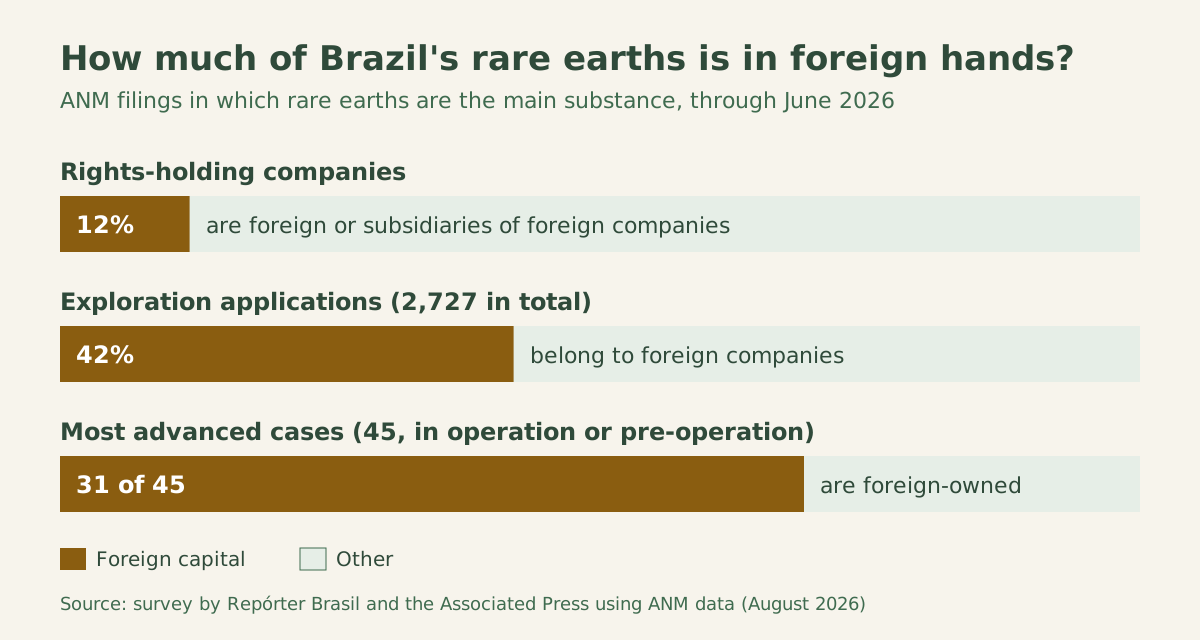
In other words, there are fewer foreign companies than Brazilian ones in the race, but they apply for more areas and are closer to producing.
Who the main companies are
The names that appear most often in the advanced projects come from Australia, the United States and Canada. The table summarizes what each company says about where it plans to separate the elements, the most valuable stage of the chain.
| Company (origin) | Project | What the company says about processing |
|---|---|---|
| USA Rare Earth (United States), owner of Serra Verde since September 3, 2026 | Pela Ema mine, Minaçu (Goiás), the only one in commercial production | First-phase output of neodymium, praseodymium, dysprosium and terbium is sold, under a contract announced as a 15-year deal, to a vehicle financed by U.S. government agencies and private capital. The acquisition announcement does not say where the material will be separated. |
| Lynas (Australia), in the process of buying Meteoric | Caldeira, Poços de Caldas (Minas Gerais) | Lynas “will carry out studies” on further processing in Brazil and mentions the possibility of integrating the project with its plant in Malaysia. |
| Aclara (Canada) | Carina, Nova Roma (Goiás) | Plans to ship a rare earth carbonate to its future separation plant in Louisiana, in the United States. |
| Brazilian Rare Earths (Australia) | Rocha da Rocha (Bahia) | Plans a refinery with a separation stage at the Camaçari Petrochemical Complex (Bahia). At the mine, only dry concentration. |
The geological details of each project are in Rare earths in Brazil: where they are and which projects exist. The Lynas deal is explained in The Caldeira Project in Poços de Caldas: what the Lynas takeover means.
What about China? According to Repórter Brasil, Chinese companies had no rare earth applications in Brazil as of June 2026, but they are starting to move. Mineração Taboca, Brazil’s largest producer of refined tin, was bought by the state-owned China Nonferrous Metal Mining Group and announced plans to study rare earths in the area around the mine, in the Amazon. In 2025, China’s Shenghe Resources signed a memorandum of understanding with the Brazilian companies WEG Mineração and Fenrir do Brasil.
Why it matters
China accounts for most of the world’s rare earth refining, as we explain in Why China dominates rare earths. The United States, Australia and other countries are looking for sources outside China, and Brazil, with the world’s second-largest reserves (about 11 million tonnes, according to the United States Geological Survey), has become a natural target. For Robert Muggah, co-founder of the Igarapé Institute, the movement “appears to be part of a broader attempt to build a rare earth supply chain without China,” with Brazil as a resource base.
The Serra Verde case shows the scale of the interest. According to USA Rare Earth’s April 2026 announcement, the Brazilian company had already secured US$ 565 million in financing from the DFC, the U.S. government’s development finance agency, and the offtake contract includes guaranteed minimum prices for neodymium, praseodymium, dysprosium and terbium, the elements used in magnets. Repórter Brasil also cites US$ 1.6 billion in support from the U.S. Department of Commerce to USA Rare Earth, announced in January 2026. The purchase was completed for about US$ 2.8 billion, as we report in Why is everyone talking about rare earths?.
The underlying question is: how much of the value of rare earths will stay in Brazil? The mine produces concentrate, and most of the value is in the following stages: separating the elements, producing metals and making magnets. Learn more in Rare earths: what they are, what they are used for and why Brazil matters.
The sides of the debate
The arguments for foreign capital
- Mineral exploration is expensive and risky. Julio Nery, director of mining affairs at Ibram (the Brazilian Mining Institute, which represents mining companies), told Repórter Brasil that, of every thousand rare earth occurrences, only a hundred justify drilling. “Of those hundred, you end up with only two good projects,” he said. Foreign companies help shoulder that risk.
- Knowledge and capital. About the Australian mining companies, Muggah said: “They bring geological knowledge, capital, a willingness to take risks and credibility with Western governments looking for alternatives to Chinese supply.”
- A guaranteed market. Long offtake contracts, like Serra Verde’s, provide predictability for financing the mine.
- Local jobs. Serra Verde had more than 350 employees in April 2026, not counting contractors, and 66% of them were from the local community, according to USA Rare Earth.
- Refining experience. Lynas is the only commercial producer of separated light and heavy rare earth oxides outside China, according to the company itself. That is precisely the stage Brazil has not mastered.
The arguments of those urging caution
- The value may go abroad. If the concentrate is separated in the United States, Malaysia or another country, Brazil keeps the lowest-value stage. Congressman Zé Silva (União Brasil party, Minas Gerais), author of the bill that became Law 15,506/2026, summed up the position: “companies are welcome to invest, but they need to transfer technology to Brazil, including processing capacity.”
- Output already committed. Contracts that send a mine’s entire output of magnet elements to a single buyer for 15 years may limit the use of that material by a future Brazilian magnet industry.
- Concentration. According to the survey, a few companies, most of them foreign, account for a large share of the applications and of the most advanced projects.
- Impacts on territories. According to Repórter Brasil, 25% of the applications overlap with or are within 10 km of conservation units or traditional communities. One example is the Quilombo Família Magalhães, in Goiás, an Afro-Brazilian community descended from people who escaped slavery, whose territory partly coincided with areas of the Carina Project. Aclara says it decided to exclude those areas and that they “will remain outside the project.”
There is also a middle position, which appears within the government itself. Carlos Leonardo Durans, a director at Brazil’s Ministry of Development, Industry, Trade and Services (MDIC), told Repórter Brasil that “the passport to operate in our country is a real commitment to joint development, to adding value.” Brazilian Rare Earths, with its planned refinery in Bahia, is an example of a foreign company promising to do the separation in Brazil.
What the new law changes
Law 15,506/2026, signed on September 16, does not prohibit or limit foreign participation. It does, however, create a screening mechanism: the council created by the law (Cimce) and the ANM may have to approve transactions such as:
- a change of control, direct or indirect, of companies holding mineral rights to critical and strategic minerals;
- “relevant participation or significant influence of foreign legal entities” in these companies;
- international supply contracts and partnerships for these minerals;
- the sale or assignment of mining titles.
The law also allows exports to be tied to value-adding commitments and allows the government to require information on the volume, destination and final beneficiary of what is exported.
The mechanism is already in use. According to the Lynas and Meteoric announcement, the purchase of the Caldeira Project depends on the council’s approval for the change of control. But there are gaps: according to an analysis by the law firm Demarest, the decree that regulated the council did not set objective criteria for concepts such as “relevant participation” and “significant influence.” In practice, it is still not clear which deals will need to go through the council.
What happens now?
With the reelection of President Lula on October 25, a few points will show where the sector is heading:
- The first decision on Caldeira. It will be a test of how the council handles a change of control between two foreign companies and whether it will require any commitment to processing in Brazil.
- The regulation of screening. Clearer criteria will determine which deals need approval and what can be required of companies.
- Where the separation plants will be built. Camaçari, Poços de Caldas, Louisiana, Malaysia: the companies’ decisions in the coming years will determine how much of the value stays in the country.
- Territorial conflicts. With thousands of exploration applications, licensing and consultation with communities remain at the center of the debate.
The discussion is no longer so much about whether to let foreign companies in, but about the conditions under which they operate. MineraMente will follow every step.
Found this article useful? Share it with someone who also wants to understand mining.
Share
Sources
- Repórter Brasil and Associated Press – Mineradoras estrangeiras detêm 4 a cada 10 projetos de terras raras no Brasil (Foreign mining companies hold 4 in 10 rare earth projects in Brazil) (August 20, 2026)
- Planalto – Lei nº 15.506, de 16 de setembro de 2026 (Law No. 15,506 of September 16, 2026, National Policy on Critical and Strategic Minerals)
- Demarest Advogados – Lei que institui a Política Nacional de Minerais Críticos e Estratégicos é sancionada; governo regulamenta o CIMCE (Law establishing the National Policy on Critical and Strategic Minerals is signed; government regulates the CIMCE) (September 18, 2026)
- USA Rare Earth – USA Rare Earth announces definitive agreement to acquire Serra Verde, press release attached to Form 8-K filed with the SEC (April 20, 2026)
- USA Rare Earth – USA Rare Earth Completes Combination with Serra Verde Group, press release attached to Form 8-K filed with the SEC (September 4, 2026)
- Lynas Rare Earths and Meteoric Resources – Lynas Rare Earths to acquire Meteoric Resources, joint announcement to the ASX (October 1, 2026)
- Brazilian Rare Earths – Rocha da Rocha Scoping Study, announcement to the ASX (August 13, 2026)
- USGS – Mineral Commodity Summaries 2026: Rare Earths
- Aclara Resources – Carina Project pre-feasibility study, release via Stockwatch (November 6, 2025)
Comments
No comments yet. Be the first to comment.