Why China dominates rare earths (and what other countries are doing)
How China came to control rare earth mining, refining and magnets, when it used that power, and what the US, Australia, Japan and Europe are doing.
Translated from the original article in Portuguese. Read the original.
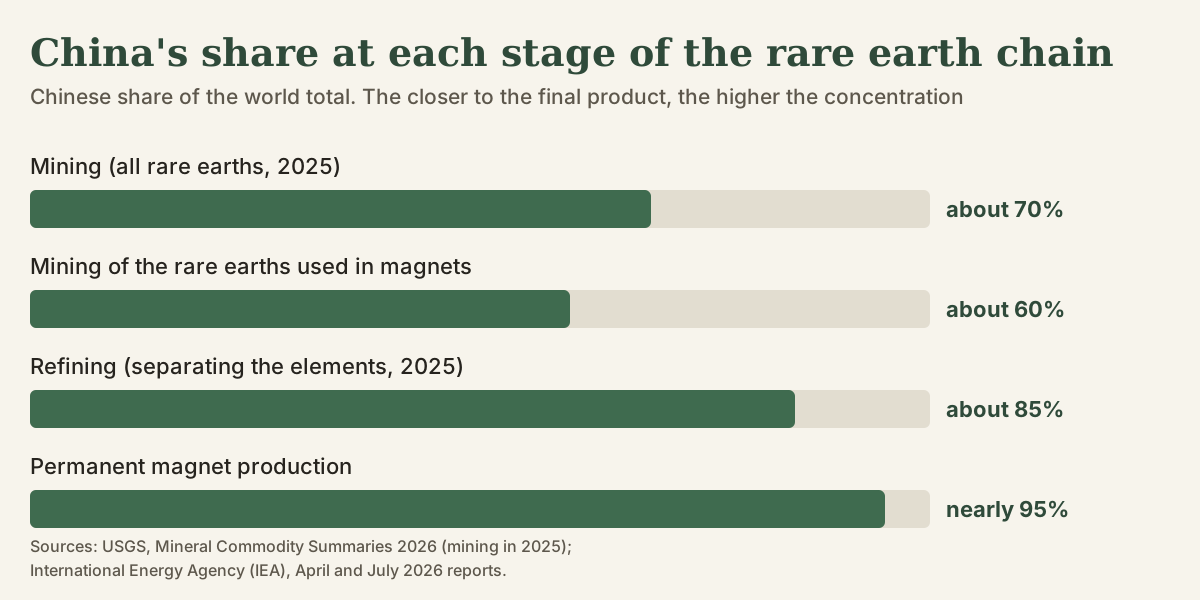
China dominates rare earths because it spent four decades building the entire chain, from mine to magnet. It combined a giant deposit, low costs, lax environmental rules in the past, state support and industrial scale. In 2025, the country mined about 70% of the world’s rare earths and did about 85% of the refining. The United States, Australia, Japan, Europe and Brazil are racing to catch up, but the task takes years.
In short
- According to the United States Geological Survey (USGS), China produced about 270,000 of the 390,000 metric tons of rare earths mined worldwide in 2025.
- In the later stages, its share is larger: about 85% of refining in 2025 (it was over 90% in 2023) and almost 95% of permanent magnets, according to the International Energy Agency (IEA).
- Until the mid-1980s, the largest producer was a mine in the United States. The turning point came between the 1980s and the 1990s.
- China has already used this power as leverage: against Japan in 2010 and through export controls in 2023 and 2025.
- Other countries are investing in mines, refineries, stockpiles and recycling, but the IEA estimates that about US$60 billion will be needed over the next decade.
How much China dominates today
Rare earths are 17 chemical elements used mainly in the magnets of electric motors and wind turbines (the basics are in Rare earths: what they are, what they’re used for and why they matter to Brazil). The chain runs from the mine to refining, which separates the elements, and from there to metals, alloys and magnets. China leads every stage, and its share grows closer to the final product. In refining, it has started to fall: from over 90% in 2023 to about 85% in 2025, according to the IEA.
How it started: Bayan Obo and the turning point of the 1990s
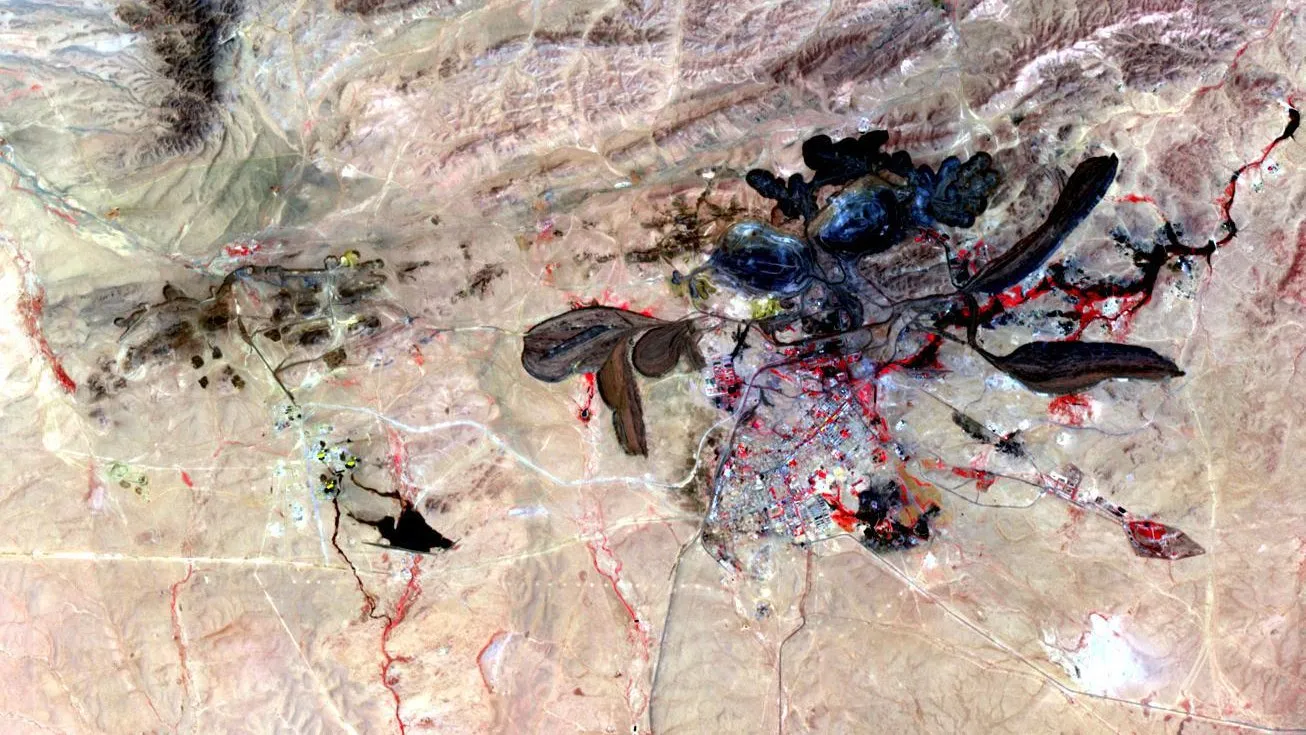
The center of the story is Bayan Obo, in Inner Mongolia, in northern China. According to the USGS, rare earths were identified there in 1927, and concentrate production began in 1957. It is an iron, niobium and rare earth deposit with reserves of at least 40 million metric tons of oxides (an estimate published by the USGS in 2002).
But from 1965 to the mid-1980s, the world’s main source was the Mountain Pass mine in California, and the US was practically self-sufficient. After a transition, the “Chinese era” began around 1991, according to the USGS. Between 1990 and 2000, Chinese production jumped from about 16,000 to 73,000 metric tons, while the rest of the world’s fell from 44,000 to 16,000. China’s share went from 27% in 1990 to over 90% in 2008.
A famous phrase sums up this vision: “The Middle East has oil, China has rare earths.” It is attributed to Chinese leader Deng Xiaoping in 1992. An article in the American magazine The National Interest places it in a January 1992 speech, citing China National Radio, but other sources point to different occasions, and we found no official transcript.
Why China won the race
Lower costs. In 2002, the USGS pointed to much lower labor and regulatory costs in China than in the US, as well as deposits favorable in number, size and heavy rare earth grade.
Less strict environmental rules in the past. According to a 2011 USGS report, part of the production came from unlicensed miners using obsolete technology, who caused significant environmental damage in Guangdong, Jiangxi and Sichuan. Many of these southern deposits are ionic clay deposits, whose impact we have already explained. In the US, environmental problems with Mountain Pass’s wastewater pipeline led to the closure of its separation plant, the USGS recorded.
The state in charge. In 1990, China declared rare earths a strategic, protected mineral. Foreigners were banned from mining and could only do separation in partnership with Chinese companies. The government set production and export quotas. In the 1990s, it refunded taxes to exporters; later it reversed course, eliminating that incentive in 2005 and starting to charge an export tax in 2007.
Refining and magnets. China did not stop at the mine. In 1998, a national basic research program put rare earth materials among its priorities, according to the USGS. Two decades ago, the country made about half of the world’s permanent magnets; today it makes almost 95%, according to the IEA. See why these magnets matter in Neodymium magnets: what they are and why they’re in electric cars and wind turbines.
Large state-owned groups. The government encouraged mergers and reduced the sector to six large state-owned groups. In December 2021, the rare earth businesses of Chinalco, China Minmetals and Ganzhou Rare Earth Group formed China Rare Earth Group, controlled by the central government, according to China Daily. The goal, according to the consultancy China Briefing, was to gain power over prices.
When rare earths became a tool of pressure
2010: the Japan case. In September, after the arrest of a Chinese fishing boat captain near the Senkaku Islands (Diaoyu, to the Chinese), Japanese companies reported that China had halted rare earth shipments to Japan. China’s Ministry of Commerce denied any ban, according to the AP news agency. An analysis in the Harvard National Security Journal treated the episode as apparent retaliation, lasting about a month.
2012 to 2015: the WTO dispute. The US, the European Union and Japan challenged China’s export quotas and taxes. In 2014, the World Trade Organization concluded that the quotas served industrial policy, not resource conservation, as China claimed. In 2015, China reported that it had eliminated them.
2023: technology. In December, China banned the export of technologies to extract and separate rare earths, produce metals and alloys, and make some magnets, citing national security and the public interest, according to Reuters.
2025 and 2026: the elements. In April 2025, China began controlling exports of seven rare earths, including dysprosium and terbium. In October, it expanded the list and, in November, suspended that expansion for one year, while keeping the April controls, according to the USGS. The IEA says the controls caused short-term disruptions and that, if fully applied, they would put up to US$6.5 trillion in economic activity per year outside China at risk. In January 2026, new restrictions on dual-use (civilian and military) products, including rare earths, targeted Japan, according to the American think tank CSIS.
China’s official argument is national security and the protection of resources and the environment. The buyers’ argument is the risk of depending on a single supplier.
What other countries are doing
United States. The US mined about 51,000 metric tons in 2025 (USGS). In July 2025, MP Materials, which operates Mountain Pass, signed a deal with the Department of Defense: the government bought US$400 million in preferred stock, set a ten-year price floor of US$110 per kilogram for the company’s neodymium-praseodymium products, and guaranteed buyers, for ten years, for the entire output of a new magnet factory scheduled for 2028, according to the company. As part of the deal, MP committed to stop selling to China. In addition, the government planned new purchases for its strategic stockpile, according to the USGS.
Australia. It mined about 29,000 metric tons in 2025, according to the USGS. Lynas extracts ore at Mt Weld and separates it at a plant in Malaysia. In May 2025, it announced its first separated dysprosium and describes itself as the only commercial producer of separated heavy rare earths outside China. Iluka is building a refinery at Eneabba, with an A$1.65 billion government loan and a start expected in mid-2027, according to the company.
Japan. After 2010, it invested in refining and recycling at home and in mines and processing abroad, according to CSIS, including US$250 million in Lynas in 2011. In October 2025, the Japanese trading company Sojitz began importing heavy rare earths from Lynas, according to Reuters. Even so, China accounted for 63% of Japan’s rare earth metal imports in 2024, according to CSIS.
European Union. The European Critical Raw Materials Act has been in force since May 23, 2024. The 2030 targets are to extract within the bloc at least 10% of annual consumption, process 40%, recycle 25%, and not depend on any single outside country for more than 65%. In October 2026, the European Commission selected 46 new strategic projects, four of them in rare earths.
Brazil. It has the world’s second-largest reserves, about 11 million metric tons, but produced only about 2,000 metric tons in 2025, according to the USGS. See the projects in Rare earths in Brazil: where they are and which projects exist, the new Law 15,506/2026 and the purchase of the Caldeira Project, in Minas Gerais, a state in southeastern Brazil, by Lynas itself. The political debate is covered in Why is everyone talking about rare earths?.
Why diversifying takes time
The IEA estimates that about US$60 billion will be needed over the next decade to diversify the chain and concludes that no country can build it alone. If planned projects move forward, China’s share of refining could fall to about 70% by 2035, according to the agency. Even so, projects outside China still fall well short of what is needed for projected demand. Since mines and refineries take years to complete, dependence is likely to decline only gradually.
Frequently asked questions
Does China have the world’s largest rare earth reserves?
Yes. According to the USGS, it has about 44 million metric tons, out of a world total of over 75 million. Brazil comes second, with about 11 million.
Since when has China dominated rare earths?
Since the early 1990s. Before that, the world’s largest source was the Mountain Pass mine in the US. By 2008, China already accounted for over 90% of production, according to the USGS.
What are China’s rare earth export controls?
They are rules that require a license to sell certain elements and products abroad. In April 2025, China added seven rare earths, including dysprosium and terbium.
Did Deng Xiaoping really say that “China has rare earths”?
The phrase “the Middle East has oil, China has rare earths” is attributed to him, in 1992. Sources disagree about the occasion, and we found no official transcript.
Found this article useful? Share it with someone who also wants to understand mining.
Share
Sources
- USGS – Mineral Commodity Summaries 2026: Rare Earths (February 2026)
- USGS – China's Rare-Earth Industry, by Pui-Kwan Tse, Open-File Report 2011-1042 (2011)
- USGS – Rare Earth Elements: Critical Resources for High Technology, Fact Sheet 087-02 (2002)
- Anadolu Agency – report on the International Energy Agency (IEA) report on rare earths (April 8, 2026)
- Investment Monitor – report on the IEA Global Critical Minerals Outlook 2026 (July 16, 2026)
- Indian Chemical News – report on the IEA report Rare Earth Elements: Pathways to Secure and Diversified Supply Chains (April 9, 2026)
- The National Interest (republished by Andrew S. Erickson) – China's Rare Earth Dominance: How Usable a Weapon?, by Andrew S. Erickson and Gabriel B. Collins (June 6, 2019)
- China Daily – State-owned enterprise seen changing rare earth market (December 24, 2021)
- China Briefing – China Merges Three Rare Earths State-Owned Entities to Increase Pricing Power and Efficiency (January 12, 2022)
- Associated Press (via Phys.org) – Japan: China rare-earth ban could hurt economy (September 28, 2010)
- Harvard National Security Journal – On-Shoring the Production of Rare Earth Metals, by David Husband (March 7, 2012)
- WTO – DS431: China, measures related to the exportation of rare earths, tungsten and molybdenum
- Reuters (via CNBC Africa) – China bans export of rare earth processing tech over national security (December 21, 2023)
- CSIS – China's Rare Earth Campaign Against Japan, by Gracelin Baskaran and Meredith Schwartz (January 13, 2026)
- Reuters (via Kitco) – Japan's Sojitz begins importing heavy rare earths from Australia (October 30, 2025)
- MP Materials – announcement of the partnership with the US Department of Defense (July 10, 2025)
- MP Materials – quarterly report (Form 10-Q) filed with the SEC, second quarter of 2025
- Lynas Rare Earths – Lynas achieves first separated Heavy Rare Earths production, ASX announcement (May 16, 2025)
- Lynas Rare Earths and Meteoric Resources – Lynas Rare Earths to acquire Meteoric Resources, joint ASX announcement (October 1, 2026)
- Lynas Rare Earths – About us
- Iluka Resources – Rare earths update, ASX announcement (June 22, 2026)
- European Commission – EU secures access to diversified, affordable, and sustainable supply of critical raw materials (May 23, 2024)
- European Commission – Critical Raw Materials Act
- European Commission – Commission selects 46 new Strategic Projects to bolster the EU's supply of critical raw materials (October 9, 2026)
Comments
No comments yet. Be the first to comment.