Critical and strategic minerals: what they are and why they became a priority
What critical and strategic minerals are under Brazil's Law 15,506/2026, who sets the list, how the US and EU do it, and why demand is growing.
Translated from the original article in Portuguese. Read the original.
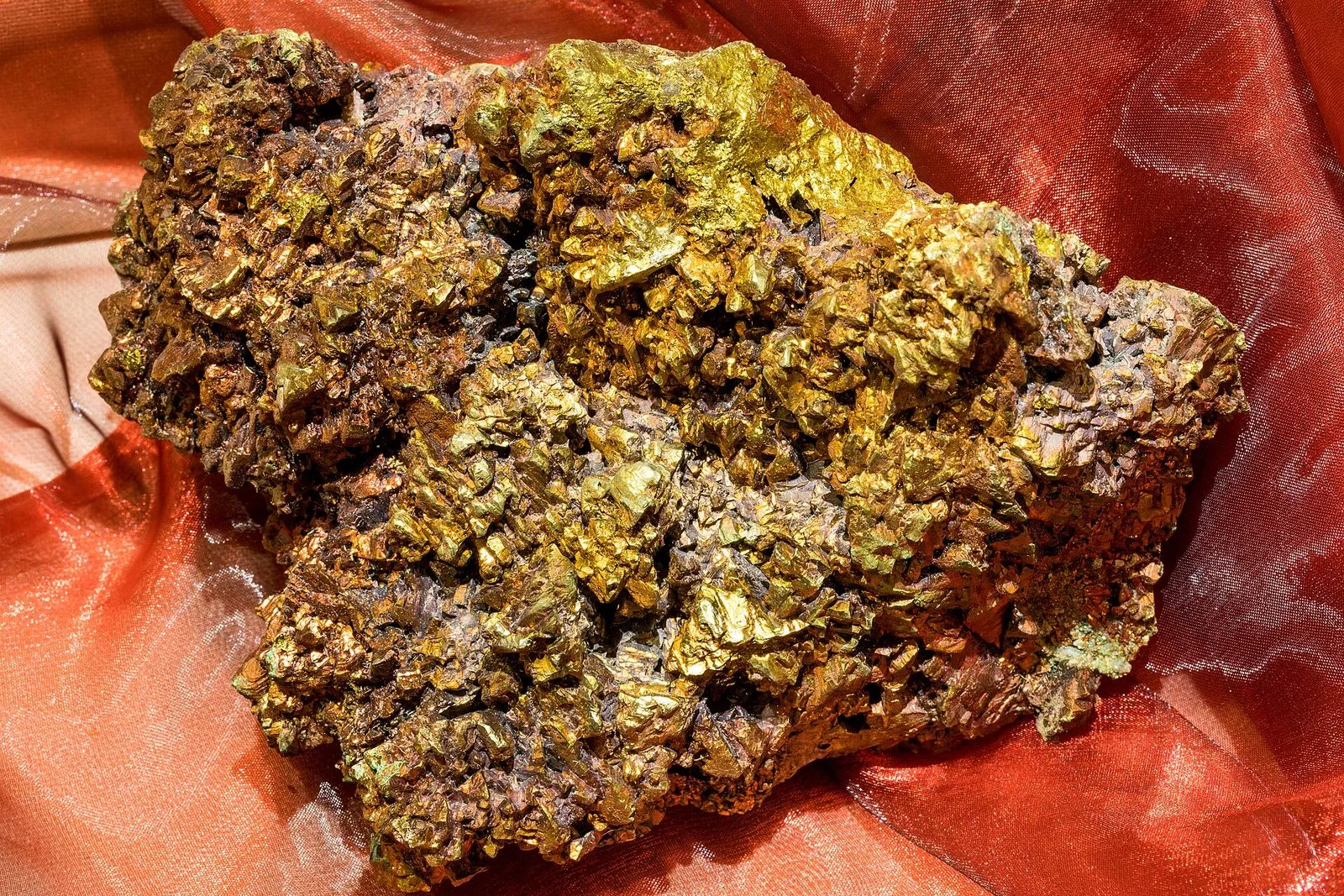
Critical minerals are the ones a country needs for important sectors of its economy but whose supply is at risk, either because domestic production is small or because world supply is concentrated in a few places. Strategic minerals, in the Brazilian definition, are those the country holds in large reserves and that carry weight in its trade balance, in technology or in regional development. Both ideas gained ground with the energy transition and with the competition between countries over supply chains, and in September 2026 they became part of Brazilian law.
In short
- Brazil’s Law 15,506/2026 separates the two concepts: a critical mineral is one whose shortage threatens the economy; a strategic mineral is one of which Brazil has significant reserves and that is essential to the economy.
- The new official list will be set by the Cimce, a council linked to Brazil’s Presidency, and reviewed every four years. As of this writing, it had not been published.
- For now, the reference is the 2021 list of strategic minerals, with 24 mineral commodities in three groups.
- Each country has its own list: the United States list has 60 minerals; the European Union list, 34 critical raw materials.
- According to the International Energy Agency (IEA), about 75% of the growth in demand for key minerals in 2025 came from the energy sector.
What critical minerals are
Brazilian law defines critical minerals as resources needed for key sectors of the economy whose availability is insufficient, unstable or vulnerable. The causes it lists are weak domestic production, dependence on imports, supply concentrated in a few countries, geopolitical risks, market restrictions and technological bottlenecks. A shortage of the mineral must pose a significant risk, mainly to the energy transition, food and nutrition security and national and technological sovereignty.
Critical does not mean rare. According to the ANM, Brazil’s National Mining Agency, what usually makes a mineral critical is the concentration of supply and processing, not scarcity in nature. The agency gives copper as an example: abundant in the Earth’s crust, but hard to replace in electrification and power grids.
And what strategic minerals are
Under the same law, strategic minerals matter to the country because of significant reserves and are essential to the economy in at least one of these respects: a surplus in the trade balance, technological development, regional development, or lower greenhouse gas emissions in their own supply chain. They can be strategic even with no direct link to the energy transition.
In other words, “critical” looks at the risk of running short; “strategic” looks at the advantage of having plenty. One example of that advantage is niobium, used in steel alloys: according to the US Geological Survey (USGS), Brazil accounted for about 93% of world production in 2025.
| Critical mineral | Strategic mineral | |
|---|---|---|
| Key question | Could the country run out? | Does the country have a lot, and does that create value? |
| What counts | Low domestic production, high imports, concentrated supply | Significant reserves, exports, technology |
| Example | Potash and phosphate, used in fertilizers (ANM) | Niobium, with Brazil leading production (USGS) |
For the ANM, agrominerals, the raw materials for fertilizers, are critical for Brazil. The country’s dependence on imported fertilizers is covered in Mining in everyday life: what comes from mines and is in your home.
Who decides which minerals make the list
The law does not include the list itself. It creates the National Council for the Industrialization of Critical and Strategic Minerals (Cimce), linked to the Presidency of the Republic, and gives it the job of defining and updating the substances in each category. The list will be reviewed every four years, in step with the federal Multi-Year Plan (Plano Plurianual), and can be reassessed sooner.
The Cimce was set up when the law was signed, on September 16, 2026, according to Agência Câmara, the news service of Brazil’s Chamber of Deputies. As of this writing, we had not found any resolution from the council with the new list. The other points of the law are covered in Law 15,506/2026: what changes with Brazil’s new critical minerals policy.
The 2021 list, still the reference
Before the law, the ANM stated that Brazil did not have a list of critical and strategic minerals. What applied was a list of strategic minerals, approved on June 18, 2021, by an interministerial committee, in a resolution signed by the Secretary of Geology, Mining and Mineral Transformation of the Ministry of Mines and Energy (MME). It serves the Pró-Minerais Estratégicos policy, which supports the environmental licensing of projects involving these minerals.
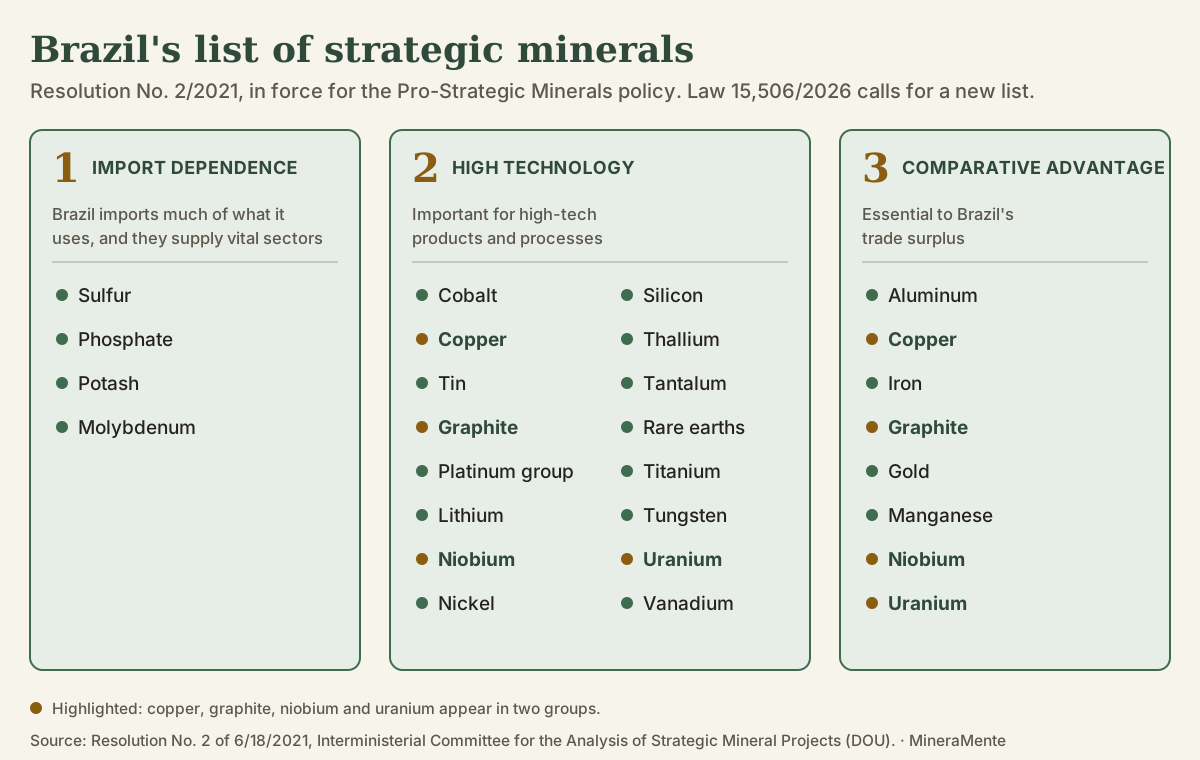
The first group (commodities the country imports heavily) resembles the new law’s idea of critical; the third (commodities that generate a trade surplus), its idea of strategic. Because copper, graphite, niobium and uranium appear in two groups, there are 24 different commodities. To learn about one of them, read Rare earths: what they are, what they are used for and why they matter to Brazil.
How other countries build their lists
The ANM points out that the list changes from country to country, because it depends on each economy’s industry.
United States. The final 2025 version of the list, prepared by the USGS and published in November of that year, has 60 minerals. Among the 10 new additions are copper, silver, potash, phosphate and uranium. The method assesses how a supply disruption would affect the economy and national security, and a 2020 law requires a review at least every three years.
European Union. The Critical Raw Materials Act, in force since May 23, 2024, lists 34 critical raw materials, of which 17 are strategic. There, “critical” means a material of high economic importance that is vulnerable to supply disruptions. “Strategic” is a subgroup of the critical ones: the most important for green, digital, defense and aerospace technologies. One of the targets for 2030 is not to depend on any single outside country for more than 65% of the consumption of each of them.
Notice the difference: in Europe, every strategic material is also critical. In Brazilian law, “strategic” has another meaning, tied to having reserves and creating wealth from them. When you compare lists, check the definition before the label.
Why demand for these minerals is growing
Low-carbon technologies use more minerals. According to the ANM, based on IEA data, an electric car requires about six times more minerals than a conventional one, and an offshore wind turbine up to nine times more than a conventional thermal power plant. Batteries use lithium, nickel, cobalt, manganese and graphite; power grids, copper and aluminum; wind turbines, rare earth magnets.
Energy drives new consumption. According to the Anadolu news agency, the IEA’s Global Critical Minerals Outlook 2026 report shows that about 75% of the growth in demand for key energy minerals (such as copper, lithium, nickel, cobalt, graphite and rare earths) in 2025 came from the energy sector, compared with about 70% in 2024. The main drivers were electric car batteries and energy storage. Demand for these minerals grew about 10% a year in recent years, faster than demand for aluminum, lead and zinc.
Supply is concentrated. Concentration in refining hit a record in 2025: on average, the top refining country for each mineral held about 72% of the market, according to the same report. The ANM cites reports according to which China accounts for 70% to 90% of the world’s processing capacity for several critical minerals. The case of rare earths is covered in Why China dominates rare earths.
And there may be shortages. The IEA expects copper and lithium supply to fall short of demand through 2035, according to the ANI news agency.
What this means for Brazil
For the ANM, the biggest risk for Brazil is not a lack of geological resources but failing to move into processing and refining. The country exports ores and concentrates of several of these substances but imports refined products, special alloys, high-purity metals and magnets. Adding value within Brazil is the focus of the new law.
There is also the environmental side: like any mining, mining these minerals has environmental and social impacts, which depend on the mining method, the location and governance, not on the label, the ANM notes. The law also covers urban mining, which recovers these minerals from electronics, batteries, end-of-life vehicles and construction debris.
Frequently asked questions
What is the difference between a critical mineral and a strategic mineral?
Under Brazil’s Law 15,506/2026, a critical mineral is one whose shortage threatens the economy, due to low domestic production, high imports or concentrated supply. A strategic mineral is one of which Brazil has significant reserves and that is essential to the trade balance, technology, regional development or emissions reduction.
Does Brazil already have an official list of critical minerals?
Not yet in the form set out by the new law, which is the Cimce’s job. Until then, the reference is the 2021 list of strategic minerals, with 24 mineral commodities in three groups.
Is a critical mineral the same as a rare mineral?
No. A mineral can be abundant and still be critical if its production or refining is concentrated in a few countries. Copper is one example cited by the ANM.
Are rare earths critical minerals?
They are on Brazil’s 2021 list, in the high-technology group, and also on the United States and European Union lists. Among the uses cited by the ANM are magnets for electric motors and wind turbines.
Can the list of critical minerals change?
Yes. Brazilian law calls for a review every four years; in the US, at least every three. According to the ANM, new deposits, recycling and substitutes can even take a mineral off the list.
Found this article useful? Share it with someone who also wants to understand mining.
Share
Sources
- Brazilian Federal Senate – Lei nº 15.506, de 16 de setembro de 2026 (Law 15,506 of September 16, 2026, full text)
- Diário Oficial da União (Brazil's official gazette) – Resolution No. 2 of June 18, 2021, of the Interministerial Committee for the Analysis of Strategic Mineral Projects (MME)
- Agência Nacional de Mineração (ANM) – FAQ Minerais Críticos e Estratégicos (critical and strategic minerals FAQ)
- Agência Câmara de Notícias – New law creates the National Policy on Critical and Strategic Minerals (September 16, 2026)
- USGS – Interior Department releases final 2025 List of Critical Minerals (November 2025)
- European Commission – Critical Raw Materials Act
- UK Government (Department for Business and Trade) – explanatory memorandum on Regulation (EU) 2024/1252 (April 23, 2025)
- Anadolu Agency – report on the IEA's Global Critical Minerals Outlook 2026 (August 1, 2026)
- ANI (via The Tribune) – report on the IEA's Global Critical Minerals Outlook 2026 (July 17, 2026)
- USGS – Mineral Commodity Summaries 2026: Niobium
Comments
No comments yet. Be the first to comment.