The minerals in an electric car: from battery to motor
Lithium, nickel, cobalt, graphite, copper, rare earths and aluminum: which minerals go into an electric car, where they are and in what amounts.
Translated from the original article in Portuguese. Read the original.
The minerals in an electric car are concentrated in two parts: the battery, which uses lithium, nickel, cobalt, manganese and graphite, and the motor, which usually has rare earth magnets and copper. According to the International Energy Agency (IEA), a typical electric car needs about six times more minerals than a combustion car. The math changes depending on the type of battery and motor, and that is what this guide explains.
In short
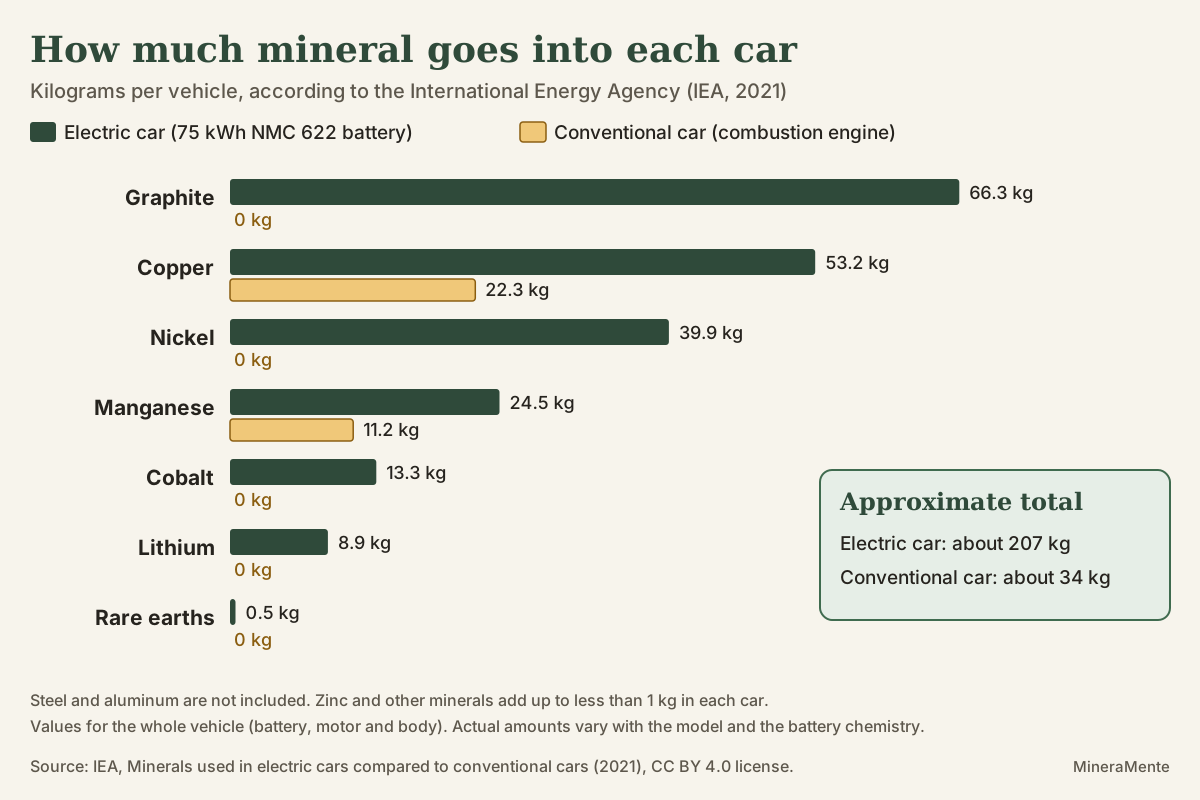
- By the IEA’s estimates (2021), an electric car contains about 207 kg of minerals such as graphite, copper, nickel and lithium, compared with about 34 kg in a conventional car, not counting steel and aluminum.
- The battery accounts for most of it: lithium, nickel, cobalt and manganese in the positive electrode and graphite in the negative one.
- LFP batteries (lithium iron phosphate) need no nickel or cobalt and already made up more than 55% of the batteries installed in electric cars worldwide in 2025.
- The most common motor uses magnets containing neodymium, but there are motors without rare earths, which use more copper.
- Production is concentrated: Congo accounted for 73% of cobalt in 2025, and China for 82% of natural graphite, according to the United States Geological Survey (USGS).
How much mineral goes into an electric car?
In 2021, the IEA compared the minerals in an electric car with those in a combustion car. The electric car in the calculation had a 75 kWh NMC 622 battery, with a graphite negative electrode, and the values are for the whole vehicle. The calculation does not include steel or aluminum, and with a different battery the nickel, cobalt and manganese numbers change a lot.
The battery: the car’s mineral heart
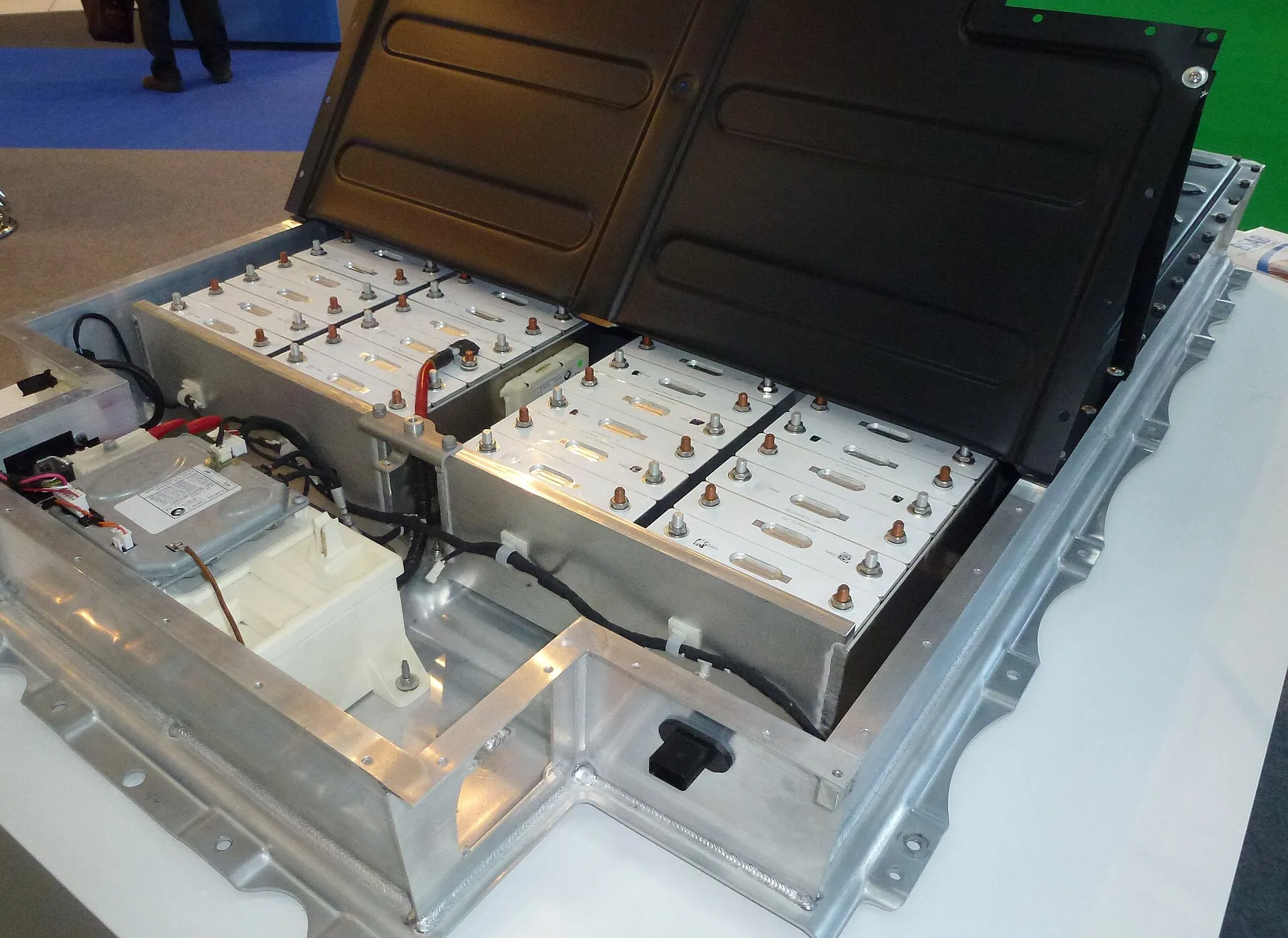
The battery is made up of cells, grouped into modules inside a pack. According to the IEA, cells account for 70% to 85% of the battery’s weight, and that is where the active minerals are:
- Positive electrode (cathode): lithium, nickel, cobalt and manganese, in proportions that vary with the chemistry.
- Negative electrode (anode): usually graphite, a form of carbon.
- Current collector: copper.
The rest of the pack is made mainly of aluminum, steel, cooling fluids and electronics.
Batteries are already the main use of lithium: the USGS estimates that 88% of the lithium consumed worldwide goes into them, including batteries for cars, energy storage and portable devices. To compare with a much smaller device, see What minerals are in your phone.
LFP or NMC: the chemistry changes the minerals
Batteries are named after the material of the positive electrode. The two main families are:
| NMC | LFP | |
|---|---|---|
| Stands for | nickel, manganese and cobalt | lithium, iron and phosphate |
| Strength | more energy per kilogram (up to 265 Wh/kg) | cheaper, stable under heat and durable |
| Weakness | depends on nickel and cobalt | less energy per kilogram (up to 205 Wh/kg) |
The energy figures are for the most recent cells, according to the Global EV Outlook 2026, the IEA’s annual report. LFP uses no nickel, cobalt or manganese, but needs about 50% more copper than NMC.
LFP gained ground fast: in 2025, it accounted for more than 55% of the batteries installed in electric cars worldwide, up from almost 50% in 2024. Its use is concentrated in China. In the European Union, its share was just over 10%.
In the NMC family, the trend has been to cut cobalt. According to the IEA, price spikes and concerns about mining conditions led manufacturers to switch from NMC 111 to more nickel-rich versions, such as NMC 622 and NMC 811 (the numbers indicate the proportions of the three metals). NMC 721 and 811 have about 10% cobalt in their metal content, not counting lithium.
Sodium-ion batteries, which use no lithium, are entering large-scale production, but they store less energy: up to 175 Wh/kg, according to the IEA.
The motor: rare earth magnets or more copper
The IEA describes two main types of motor:
- Permanent magnet synchronous motor. It is the most efficient and compact. Its neodymium-iron-boron magnets contain 0.25 to 0.50 kg of neodymium per vehicle, plus 0.06 to 0.35 kg of other rare earths, such as dysprosium and terbium, and 3 to 6 kg of copper.
- Induction motor. It uses no rare earths, but requires 11 to 24 kg of copper and is less efficient. Tesla used this motor in the Model S, and Audi made a version with an aluminum rotor in the e-tron.
In 2021, more than 90% of the electric cars on sale used permanent magnets, according to the IEA. Other options under study were motors with fewer rare earths, ferrite magnets and switched reluctance motors, which need neither rare earths nor copper but were at the early prototype stage.
To understand this magnet and who dominates its production, read Neodymium magnets: what they are and why they are in electric cars and wind turbines. For the group of elements, see Rare earths: what they are, what they are used for and why Brazil matters.
Copper and aluminum
Copper is, in the IEA’s words, a cornerstone of all electricity-related technologies: among metals, only silver conducts better. In the IEA’s calculation, the electric car has 53.2 kg of copper, more than double the 22.3 kg in the combustion car.
Aluminum is left out of the comparison, but it shows up in the battery pack and in some induction motors. It conducts less electricity (copper conducts about 60% more), but it weighs less than a third as much. It comes from bauxite: according to the USGS, 4 tonnes of bauxite yield 2 of alumina, which become 1 tonne of aluminum. Brazil produced about 33 million tonnes of bauxite in 2025, behind Guinea, Australia and China.
Where these minerals come from
| Mineral | Use in the car | Largest producers (2025, USGS) | Brazil |
|---|---|---|---|
| Lithium | battery | Australia, China and Chile | about 12,000 t |
| Nickel | NMC battery | Indonesia (2.6 of 3.9 million t) | about 70,000 t |
| Cobalt | NMC battery | Congo (73%) and Indonesia (14%) | not on the list |
| Manganese | NMC battery | South Africa, Gabon, Ghana and Australia | about 800,000 t of contained manganese |
| Natural graphite | battery | China (82%) | about 65,000 t and the second-largest reserves |
| Rare earths | motor magnets | China (270,000 of 390,000 t) | about 2,000 t |
| Copper | motor and battery | Chile, Congo and Peru | not on the list |
Two details: most manganese goes to steelmaking, since its consumption tracks the steel industry, according to the USGS. And the concentration does not stop at the mine: China made more than 80% of the world’s battery cells in 2025, according to the IEA. To see other objects that depend on mines, read Mining in everyday life: what comes from mines and is in your home.
What about Brazil?
According to the IEA, Brazil sold about 180,000 electric cars in 2025, or 9% of new cars, up from 6.5% in 2024. It is one of the few countries where more plug-in hybrids (with a combustion engine and a battery recharged from the outlet) are sold than pure electric cars. Just under 85% of these cars were made in China. Worldwide, sales topped 20 million in 2025, one in every four new cars.
Does recycling solve it?
Not yet. According to the IEA, almost all electric car batteries installed in recent years are still in use and should last until the mid-2030s. There is a lag of about 15 years between the growth in demand and the arrival of large volumes of old batteries for recycling, which today mainly recovers manufacturing scrap. Meanwhile, world lithium consumption grew 20% in 2025, according to the USGS. The limits of recycling are covered in Urban mining: can recycling e-waste replace mines?.
Frequently asked questions
What minerals are in an electric car?
In the battery, lithium, nickel, cobalt, manganese and graphite, as well as copper and aluminum. In the motor, rare earths such as neodymium, and copper. The exact list depends on the battery chemistry and the type of motor.
How much lithium is in an electric car?
In the IEA example, with a 75 kWh NMC 622 battery, about 8.9 kg. Graphite (66.3 kg) and nickel (39.9 kg) weigh much more in the same car.
Does every electric car battery contain cobalt?
No. LFP batteries use neither cobalt nor nickel and already make up more than half of the batteries installed in electric cars worldwide, according to the IEA. NMC batteries use cobalt, but in ever smaller proportions.
Does every electric car use rare earths?
Most do, in the motor magnet. Induction motors need no rare earths, but they use more copper and are less efficient.
Does an electric car use more minerals than a combustion car?
Yes, about six times more, not counting steel and aluminum, according to the IEA. In exchange, it does not burn fuel: the world’s electric fleet avoided the consumption of about 1.7 million barrels of oil per day in 2025.
Found this article useful? Share it with someone who also wants to understand mining.
Share
Sources
- IEA – The Role of Critical Minerals in Clean Energy Transitions (May 2021)
- IEA – Minerals used in electric cars compared to conventional cars (chart, May 5, 2021)
- IEA – Global EV Outlook 2026: Executive summary (May 2026)
- IEA – Global EV Outlook 2026: Trends in electric cars (May 2026)
- IEA – Global EV Outlook 2026: Electric vehicle batteries (May 2026)
- USGS – Mineral Commodity Summaries 2026: Lithium (February 2026)
- USGS – Mineral Commodity Summaries 2026: Nickel (February 2026)
- USGS – Mineral Commodity Summaries 2026: Cobalt (February 2026)
- USGS – Mineral Commodity Summaries 2026: Manganese (February 2026)
- USGS – Mineral Commodity Summaries 2026: Graphite (February 2026)
- USGS – Mineral Commodity Summaries 2026: Copper (February 2026)
- USGS – Mineral Commodity Summaries 2026: Rare Earths (February 2026)
- USGS – Mineral Commodity Summaries 2026: Bauxite and Alumina (February 2026)
Comments
No comments yet. Be the first to comment.