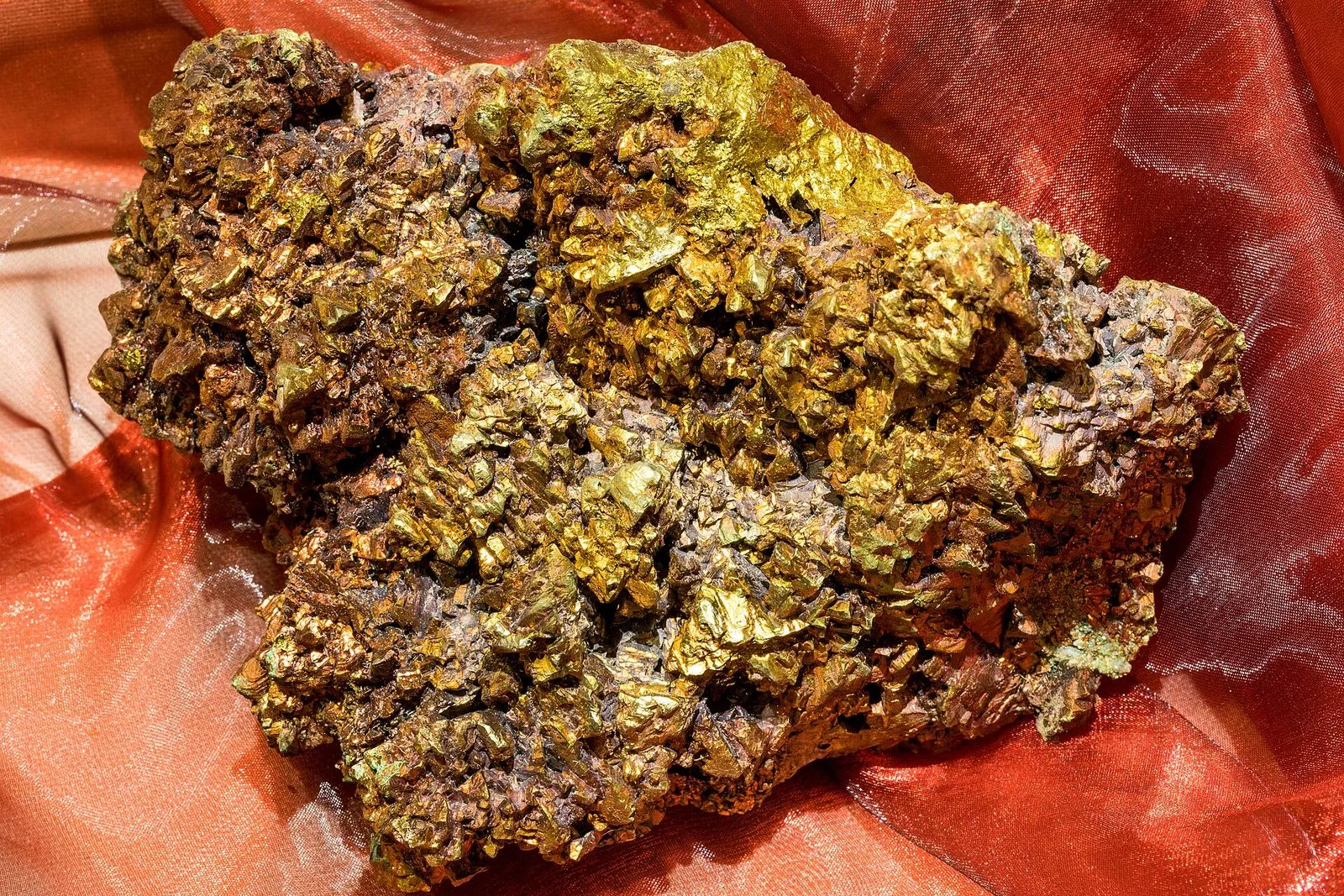
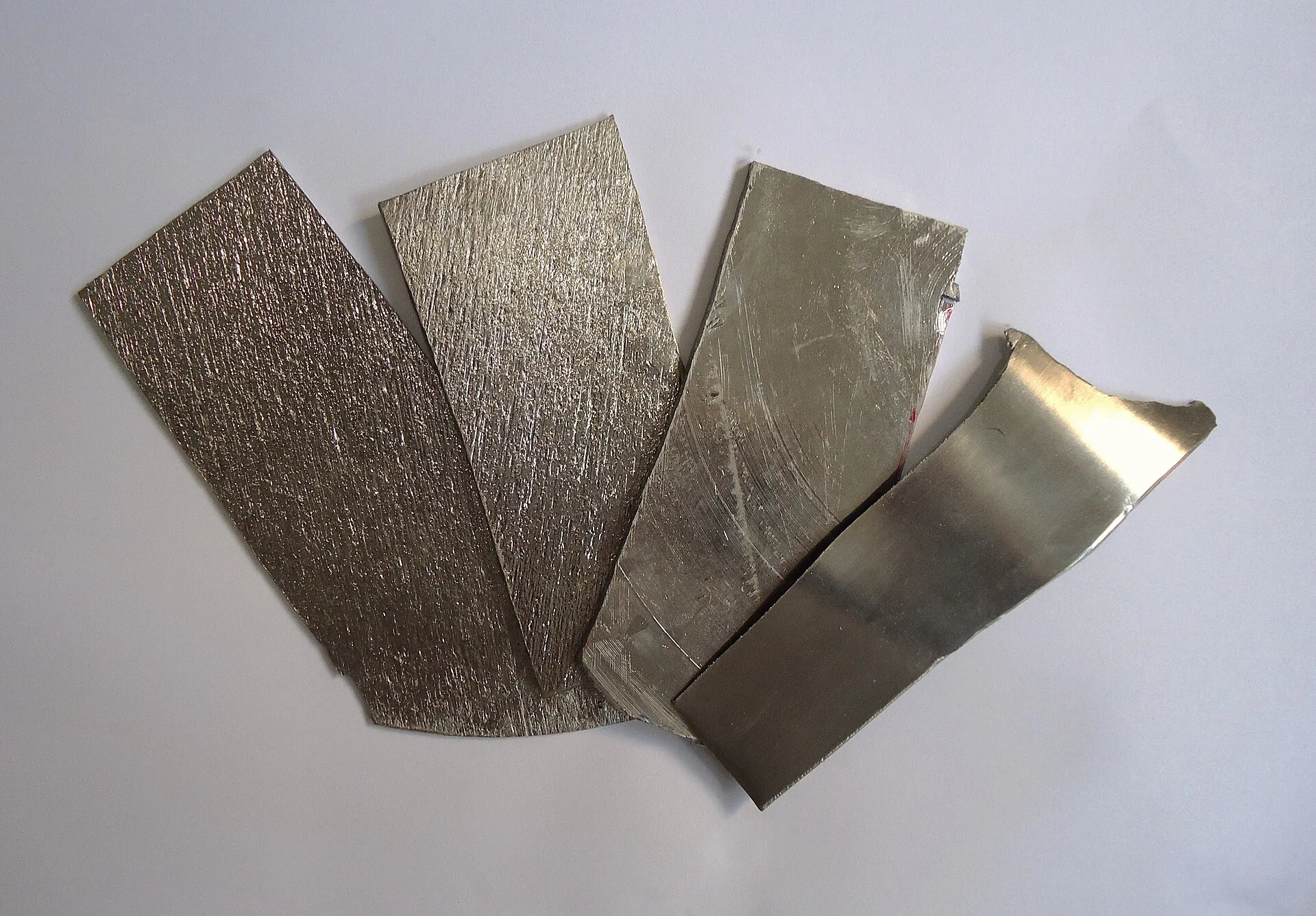
The minerals that feed agriculture: potassium, phosphate and limestone
Which minerals are in fertilizers, where potassium, phosphate and agricultural lime come from, and why Brazil imports over 90% of its fertilizer.
Translated from the original article in Portuguese. Read the original.
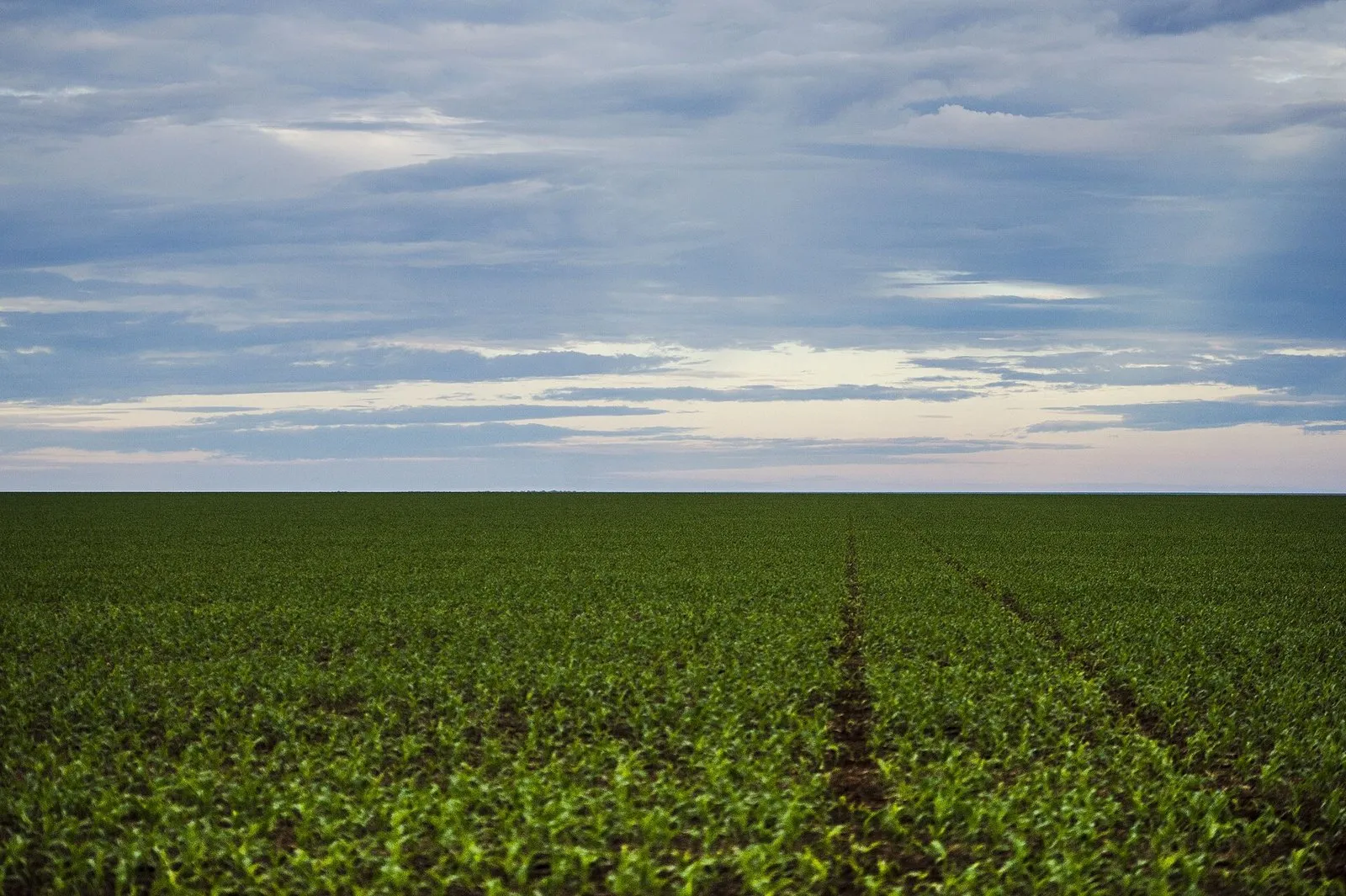
The main minerals in fertilizers are phosphate rock, which supplies phosphorus, and potassium salts, such as sylvinite. Alongside them comes limestone, which is not a fertilizer but corrects soil acidity so that fertilizer can work. Brazil is a major food producer and, even so, it imports most of the fertilizers it uses.
In short
- NPK stands for nitrogen (N), phosphorus (P) and potassium (K). Only phosphorus and potassium come from mines. Nitrogen comes from the air, turned into ammonia using natural gas.
- Brazil imported about 91% of the fertilizers it consumed in 2024, according to Infra S.A., a company linked to Brazil’s Ministry of Transportation, using data from the National Association for the Distribution of Fertilizers (Anda).
- Phosphate comes mainly from the states of Minas Gerais, Goiás and São Paulo. Potassium has one producing mine, in Sergipe, and a project in Autazes, in the state of Amazonas, that is disputed by the Indigenous Mura people.
- Agricultural lime is the exception: Brazil produces practically all it consumes.
- Phosphate and potassium are on Brazil’s 2021 list of strategic minerals, and Law 15,506/2026 linked critical minerals to food security.
Where each letter of NPK comes from
According to Brazil’s National Fertilizer Plan (PNF), launched by the federal government in 2022, nitrogen, phosphorus and potassium are the primary macronutrients for plants and, when mixed, “make up the NPK formulas.” The U.S. Geological Survey (USGS) states that none of the three has a substitute in agriculture.
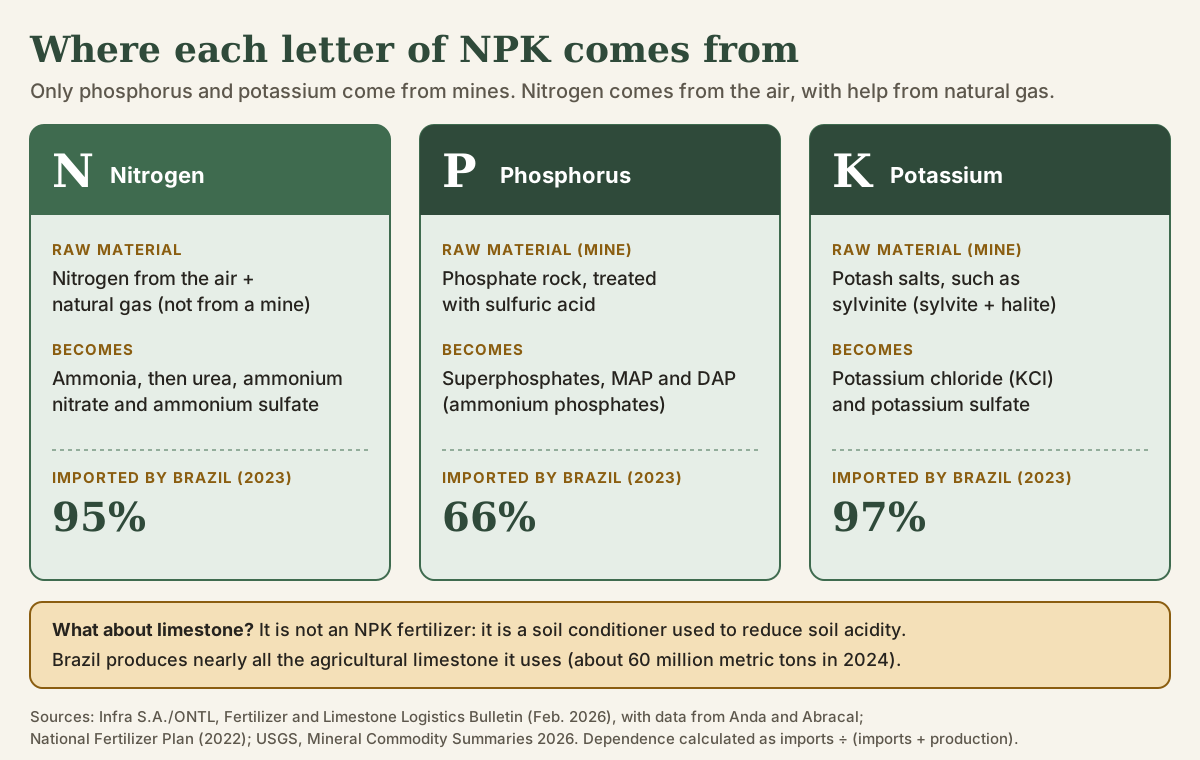
Nitrogen: it does not come from a mine. It is taken from the atmosphere, a source the USGS considers “unlimited.” The challenge is turning it into ammonia, and for that the industry uses natural gas, the dominant feedstock in the U.S. In Brazil, natural gas has been used to make ammonia and urea since 1971, according to the PNF. In 2023, the country imported 95% of the nitrogen fertilizers it consumed, and Infra S.A. attributes part of this to the high cost of natural gas.
Phosphorus and potassium: they come from mines. Phosphate rock is treated with sulfuric acid and becomes superphosphates and ammonium phosphates (MAP and DAP). Potassium salts are turned mainly into potassium chloride. Both supply chains start at a mine, like the ones described in How a mine works: from discovery to closure.
Phosphate: where Brazil’s mines are
Unlike most of the world, where marine sedimentary rocks predominate, Brazil has phosphate in igneous rocks, formed from magma, according to the USGS. According to the PNF, national production of phosphate concentrate, 5.3 million tonnes in 2019, came from alkaline rock and carbonatite complexes in Tapira, Salitre (Patrocínio) and Araxá, in Minas Gerais, a state in southeastern Brazil, Catalão, in Goiás, and Cajati, in São Paulo, among others.
The Patos de Minas mine (Minas Gerais) was already idle in 2022. In October 2025, Mosaic completed the sale of this unit to Fosfatados Centro and said it expected the buyer to restart operations. In January 2026, according to the newspaper Diário do Comércio, Mosaic extended the halt to phosphate production in Araxá, attributed to the cost of sulfur, used to make sulfuric acid.
Even so, 66% of the phosphate fertilizers used in 2023 were imported, according to Infra S.A.
Potassium: the most critical case
Potassium comes from evaporite deposits, salts that accumulated as ancient waters evaporated. The most common ore is sylvinite, which the PNF defines as a mixture of sylvite (potassium chloride) and halite (sodium chloride, table salt). According to the plan, Brazil is the world’s second-largest consumer of potassium, behind China. In 2023, it imported about 97% of what it used.
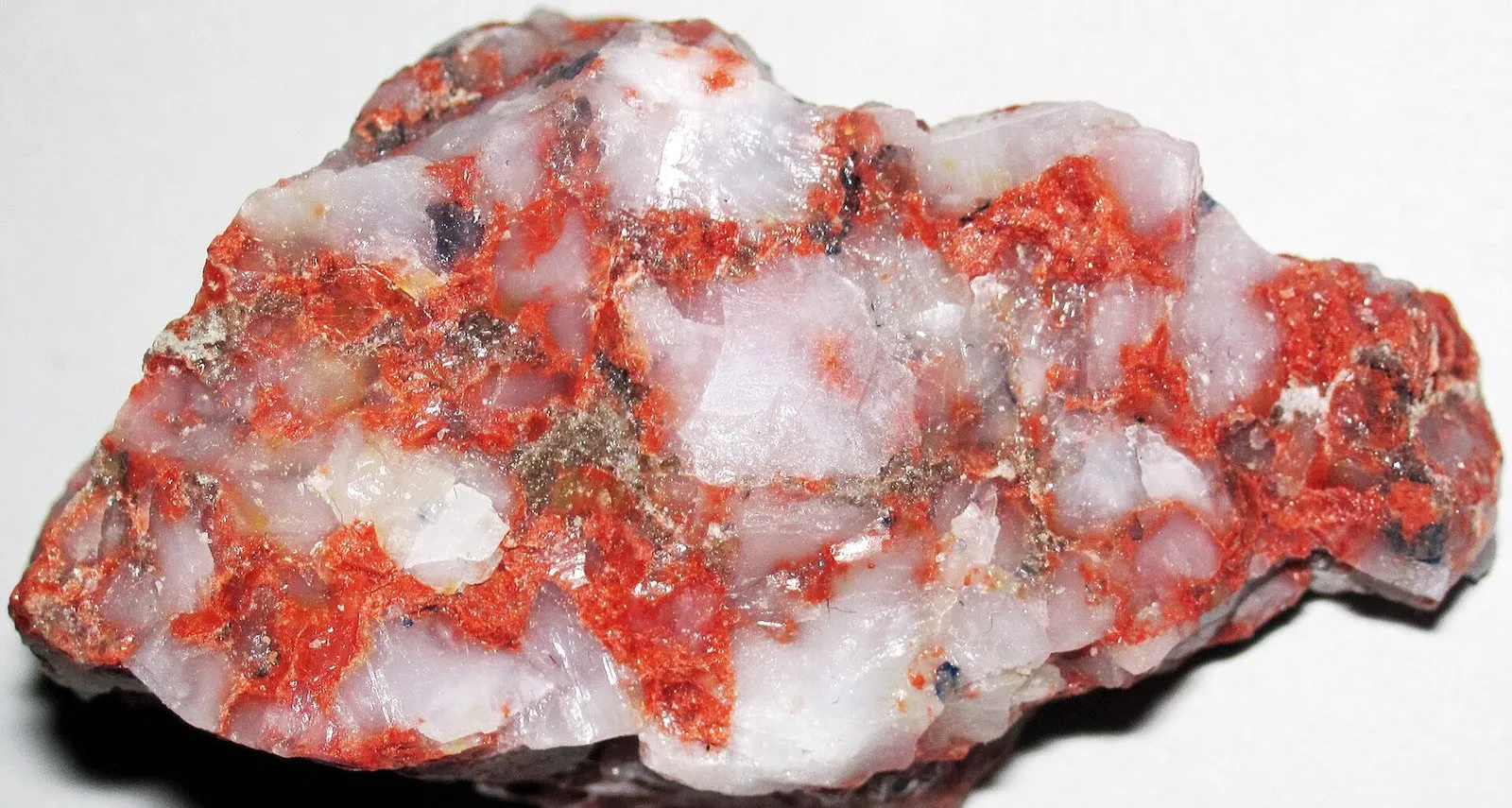
Taquari-Vassouras, in Sergipe, a state in northeastern Brazil, is the country’s only potash production site, according to the PNF, and produced about 9.5 million tonnes of K₂O (the measure used for potassium content) from 1988 to 2020. In 2025, Mosaic sold the mine to VL Mineração, stating that the operation needed more than US$25 million in investment to remain viable.
Autazes, in the Amazonian state of Amazonas, is the big project underway. Potássio do Brasil, a subsidiary of Brazil Potash, wants to open an underground sylvinite mine there. According to the company, initial production could reach 2.4 million tonnes per year, about 20% of current Brazilian demand. Infra S.A. lists the project with “works started” and production expected between 2028 and 2032. The two sides:
- The company says that a consultation with the Mura people, monitored by the courts, showed “more than 90% support.” In August 2026, it reported that the president of Brazil’s Supreme Federal Court (STF), Justice Edson Fachin, rejected a request from the Federal Public Defender’s Office to suspend the licenses.
- Critics dispute this. Brazil’s Federal Public Prosecutor’s Office (MPF), in a lawsuit filed in May 2024, seeks the suspension of the installation licenses issued by the Amazonas state environmental agency (Ipaam), arguing that licensing should be the responsibility of Ibama, Brazil’s federal environmental agency. According to the Indigenist Missionary Council (Cimi), Funai, Brazil’s federal Indigenous affairs agency, confirmed in August 2026 that the project overlaps the Lago do Soares Indigenous Land, claimed by the Mura and still under study. Mura leaders dispute the consultation.
The broader debate is covered in Mining on Indigenous lands in Brazil: what is being discussed in Congress.
Agricultural lime: the mineral that makes fertilizer work
Tropical soils tend to be acidic. According to researchers at Embrapa (the Brazilian Agricultural Research Corporation), heavy rain washes calcium and magnesium out of the soil. In very acidic soil, phosphorus, calcium, magnesium and potassium become less available, and aluminum is released in forms that are toxic to roots. This is the case in the soils of the Cerrado, Brazil’s tropical savanna, where aluminum toxicity usually appears below pH 5.5.
The solution is liming: applying ground limestone to raise the pH to the 5.5 to 6.5 range, neutralize aluminum and increase calcium and magnesium levels. Embrapa considers it “essential for the efficient use of fertilizers.” Calcitic limestone has less than 5% magnesium oxide, and dolomitic limestone more than 12%. Because it dissolves slowly, it needs to be applied before planting.
Here Brazil is self-sufficient. According to data from the Brazilian Association of Agricultural Limestone Producers (Abracal) compiled by Infra S.A., the country consumed about 59.6 million tonnes in 2024 and produced 59.9 million, with Mato Grosso in the lead. Abracal estimates that about two-thirds of arable soils still need to be corrected.
Why Brazil imports so much
According to Infra S.A., imports accounted for 70% of the fertilizer supply in 2015 and reached 91% in 2024, when the country consumed 45.6 million tonnes and imported 41.3 million. Domestic production fell from about 9 million to 7.2 million tonnes over the period.
The PNF points out the risk: the country is exposed to prices, exchange rates, freight and decisions by other countries, such as the export restrictions imposed by China and Russia in 2021 and 2022. For potassium, the plan projected that, in an intermediate scenario and with incentives, dependence could fall to 40% by 2052. Infra S.A., on the other hand, calculates that even with all of Brazil’s potash plants at full capacity, it would remain at 95%.
Rock dust: alternative or complement?
Remineralizers, or rock dust, are ground silicate rocks, such as basalt, that release nutrients slowly. They were defined in Law 12,890/2013, and the PNF has a target of producing 2 million tonnes per year by 2030.
Research calls for caution. In 2004, Embrapa Cerrados already noted that rocks with 2% to 6% potassium are not worth transporting over long distances. A 2020 study by researchers from IFMS (the Federal Institute of Mato Grosso do Sul), Embrapa and UCDB (Dom Bosco Catholic University) concluded that the use of rock dust “still depends on technical, economic and environmental studies.” In the trial, with second-crop corn in Mato Grosso do Sul, soluble NPK fertilizer produced higher yields than doses of 6 and 12 tonnes per hectare of basalt dust.
Fertilizers in critical minerals policy
Phosphate and potassium are in the first group of Brazil’s 2021 list of strategic minerals, alongside sulfur and molybdenum: the goods for which the country “depends on imports to a high percentage.” Law 15,506/2026 defines as critical those minerals with insufficient supply for key sectors, including those needed to “guarantee food and nutrition security.” The law also opens tax credits and incentivized debentures, bonds used to finance investments, to fertilizers. See Law 15,506/2026: what changes with Brazil’s new critical minerals policy, Critical and strategic minerals: what they are and why they became a priority and, for other everyday minerals, Mining in everyday life: what comes from mines and is in your home.
Frequently asked questions
Which minerals are used in fertilizers?
The main ones are phosphate rock, a source of phosphorus, and potassium salts, such as sylvinite. Sulfur is used to make phosphate fertilizers. Limestone is used alongside them, to correct soil acidity.
Does the nitrogen in fertilizer come from a mine?
No. It is taken from the air and turned into ammonia using natural gas. Urea and other nitrogen fertilizers are made from ammonia.
How much of the fertilizer used in Brazil is imported?
About 91% in 2024, according to Infra S.A. with data from Anda. In 2023, dependence was 95% for nitrogen, 66% for phosphorus and 97% for potassium.
What is limestone used for in agriculture?
To correct soil acidity. It raises the pH, neutralizes toxic aluminum and increases calcium and magnesium levels. As a result, plants make better use of fertilizer.
Is the Autazes potash project already operating?
No. According to Infra S.A., construction has started and production is expected between 2028 and 2032. The project is disputed by the MPF and by Mura leaders, who point to an overlap with an Indigenous land under study.
Found this article useful? Share it with someone who also wants to understand mining.
Share
Sources
- Brazilian Federal Government (SAE) – Plano Nacional de Fertilizantes 2050 (National Fertilizer Plan, March 2022)
- Infra S.A./Observatório Nacional de Transporte e Logística – Boletim de Logística: a logística do mercado de fertilizantes e calcário no Brasil (Logistics Bulletin: the logistics of the fertilizer and limestone market in Brazil, February 2026)
- USGS – Mineral Commodity Summaries 2026: Potash
- USGS – Mineral Commodity Summaries 2026: Phosphate Rock
- USGS – Mineral Commodity Summaries 2026: Nitrogen (Fixed)–Ammonia
- Embrapa – Veloso et al., Correção da acidez do solo (correcting soil acidity), ch. 10 of Recomendações de calagem e adubação para o estado do Pará (liming and fertilization recommendations for the state of Pará, 2020)
- Embrapa Arroz e Feijão – Fageria and Stone, Manejo da acidez dos solos de cerrado e de várzea do Brasil (managing acidity in Brazil's Cerrado and floodplain soils; Documentos 92, 1999)
- Dettmer et al. (IFMS, Embrapa and UCDB) – Uso de pó de rocha em sistemas de produção agrícola: breve análise sobre viabilidade técnica (use of rock dust in agricultural production systems: a brief analysis of technical feasibility; 2020, Alice/Embrapa repository)
- Embrapa Cerrados – Pó de rocha será nova fonte de potássio para agricultura (rock dust will be a new source of potassium for agriculture; November 1, 2004)
- Brazilian Federal Senate – Law No. 15,506 of September 16, 2026 (full text)
- Diário Oficial da União (Brazil's official gazette) – Resolution No. 2 of June 18, 2021, of the Interministerial Committee for the Analysis of Strategic Minerals Projects
- The Mosaic Company – Mosaic Announces Agreement for Sale of Potash Mining Operations in Brazil to VL Mineração (August 13, 2025)
- The Mosaic Company – Mosaic Announces Completion of Sale of Potash Mining Operations in Brazil to VL Mineracao (November 4, 2025)
- The Mosaic Company – Mosaic Announces Completion of Sale of Phosphate Mining Unit in Brazil to Fosfatados Centro (October 6, 2025)
- Diário do Comércio – Mosaic prorroga paralisação da produção de fosfato em Araxá (Mosaic extends halt to phosphate production in Araxá; January 22, 2026)
- Brazil Potash (press release reproduced by Finviz) – Brazil's Supreme Federal Court issues favorable decision for Brazil Potash (August 21, 2026)
- Cimi – Mineradora canadense desmata áreas e avança sobre território reivindicado pelo povo Mura no Amazonas (Canadian mining company clears land and advances onto territory claimed by the Mura people in Amazonas; April 7, 2026)
- Cimi – "Não há dúvidas" de que megaprojeto de mineração de potássio sobrepõe território Mura, reafirma Funai ("No doubt" that potash mining megaproject overlaps Mura territory, Funai reaffirms; August 19, 2026)
Comments
No comments yet. Be the first to comment.